
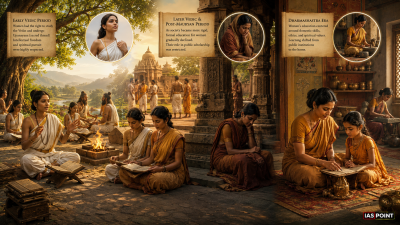
The status of women’s education in ancient India was not static; it underwent significant transformation from the Vedic period to the later Dharmashastra era. In the early stages, women enjoyed substantial intellectual freedom, including the right to study the Vedas and undergo the Upanayana (sacred thread) ceremony. However, as the social structure became more rigid during the later Vedic and Post-Mauryan periods, formal educational opportunities for women gradually diminished, shifting from public scholarship to domestic-centered learning.
Categories of Female Scholars
Ancient Indian texts classify educated women into two distinct categories based on their pursuit of knowledge and social choices.
- Brahmavadinis: These were women who opted for a lifelong pursuit of philosophy and theology. They did not marry and dedicated their lives to Vedic study, often becoming teachers and seers (Rishikas) themselves.
- Sadyodvahas: These women pursued education until they reached the age of marriage (usually 15 or 16). Their curriculum focused on the Vedas, music, dance, and essential domestic sciences required to manage a household.
Intellectual Contributions and Notable Personalities
The Rig Veda mentions nearly 20 women among its composers, proving that women were active participants in the highest level of intellectual discourse.
| Scholar | Contribution and Context |
|---|---|
| Gargi Vachaknavi | A philosopher who famously challenged Sage Yajnavalkya in the court of King Janaka on the origin of all existence. |
| Maitreyi | The philosopher-wife of Yajnavalkya who rejected material wealth in favor of “Amritatva” (immortality through knowledge). |
| Lopamudra | A renowned philosopher and wife of Sage Agastya; she is credited with contributing to the Rig Veda. |
| Ghosha | A female seer who composed hymns dedicated to the Ashvins and was known for her mastery of Vedic rituals. |
| Visvavara | A philosopher who not only composed Vedic hymns but also performed the functions of a priest (Hotri). |
| Ubhay Bharati | The wife of Mandana Misra; she famously acted as the judge in the historic debate between her husband and Adi Shankaracharya. |
Subjects and Curriculum for Women
The curriculum for women was designed to provide a balance between spiritual enlightenment and practical aesthetic skills.
- Vedic Literature: In the early periods, women studied the Vedas, Vedangas, and Upanishads.
- Fine Arts (Lalit Kala): Education often included the 64 Kalas (arts), such as singing, dancing, painting, flower arrangement, and playing instruments like the Veena.
- Military Training: In some kshatriya families, women were trained in statecraft and the use of weapons. References in the Arthashastra suggest the existence of female bodyguards and spies.
- Scientific Knowledge: Basic mathematics, medicinal herb identification, and domestic economics were integral parts of their learning.
Educational Rituals and Social Status
During the Vedic era, the Upanayana ceremony was mandatory for girls, signifying their eligibility for formal Vedic study.
- The Upanayana Shift: Harita Smriti mentions that girls were allowed to undergo the thread ceremony. However, by the time of the Manusmriti, the marriage ceremony (Vivaha) was increasingly equated to the Upanayana for women, effectively ending their formal Vedic schooling.
- Teaching as a Profession: Women who took up teaching as a profession were referred to as Upadhyaya or Upadhyayi. If they were the wives of teachers, they were called Upadhyayani.
Buddhist and Jain Perspectives on Women’s Education
The Heterodox sects provided a significant alternative for women’s intellectual advancement outside the Brahmanical framework.
- Buddhist Nunneries: The establishment of the Bhikshuni Sangha allowed women to lead a life of celibacy and scholarship.
- Therigatha: A collection of poems within the Pali Canon composed by elder nuns (Theris), reflecting their high degree of literacy and philosophical depth.
- Jainism: Jain texts record instances of women becoming highly learned scholars and heading administrative units of the religious order. For example, Chandana, a contemporary of Mahavira, headed a large order of nuns.
Decline of Female Education
The decline of formal education for women is attributed to several socio-political factors in late ancient India.
- Early Marriage: The lowering of the marriageable age restricted the time available for formal study.
- Discontinuation of Upanayana: The clerical decision to deny women the sacred thread ceremony barred them from reciting the Vedas.
- Economic Shifts: As the economy became more agrarian and caste-based, the focus shifted toward hereditary domestic roles rather than intellectual pursuits.
- Foreign Invasions: Increasing instability led to a more protective and restrictive environment for women, further curbing their mobility and access to public centers of learning like Gurukuls.
Key Facts for UPSC Prelims
- Rishikas: The term used for female seers who authored Vedic hymns.
- The Brihadaranyaka Upanishad: Contains the most vivid descriptions of female participation in royal philosophical assemblies.
- Aparajita: A term sometimes used to describe highly learned women who were “undefeated” in debates.
- Pratishakhya: Ancient texts on phonetics that suggest women were involved in the preservation of oral Vedic traditions.