
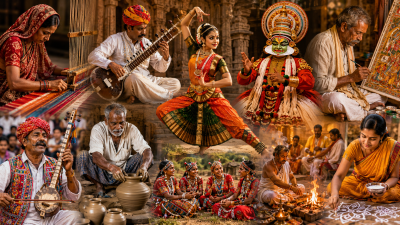
The UNESCO 2003 Convention for the Safeguarding of the Intangible Cultural Heritage defines ICH as the practices, representations, expressions, knowledge, and skills—as well as the instruments, objects, artifacts, and cultural spaces associated therewith—that communities recognize as part of their cultural heritage. Unlike tangible sites, ICH is living heritage, transmitted from generation to generation and constantly recreated by communities in response to their environment and history.
Categories of Intangible Cultural Heritage
Under the UNESCO framework, ICH is classified into five broad domains:
- Oral traditions and expressions, including language as a vehicle of the intangible cultural heritage.
- Performing arts (music, dance, and theatre).
- Social practices, rituals, and festive events.
- Knowledge and practices concerning nature and the universe.
- Traditional craftsmanship.
UNESCO Lists of Intangible Cultural Heritage
UNESCO maintains two primary lists and one register to manage global ICH:
- Representative List of the Intangible Cultural Heritage of Humanity: Ensures better visibility of the traditions and knowledge of communities without recognizing standards of excellence or exclusivity.
- List of Intangible Cultural Heritage in Need of Urgent Safeguarding: Identifies heritage whose viability is at risk and for which specialized safeguarding measures are required.
- Register of Good Safeguarding Practices: Features programs and projects that best reflect the principles of the 2003 Convention.
India’s Inscribed Intangible Cultural Heritage Sites
As of 2026, India has 15 elements inscribed on the UNESCO Representative List of the Intangible Cultural Heritage of Humanity.
| Year | ICH Element | State / Region | Primary Features |
| 2008 | Koodiyattam | Kerala | Sanskrit theatre; recognized as the oldest surviving theatre form in India. |
| 2008 | Ramlila | Pan-India | Traditional performance of the Ramayana; specifically noted for the Ramnagar celebrations. |
| 2008 | Tradition of Vedic Chanting | Pan-India | Oral transmission of the Vedas with precise intonation (Swaras) and hand gestures (Mudras). |
| 2009 | Ramman | Uttarakhand | Religious festival and ritual theatre of the Garhwal Himalayas; honors the tutelary deity Bhumiyal Devta. |
| 2010 | Chhau Dance | WB, Odisha, Jharkhand | Masked martial dance; three distinct styles: Seraikella, Mayurbhanj, and Purulia. |
| 2010 | Kalbelia Folk Songs/Dances | Rajasthan | Performed by the Kalbelia tribe (snake charmers); involves sensuous movements mimicking a cobra. |
| 2010 | Mudiyettu | Kerala | Ritual dance-drama based on the mythological tale of a battle between the goddess Kali and the demon Darika. |
| 2012 | Buddhist Chanting | Ladakh | Recitation of sacred Buddhist texts in the trans-Himalayan Ladakh region by monks. |
| 2013 | Sankirtana | Manipur | Ritual singing, drumming, and dancing; centers on the life of Krishna; performed by the Meitei people. |
| 2014 | Traditional Brass and Copper Craft | Punjab | Craft of the Thatheras of Jandiala Guru; involves heating and hammering metal into utilitarian vessels. |
| 2016 | Yoga | Global / India | Ancient Indian practice for physical, mental, and spiritual well-being. |
| 2016 | Nowruz | Pan-India (Parsi) | The Persian New Year celebration; observed by various communities including the Parsi community in India. |
| 2017 | Kumbh Mela | UP, MP, UK, MH | Largest peaceful congregation of pilgrims; held at Prayagraj, Haridwar, Ujjain, and Nasik. |
| 2021 | Durga Puja in Kolkata | West Bengal | Annual festival honoring Goddess Durga; celebrates the triumph of good over evil through art and public installation. |
| 2023 | Garba of Gujarat | Gujarat | Ritualistic and devotional dance performed during Navratri; dedicated to the feminine energy or Shakti. |
Detailed Analysis of Key Elements
Vedic Chanting and Oral Traditions
Vedic chanting is considered the world’s oldest unbroken oral tradition. The UNESCO recognition emphasizes the importance of the Shakha system (different branches or versions of the Vedas) and the complex mnemonic techniques used to ensure the purity of the sound and text across millennia.
Koodiyattam: The Sanskrit Theatre
It is the only surviving specimen of ancient Sanskrit theatre. Performed in specialized temple theatres called Koothambalams, it employs highly stylized gestures (Mudras) and facial expressions (Rasas). The actor’s training often lasts 10 to 15 years.
Chhau Dance: The Martial Rhythm
A unique blend of martial arts, acrobatics, and storytelling.
- Seraikella (Jharkhand) and Purulia (West Bengal) styles use masks to represent characters.
- Mayurbhanj (Odisha) style is performed without masks, focusing more on body kinetics.
Sankirtana of Manipur
This is a vibrant cultural expression of the Vaishnava people in Manipur. It involves two primary drummers (Pung) and singers who perform in a circle. It is performed at every major milestone in a person’s life, from birth to death, acting as a social binder.
The National Inventory of ICH (Sangeet Natak Akademi)
The Sangeet Natak Akademi (SNA) serves as the nodal agency in India for the UNESCO ICH list. It maintains the National Inventory of Intangible Cultural Heritage, which contains hundreds of elements across India. This list serves as a “Tentative List” from which nominations are prepared for UNESCO.
Important Institutions and Schemes
Sangeet Natak Akademi
Established in 1953, it is the apex body for performing arts in India. It implements the UNESCO 2003 Convention and documents endangered art forms.
Zonal Cultural Centres (ZCCs)
The Ministry of Culture has established seven ZCCs across India (Patiala, Nagpur, Udaipur, Prayagraj, Kolkata, Dimapur, and Thanjavur) to preserve and promote regional ICH.
Scheme for Safeguarding the Intangible Cultural Heritage and Diverse Cultural Traditions of India
This scheme aims to rejuvenate and revitalize various institutions, groups, individuals, and NGOs engaged in the protection of ICH. It provides financial assistance for training, documentation, and dissemination.
Strategic Facts for UPSC Prelims
- Year of Adoption: The UNESCO Convention for the Safeguarding of the ICH was adopted in 2003 and came into force in 2006.
- India’s Ratification: India ratified the convention in September 2005.
- Nodal Agency: Sangeet Natak Akademi (Ministry of Culture).
- Latest Addition: Garba of Gujarat (2023) is the 15th Indian element on the list.
- First Elements: Ramlila, Vedic Chanting, and Koodiyattam were the first to be recognized (2008).
- Diversity: While South Indian and North Indian traditions were recognized early, recent inclusions like Sankirtana and Buddhist Chanting have increased representation from the Northeast and Himalayan regions.