
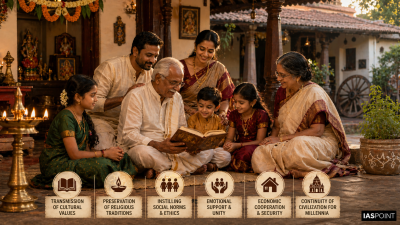
The family serves as the fundamental unit of the Indian social fabric, acting as the primary vehicle for the transmission of cultural values, religious traditions, and social norms. In the context of Indian heritage, the family is not merely a domestic unit but a socio-economic institution that has sustained the civilization’s continuity for millennia.
The Joint Family System: Characteristics and Functions
The traditional Indian family is characterized by the “Joint Family” (Samyukta Parivara), which typically consists of three or more generations living under a single roof, sharing a common kitchen, property, and place of worship.
- Common Kitchen and Hearth: The sharing of food cooked at a single hearth is a primary marker of a joint family, symbolizing unity and shared resources.
- Common Property: Ancestral property is held jointly, and the income of all members is pooled into a common fund managed by the head of the family.
- The Karta: The eldest male member, known as the Karta, holds absolute authority over domestic and financial decisions, acting as the legal representative of the family.
- Social Security: The joint family provides a natural insurance system for the aged, infirm, widows, and orphaned children, ensuring no member is left destitute.
- Cultural Transmission: It serves as a “living museum” where oral traditions, rituals, and professional skills (such as weaving or pottery) are passed from elders to the youth.
Classification of Family Structures in India
While the patriarchal joint family is the dominant model, India exhibits a diverse range of family structures based on lineage and residence.
| Type of Family | Key Feature | Prevalence/Example |
| Patrilineal | Lineage traced through the father’s side. | Majority of Hindus, Muslims, and Sikhs. |
| Matrilineal | Lineage traced through the mother’s side. | Nayars of Kerala, Khasis and Garos of Meghalaya. |
| Patrilocal | Wife moves to the husband’s ancestral home. | Common across North and Central India. |
| Matrilocal | Husband moves to the wife’s ancestral home. | Traditional Khasi and Garo tribes. |
| Nuclear Family | Consists only of husband, wife, and unmarried children. | Increasing in urban industrial centers. |
Kinship Systems: The Social Network
Kinship (Bandhutva) refers to the web of social relationships that form an important part of the lives of most humans in most societies. In India, kinship is categorized into two primary types:
- Consanguineous Kinship: Relationships based on blood ties (e.g., parents, siblings, children).
- Affinal Kinship: Relationships established through marriage (e.g., in-laws, spouse).
Regional Variations in Kinship Rules
The rules governing kinship and marriage vary significantly between Northern and Southern India, a distinction famously analyzed by sociologist Irawati Karve.
North Indian Kinship System
- Sapinda Exogamy: Marriage is prohibited within certain degrees of kinship on both the paternal and maternal sides (usually five to seven generations).
- Village Exogamy: Members of the same village are often treated as fictional kin; hence, marriage within the village is traditionally avoided.
- Hypergamy (Anuloma): Emphasis on marrying a daughter into a family of equal or higher social status.
South Indian Kinship System
- Consanguineous Marriage: Preference for cross-cousin marriages (marrying the father’s sister’s daughter or mother’s brother’s son).
- Uncle-Niece Marriage: In certain communities (like parts of Karnataka and Andhra Pradesh), marriage between a maternal uncle and his niece is traditionally permitted.
- Matrilineal Influence: Even in patrilineal groups, the mother’s brother (maternal uncle) plays a pivotal role in ritual ceremonies.
Important Concepts and Terminologies
- Gotra: A clan-like group tracing descent from a common mythical ancestor (usually a Rishi). Marriage within the same Gotra is strictly prohibited in many Hindu communities.
- Lineage (Vamsha): A more immediate descent group where members can trace their actual genealogical links to a common ancestor.
- Incest Taboo: Universal rules within the kinship system that prohibit sexual relations between close relatives.
- Totemism: Found in many Indian tribes (like the Gonds or Bhils), where kinship groups are associated with a sacred animal or plant (Totem).
Changes in the Modern Family Structure
Industrialization, urbanization, and legal reforms have significantly impacted the traditional family.
- From Joint to Nuclear: Economic migration has led to the proliferation of nuclear families in cities, though “Functional Jointness” remains where families stay connected emotionally and financially.
- Legal Reforms: The Hindu Succession (Amendment) Act, 2005, granted equal coparcenary rights to daughters, challenging traditional patrilineal property norms.
- Women’s Autonomy: Increased education and workforce participation are shifting the power balance within the family from the Karta to a more egalitarian decision-making process.
UPSC Trivia and Key Facts
- Tavad: The term for a matrilineal joint family among the Nayars of Kerala.
- Illom: The term for a patrilineal joint family among the Nambudiri Brahmins of Kerala.
- Fictional Kinship: The practice of addressing non-relatives by kinship terms (e.g., calling a neighbor “Chacha” or “Didi”) is a unique feature of Indian social cohesion.
- The Mitakshara School: A school of Hindu law (prevailing in most of India) where a son acquires a right in ancestral property by birth.
- The Dayabhaga School: Prevalent in West Bengal and Assam, where the son’s right to property arises only after the father’s death.