
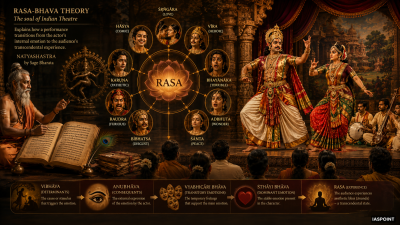
The aesthetic foundation of Indian classical theatre is built upon the Rasa-Bhava theory, primarily detailed in the Natyashastra by Sage Bharata. This system explains how a performance transitions from the actor’s internal emotion to the audience’s transcendental experience. It is the core “soul” of Indian art, distinguishing it from the Western focus on plot or conflict.
The Concept of Rasa (Aesthetic Flavor)
Rasa literally translates to “juice,” “essence,” or “flavor.” In the context of drama, it refers to the ultimate aesthetic experience or the emotional state enjoyed by the spectator (Rasika).
- The Rasa Sutra: Bharata Muni defines the creation of Rasa through the formula: Vibhavanubhava-vyabhichari-samyogad-rasanishpattih. This translates to: Rasa is produced by the combination of Vibhava (determinants), Anubhava (consequents), and Vyabhicharibhava (transitory mental states).
- The Ninth Rasa: While the Natyashastra originally listed eight Rasas, the philosopher Abhinavagupta later introduced Shanta Rasa (Peace/Tranquility) in his commentary Abhinavabharati, making it the “Navarasa.”
The Nine Rasas (Navarasa) and their Attributes
Each Rasa is associated with a specific presiding deity and a symbolic color, reflecting the systematic nature of ancient Indian aesthetics.
| Rasa (Sentiment) | Bhava (Primary Emotion) | Color | Presiding Deity |
| Shringara (Erotic/Love) | Rati (Pleasure) | Light Green | Vishnu |
| Hasya (Comic/Laughter) | Hasya (Mirth) | White | Pramatha |
| Karuna (Pathetic/Compassion) | Shoka (Sorrow) | Grey | Yama |
| Raudra (Furious/Anger) | Krodha (Anger) | Red | Rudra |
| Veera (Heroic/Valor) | Utsaha (Energy) | Pale Orange | Mahendra |
| Bhayanaka (Terrible/Fear) | Bhaya (Fear) | Black | Kala |
| Bibhatsa (Odious/Disgust) | Jugupsa (Disgust) | Blue | Mahakala |
| Adbhuta (Marvelous/Wonder) | Vismaya (Astonishment) | Yellow | Brahma |
| Shanta (Peace/Quietism) | Sama (Tranquility) | White | Vishnu/Shiva |
The Concept of Bhava (Emotional State)
Bhava refers to the state of being or the internal emotion portrayed by the actor. If Rasa is the “flavor” of the dish, Bhava represents the “ingredients.”
Classification of Bhavas
The Natyashastra identifies 49 Bhavas which are categorized into three distinct groups:
- Sthayi Bhavas (Permanent Emotions): These are the 8 (or 9) dominant emotions that stay with the audience throughout the play. These directly lead to the corresponding Rasa.
- Vyabhichari Bhavas (Transitory Emotions): 33 fleeting mental states (like shame, jealousy, or anxiety) that support and strengthen the Sthayi Bhava.
- Sattvika Bhavas (Involuntary States): 8 physical manifestations of deep emotion that an actor cannot easily fake, such as perspiration (Sveda), trembling (Kampa), or tears (Ashru).
The Process of Aesthetic Transformation
The transformation of raw human emotion into a universal aesthetic experience involves several structural components:
- Vibhava (The Cause): The stimuli that trigger emotion. This includes the Alambana (the object/person, e.g., the hero/heroine) and the Uddipana (the environment, e.g., a garden or moonlight).
- Anubhava (The Effect): The physical gestures or outward manifestations of the emotion by the actor (e.g., a glance, a smile, or a sigh).
- Sadharanikarana: A concept introduced by Bhattanayaka, referring to “universalization.” It is the process where the audience detaches from their personal identity and experiences the emotion in a universal, non-personal way.
Four Pillars of Abhinaya (Expression)
To successfully evoke Rasa, the actor must master the four types of Abhinaya:
- Angika: Expression through body parts and gestures (Mudras).
- Vachika: Expression through speech, rhythm, and intonation.
- Aharya: Expression through costumes, makeup, and jewelry.
- Sattvika: Expression through the mental and psychological state of the character.
Key Trivia and Facts for UPSC
- Major Commentators: Apart from Bharata, major contributions were made by Lollata, Sankuka, Bhattanayaka, and Abhinavagupta.
- Dhvanyaloka: Written by Anandavardhana, this text introduced the Dhvani theory (suggestion), suggesting that Rasa is best experienced through subtle suggestion rather than direct statement.
- Religious Integration: The Bhakti movement later utilized Rasa theory, particularly Shringara and Vatsalya (parental love), to describe the devotee’s relationship with the Divine (e.g., Jayadeva’s Gita Govinda).
- Standard Performance Order: A classical performance traditionally begins with the Nandi (Prayer) to establish the desired Shanta or Mangala (auspicious) environment before introducing the primary Rasa.