
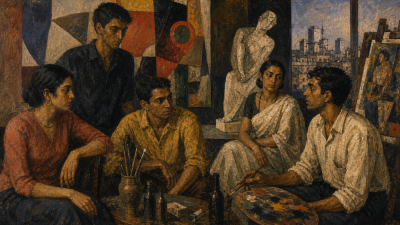
The Progressive Artists’ Group (PAG) was established in 1947 in Bombay, coinciding with India’s independence. It represented a radical departure from both the British academic realism and the nationalist sentimentality of the Bengal School. The group sought to create a new “Internationalist” vocabulary for Indian art that was secular, modern, and formally rigorous.
- Foundation: The group was founded by six core members: F.N. Souza, S.H. Raza, M.F. Husain, K.H. Ara, H.A. Gade, and S.K. Bakre.
- The Manifesto: Drafted by F.N. Souza, the manifesto famously stated, “Today we paint with absolute freedom for contents and techniques, almost anarchic, save that we are governed by one or more objective—the absolute immortalization of vital forces in a medium of effort.”
- Rejection of Tradition: They rejected the “revivalist” approach of the Bengal School, which they viewed as nostalgic and limiting. Instead, they embraced Western Modernism (Cubism, Expressionism, Post-Impressionism) while grounding their subjects in the Indian reality.
Profile of the Core Founding Members
The PAG was a heterogeneous group where each artist maintained a distinct stylistic identity.
| Artist | Primary Style / Influence | Key Themes & Notable Works |
| F.N. Souza | Expressionism / Folk Art | Known for “Black Paintings” and distorted figures; Crucifixion. |
| S.H. Raza | Abstraction / Tantra | Transitioned from landscapes to the Bindu (The Dot/Seed); Saurashtra. |
| M.F. Husain | Cubism / Indian Cinema | Depicted Indian epics, rural life, and horses; Mahabharata series, Between the Spider and the Lamp. |
| K.H. Ara | Still Life / Nudes | A self-taught artist known for spontaneous brushwork and human forms. |
| H.A. Gade | Landscape Abstraction | One of the first Indian abstract painters; focused on color and structure. |
| S.K. Bakre | Sculpture and Painting | The only sculptor in the original group; known for semi-abstract bronze works. |
Stylistic Innovations and Techniques
The PAG acted as a bridge between the local and the global, introducing several technical shifts in the Indian art scene.
- Synthesis of Forms: They combined the bold lines of Basohli miniatures and Mathura sculptures with the structural innovations of Paul Cézanne and Pablo Picasso.
- Emphasis on Texture: Unlike the smooth “Wash” technique of the Bengal School, the PAG utilized heavy impasto, palette knives, and vibrant, non-naturalistic colors to express emotional intensity.
- Secular Modernism: They moved away from purely religious iconography to explore universal human conditions, urban landscapes, and social struggles in post-partition India.
Expansion and Associated Artists
While the core group was small, their influence attracted several other masters who later defined Indian modernism.
- Tyeb Mehta: Known for his “Diagonal” series and themes of alienation and violence, deeply influenced by the trauma of partition.
- Akbar Padamsee: Famous for his “Metascapes” and “Mirror Images,” exploring the relationship between space and form.
- Ram Kumar: Renowned for his melancholic abstract landscapes of Varanasi, shifting from figurative to total abstraction.
- V.S. Gaitonde: Regarded as India’s premier abstractionist, his works focused on the spiritual quality of light and color, often associated with Zen philosophy.
Comparative Analysis: Bengal School vs. Progressive Artists’ Group
| Feature | Bengal School of Art | Progressive Artists’ Group (PAG) |
| Period | Early 20th Century (Swadeshi) | Post-Independence (1947 onwards) |
| Philosophical Base | Nationalist, Spiritual, Revivalist | Internationalist, Secular, Formalist |
| Primary Medium | Watercolors, Tempera, Wash | Oil on Canvas, Acrylics, Mixed Media |
| Influence | Ajanta, Mughal, Japanese art | Cubism, Fauvism, Expressionism |
| Goal | To reclaim ancient Indian identity | To establish a modern Indian language |
Institutional Impact and Legacy
The PAG was short-lived as a formal entity—disbanding effectively by the mid-1950s as members moved to Europe (Raza to Paris, Souza to London)—but its impact was permanent.
- Bombay School Influence: They shifted the center of the Indian art world from Calcutta to Bombay.
- Commercial Success: Today, works by PAG members (Gaitonde, Raza, Husain, Mehta) command the highest prices in international auctions, establishing India as a significant player in the global art market.
- Birth of Contemporary Art: The freedom of expression championed by the PAG paved the way for the “Group 1890” and subsequent contemporary movements in India.
Fact Sheet for UPSC Prelims: Critical Trivia
- The 1948 Exhibition: The group’s first significant exhibition was held at the Bombay Art Society in 1948, which shocked the traditionalist critics of the time.
- S.H. Raza’s Bindu: The Bindu became the signature motif for Raza, representing the center of creation and a synthesis of Indian philosophy with geometric abstraction.
- M.F. Husain and the Bharat Ratna: Often called the “Picasso of India,” Husain’s career was marked by both immense popularity and significant controversy regarding his depictions of deities.
- V.S. Gaitonde’s Record: His untitled abstract works frequently set records for the most expensive Indian painting sold at auction, often exceeding $4 million.
- The “Group 1890” Connection: Some artists associated with the PAG spirit later formed Group 1890 (led by J. Swaminathan), which further critiqued the “Western” influence on Indian modernism, seeking a “Natural” or “Indigenous” modernism.