
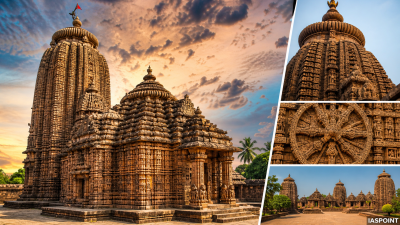
Kalinga architecture is a distinct sub-style of the Nagara (North Indian) school of temple architecture that flourished in the ancient Kalinga region (modern-day Odisha and parts of Northern Andhra Pradesh). This style reached its zenith between the 7th and 13th centuries CE under the patronage of the Shailodbhavas, Bhauma-Karas, Somavamsis, and the Eastern Gangas. Unlike the general Nagara style, Kalinga architecture follows a rigid set of canonical texts known as the Shilpa Shastras, ensuring a unique regional identity.
Structural Classification of Kalinga Temples
The Kalinga style classifies temple structures into three distinct types based on the shape of the shikhara (tower) and the functional hall.
Rekha Deula
- This refers to the sanctum sanctorum (Garbhagriha) which houses the main deity.
- It features a tall, curvilinear tower that rises vertically before curving inward at the top.
- The square ground plan transitions into a circular crowning element called the Amalaka.
Pidha Deula
- This is generally the Jagamohana (assembly hall) where devotees gather.
- The roof consists of several horizontal platforms (pidhas) stacked in a stepped pyramidal shape.
- It is always shorter than the Rekha Deula to maintain the visual hierarchy of the main shrine.
Khakhara Deula
- A rare style reserved primarily for Tantric or Shakti deities (Goddess temples).
- The roof is rectangular and barrel-vaulted, resembling the shape of a pumpkin (Khakhara) or a wagon vault.
- Example: Vaital Deula in Bhubaneswar.
Essential Architectural Components
Every Kalinga temple is a composite of specific vertical and horizontal divisions.
- Bada: The lower part or the vertical wall of the temple.
- Gandi: The main body or the trunk of the tower (the curvilinear portion).
- Mastaka: The crowning head, which includes the Amalaka (fluted disc) and the Kalasha (finial).
- Jagati: The raised masonry platform upon which the entire temple stands.
- Parsvadevata: Niches on the exterior walls housing secondary deities related to the main god.
The Three Magnificent Examples
| Temple Name | Period/Dynasty | Key Features |
| Lingaraja Temple (Bhubaneswar) | 11th Century / Somavamsi | Considered the culmination of Kalinga style. Includes four structures: Ganjadeula (Sanctum), Jagamohana, Natamandira (Dance Hall), and Bhogamandapa (Offering Hall). |
| Jagannath Temple (Puri) | 12th Century / Eastern Ganga | Built by King Anantavarman Chodaganga Deva. It is famous for being one of the Char Dham sites and is elevated on a massive platform called the Suta-vedi. |
| Konark Sun Temple | 13th Century / Eastern Ganga | Built by Narasimhadeva I. Designed as a colossal chariot with 24 wheels and 7 horses. It is a UNESCO World Heritage Site known as the “Black Pagoda.” |
Evolution of Temple Layouts
The complexity of Kalinga architecture evolved through three major phases:
- Early Phase (7th–9th Century): Represented by the Parasurameswar Temple. These were simple structures consisting only of the Rekha Deula and a flat-roofed Jagamohana.
- Middle Phase (10th–11th Century): Represented by the Mukteswar Temple. Known as the “Gem of Odisha Architecture,” it introduced the highly decorative Torana (arched gateway) and refined carvings.
- Mature Phase (11th–13th Century): The structures became massive. The addition of the Natamandira and Bhogamandapa became standard, resulting in a linear four-chambered arrangement.
Distinctive Features and Artistry
- Exterior vs. Interior: Kalinga temples are characterized by lavishly carved exterior walls depicting secular life, erotica, and mythology, while the interiors are strictly plain and dark.
- Material: Most temples were constructed using Khondalite (a type of metamorphic rock) and Chlorite for doorframes and icons.
- No Mortar: Similar to other Dravidian and Nagara styles, the stones were held together by iron dowels and precise architectural balance.
- The Wheels of Konark: The 24 wheels of the Sun Temple act as sundials, capable of calculating time accurately to the minute.
Trivia for UPSC Prelims
- The Black and White Pagodas: European sailors referred to the Konark Sun Temple as the “Black Pagoda” (due to its dark color and magnetic properties affecting compasses) and the Jagannath Temple as the “White Pagoda.”
- Nava-Graha Slab: A common feature in later Kalinga temples is a stone slab above the sanctum doorway depicting the nine planetary deities.
- Vesara Influence: While primarily Nagara, the Kalinga style is often seen as a bridge between the North and South due to its unique treatment of the tower and the tiered Jagamohana.
- Dhauli Giri: Though not a temple, the rock-cut elephant at Dhauli is the earliest specimen of Kalinga art, dating back to the Mauryan period (Ashoka).