
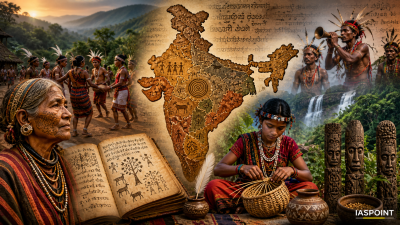
The tribal languages of India, predominantly spoken by the Scheduled Tribes (STs), represent the oldest linguistic layers of the Indian subcontinent. While the Eighth Schedule recognizes 22 official languages, the vast majority of India’s 700+ distinct tribal communities speak mother tongues that fall outside this formal recognition. These languages are vital repositories of indigenous knowledge, folklore, and ecological wisdom.
Major Linguistic Families of Tribal India
Tribal languages in India are classified into four primary linguistic groups, reflecting the migratory and ancestral history of the various tribes.
| Linguistic Family | Primary Regions | Representative Tribes & Languages |
|---|---|---|
| Austro-Asiatic (Munda) | Central and Eastern India, Northeast | Santhali, Mundari, Ho, Khasi, Korku |
| Dravidian | Central India and South India | Gondi, Kui, Kurukh (Oraon), Toda, Kota |
| Sino-Tibetan (Tibeto-Burman) | Himalayas and Northeast India | Bodo, Miri, Karbi, Nyishi, Meitei, Naga dialects |
| Indo-Aryan | Western and Central India | Bhili, Lambadi, Halbi, Sadri |
The Eighth Schedule and Tribal Representation
Currently, only two languages primarily identified as “tribal” have been accorded the status of Scheduled Languages under the Eighth Schedule of the Constitution.
- Bodo: Added via the 92nd Amendment Act, 2003. It is a Sino-Tibetan language spoken mainly in the Bodoland Territorial Region of Assam.
- Santhali: Also added via the 92nd Amendment Act, 2003. It belongs to the Austro-Asiatic family and uses the Ol Chiki script, invented by Pandit Raghunath Murmu. It is the most widely spoken tribal language in India.
Scripts and Literacy in Tribal Cultures
Most tribal languages were historically oral. However, several tribes have developed or adopted unique scripts to preserve their linguistic identity.
- Ol Chiki: Used for Santhali (invented in 1925).
- Warang Chiti: Used for the Ho language in Jharkhand and Odisha.
- Tolong Siki: Used for the Kurukh language (Oraon tribe).
- Ahom Script: Historically used by the Tai-Ahom people of Assam.
- Meitei Mayek: The traditional script for the Meitei language in Manipur.
Endangered Tribal Languages and UNESCO Status
According to UNESCO’s Atlas of the World’s Languages in Danger, India has the highest number of endangered languages globally (approximately 197). A language is considered endangered if it is no longer learned by children as a mother tongue.
- Critically Endangered: Languages like Asur (Jharkhand), Birhor (Chhattisgarh), and Great Andamanese (Andaman Islands).
- Extinct: The Bo language of the Andaman Islands became extinct in 2010 following the death of its last speaker, Boa Sr.
- Linguistic Vulnerability: Small tribal groups in the Nilgiris (Toda, Kota) and the Himalayan belts (Ladakhi, Shina) face severe pressure from dominant regional languages.
Constitutional and Institutional Safeguards
The Indian State provides specific protections to ensure the survival of tribal linguistic heritage.
- Article 29: Grants any section of citizens residing in India having a distinct language, script, or culture the right to conserve the same.
- Article 350A: Directs States to provide primary education in the mother tongue to linguistic minority groups, which is crucial for tribal children.
- Article 350B: Appointment of a Special Officer for Linguistic Minorities to investigate and report on safeguards.
- Scheme for Protection and Preservation of Endangered Languages (SPPEL): Instituted by the Ministry of Education to document languages spoken by fewer than 10,000 people.
- Tribal Research Institutes (TRIs): Established across various states to document tribal dialects, create dictionaries, and publish folk literature.
Significant Tribal Languages and Geographic Distribution
- Gondi: Spoken by the Gond tribe across Madhya Pradesh, Maharashtra, and Chhattisgarh. It is a Dravidian language with a rich oral tradition (Gondi Punem).
- Bhili: Spoken by the Bhil tribe in Rajasthan, Gujarat, and Madhya Pradesh. It is an Indo-Aryan language and holds the record for the largest group of speakers among non-scheduled languages.
- Khasi & Jaintia: Austro-Asiatic languages spoken in Meghalaya, unique for being surrounded by Tibeto-Burman and Indo-Aryan speakers.
- Adi & Nyishi: Important Tibeto-Burman languages of Arunachal Pradesh characterized by a strong oral tradition of “Abangs” (ritual hymns).
Key Trivia for Prelims
- The People’s Linguistic Survey of India (PLSI): A non-governmental initiative headed by G.N. Devy that identified 780 languages in India, many of which are undocumented tribal dialects.
- Jarawa and Onge: These Andamanese tribes speak languages that are “Language Isolates,” meaning they have no demonstrable genetic relationship with any other language family in the world.
- Kui: A Dravidian language spoken by the Kondh tribe in Odisha, noted for its complex morphology.
- Nihali: A language isolate spoken in Maharashtra and Madhya Pradesh, currently facing extinction.