
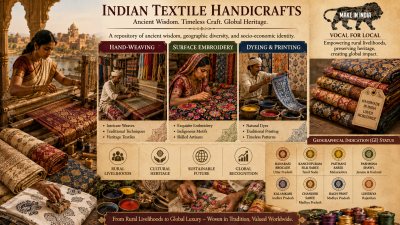
Indian textile handicrafts represent a repository of ancient wisdom, geographic diversity, and socio-economic identity. These crafts are categorized into three primary domains: Hand-weaving, Surface Embroidery, and Dyeing & Printing. Under the “Make in India” and “Vocal for Local” initiatives, these handicrafts have transitioned from rural livelihoods to global luxury commodities, with many securing Geographical Indication (GI) status.
Significant Hand-Woven Traditions
Hand-weaving is the process of interlacing warp (longitudinal) and weft (transverse) yarns. In India, this varies from the sheerest muslins to heavy gold brocades.
- Chanderi (Madhya Pradesh): Known for its “sheer” texture, it uses a blend of silk and fine cotton with small traditional motifs called Buttis.
- Maheshwari (Madhya Pradesh): Introduced by Queen Ahilyabai Holkar, these sarees are characterized by reversible borders (Tanchoi) and linear patterns.
- Kancheepuram (Tamil Nadu): Distinguished by its “Temple Borders” and the Korvai technique, where the border and body are woven separately and then joined.
- Baluchari (West Bengal): Famous for depicting scenes from the Ramayana and Mahabharata on the pallu (anchor) of the saree.
- Sambalpuri (Odisha): A “Baandha” or Ikat craft where yarns are tied and dyed before weaving to create blurry-edged geometric patterns.
Traditional Embroidery Crafts of India
Embroidery involves decorating fabric using a needle and thread, often incorporating beads, quills, and sequins.
| Embroidery Style | State of Origin | Key Features |
| Chikan Kari | Uttar Pradesh (Lucknow) | Delicate shadow work traditionally done on white muslin; involves 36 different types of stitches. |
| Phulkari | Punjab | “Flower work” done with silk threads on coarse cotton (Khaddar); stitches are applied from the reverse side. |
| Kantha | West Bengal/Odisha | Originally a “running stitch” used to join old saris to make quilts; often depicts floral or animal motifs. |
| Kasuti | Karnataka | Intricate embroidery requiring the counting of threads; motifs include chariots, lamps, and elephants. |
| Toda Embroidery | Tamil Nadu | Locally called Pukhoor, it is practiced by the Toda tribe using red and black threads on white unbleached cotton. |
| Zardosi | Uttar Pradesh/Delhi | Heavy metal embroidery using gold and silver threads, pearls, and precious stones. |
| Lambadi | Telangana/Andhra | Practiced by the Banjara tribes, it uses mirrors, shells, and coins on colorful fabric. |
Resist-Dyeing and Printing Techniques
Indian artisans mastered the chemistry of natural colors and the physics of “resist” (preventing dye from reaching certain areas of the cloth).
Tie-and-Dye (Bandhej)
- Bandhani (Gujarat/Rajasthan): Involves tying tiny knots on the fabric before dyeing to create dotted patterns. Shikari (hunting scenes) and Ekdali (single dot) are popular variants.
- Leheriya (Rajasthan): A diagonal striped pattern representing waves, traditionally produced in Jaipur and Jodhpur.
- Ikat (Pochampally/Patola): Unlike Bandhani, here the yarns are dyed before they are put on the loom. Pochampally (Telangana) is famous for geometric Ikats, while Patan (Gujarat) is world-renowned for Double Ikat.
Block and Pen Printing
- Ajrakh (Gujarat): A complex 16-step process using wooden blocks and natural dyes (Indigo and Madder). It is characterized by star-like geometric patterns.
- Bagh Print (Madhya Pradesh): Uses copper-rich water from the Bagh River and wooden blocks to create floral and geometric motifs in red and black.
- Sanganeri and Bagru (Rajasthan): Sanganeri is known for delicate floral prints on white backgrounds, while Bagru uses “Dabu” (mud-resist) printing.
- Kalamkari (Andhra Pradesh): Srikalahasti style uses a bamboo pen for freehand drawing of mythological themes, while Machilipatnam style uses block printing for floral designs.
Special Textile Crafts: Beyond Apparel
- Applique and Pipli Work (Odisha): Involves stitching small pieces of colored cloth onto a base fabric to create umbrellas, canopies, and lampshades used in the Jagannath Puri Rath Yatra.
- Itkat/Mashru (Gujarat): A “permitted” fabric for the clergy, featuring a silk warp and cotton weft, ensuring silk does not touch the skin.
- Kullu & Kinnauri Shawls (Himachal Pradesh): Famous for their geometric patterns influenced by Central Asian aesthetics, woven in wool.
Fact-File for UPSC Prelims
- First Textile GI Tag: The Pochampally Ikat was the first traditional textile to receive a Geographical Indication tag in India (2004).
- Handloom Mark: A scheme launched by the Government of India to provide a collective identity to handloom products and guarantee their genuineness.
- Silk Mark: Managed by the Central Silk Board to certify that the product is made from 100% natural silk.
- The ‘Korvai’ Technique: Unique to Kancheepuram, it requires two weavers to sit on either side of the loom to manage the heavy contrast borders.
- Ahimsa Silk: Also known as Eri Silk, it is produced without killing the silkworm, making it a staple in Buddhist and Jain textile traditions.
- National Handloom Day: Celebrated on August 7 to commemorate the Swadeshi Movement which was launched on this day in 1905.