
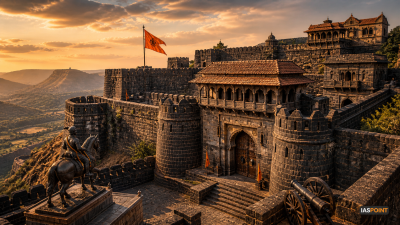
Maratha architecture emerged as a distinct style during the reign of Chhatrapati Shivaji Maharaj and reached its zenith under the Peshwas. Primarily concentrated in Maharashtra, it is characterized by its utilitarian focus, military resilience, and a unique blend of Deccan, Mughal, and Rajput influences. The style is defined by its use of local materials like basalt rock and timber, designed to withstand both the rugged terrain of the Western Ghats and prolonged military sieges.
Military Architecture: The Hill Forts (Giri Durg)
The backbone of Maratha power lay in its forts, which prioritized strategic positioning over ornamental display. Shivaji Maharaj either captured or built over 300 forts, classified into Hill Forts, Sea Forts, and Land Forts.
- Defensive Features: Use of massive basalt stone blocks, “Zunjhar Machi” (fortified cliffs), and “Gomukhi” (cow-mouth) entrance gates designed to hide the main entrance from the enemy’s direct line of sight.
- Raigad Fort: The capital of the Maratha Empire, featuring the “Nagara Khana” (drum tower) and a massive market area with high plinths.
- Pratapgad Fort: Famous for its strategic layout amidst dense forests, designed to trap invading armies.
- Sea Forts (Jal Durg): Masterpieces like Sindhudurg and Janjira (though Janjira was held by Siddis, it influenced Maratha naval design) used molten lead in foundations to resist the corrosive action of the sea.
Palace Architecture: The Wada Style
As the empire stabilized under the Peshwas, secular architecture evolved into the “Wada” style—large, multi-storied residential mansions built around one or more open courtyards (Chowks).
- Structural Elements: High outer walls for security, heavy timber pillars (often in the “Suru” or cypress tree shape), and sloping roofs to drain heavy monsoon rain.
- Shaniwar Wada (Pune): The seat of the Peshwas. It featured seven stories (destroyed by fire) and the Dilli Darwaza, a massive gate with iron spikes to deter elephant charges.
- Sarkar Wada (Nashik): Notable for its intricate wood carvings and massive timber beams.
- Materials: A combination of stone for the ground floor and timber or brick for the upper floors.
Temple Architecture: The Maratha Synthesis
Maratha temples revived the ancient Hemadpanti style while incorporating Mughal elements like domes and arches.
- Deepastambha: A unique feature of Maratha temples is the tall, free-standing stone pillar with projections to hold oil lamps, often found at the entrance.
- Shikhara and Dome: Many temples featured a traditional North Indian Shikhara combined with Deccan-style lime-plastered domes.
- Sabhamandapa: Large assembly halls with wooden pillars and carved ceilings.
- Key Examples:
- Kasba Ganpati (Pune): Built during Shivaji’s time.
- Trimbakeshwar (Nashik): Rebuilt by Nana Saheb Peshwa in black stone.
- Grishneshwar Temple: Rebuilt by Ahilyabai Holkar, showcasing the Maratha patronage of Jyotirlingas.
Comparison: Maratha vs. Mughal Architecture
| Feature | Maratha Architecture | Mughal Architecture |
| Philosophy | Pragmatic and Defensive | Aesthetic and Imperial |
| Primary Material | Basalt (Black Stone) and Timber | Red Sandstone and Marble |
| Arches | Simple, often using timber lintels | Multi-foliated and decorative |
| Ornamentation | Intricate Wood Carving | Pietra Dura and Inlay Work |
| Landscaping | Functional water tanks (Taki) | Formal Charbagh Gardens |
Contributions of Ahilyabai Holkar
A significant chapter of Maratha architecture is the reconstruction of Hindu shrines across India by Queen Ahilyabai Holkar of Indore.
- Somnath Temple (Gujarat): Reconstructed after repeated destructions.
- Vishnupad Temple (Gaya): Famous for its grey basalt structure and 100-foot high Shikhara.
- Kashi Vishwanath (Varanasi): The current structure of this pre-eminent Jyotirlinga was built by her in 1780.
- Maheshwar Fort: A beautiful example of riverfront architecture with ornate Chhatris (cenotaphs) and ghats on the Narmada river.
Key Architectural Elements and Trivia
- Teakwood Usage: Maratha Wadas used high-quality teakwood for pillars and ceilings, often decorated with floral and geometric patterns.
- Hemadpanti Influence: A 13th-century style using black basalt without mortar, which influenced early Maratha stone masonry.
- The Nana Phadnavis Wada (Menavali): Famous for its preserved murals and a massive bell captured from the Portuguese.
- Water Management: Maratha forts are legendary for their rock-cut cisterns (e.g., at Shivneri) which provided year-round water supply to the garrison.
- Chhatri of Janoji Bhonsle: Located at Nagpur, it represents the funerary architecture of the Maratha sub-clans.
Summary of Maratha Capitals and Architectural Hubs
- Pune: Heart of the Peshwa Wadas and Shaniwar Wada.
- Satara: Known for the Ajinkyatara fort and royal palaces.
- Nagpur: Hub for the Bhonsle Maratha style.
- Indore and Maheshwar: Centers for Holkar architecture.
- Gwalior: Seat of the Scindia Marathas, blending Maratha and Rajput styles in the Jai Vilas Palace.