
Colonial sculpture in India (approx. 1750–1947) emerged as a tool of political messaging and imperial self-representation. Primarily driven by British interests, it introduced European Neoclassical and Gothic styles to the Indian landscape. Sculptural activity was initially dominated by British artists commissioned by the East India Company, later transitioning to the “Company School” influence where Indian artisans adapted to Western techniques. This period marked a radical shift from traditional Indian stone-carving to the use of white marble, bronze casting, and the creation of freestanding public monuments.
Dominant Styles and Themes
Colonial sculpture was characterized by realism and a focus on the individual, contrasting with the stylized or spiritual focus of ancient Indian art.
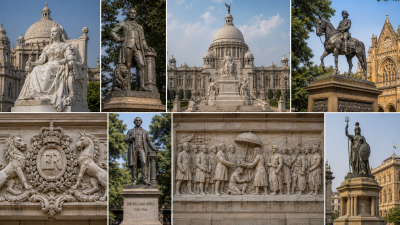
- Neoclassicism: Inspired by the Renaissance and Ancient Greece, this style emphasized anatomical precision and heroic poses. It is most visible in the marble statues of British officials located in Victoria Memorial and St. John’s Church, Kolkata.
- Imperial Iconography: Sculptures were designed to project power. Common motifs included the British Lion, the Victoria Cross, and portraits of Viceroys and Generals in military regalia.
- Public Statuary: For the first time in Indian history, sculptures were placed in “public squares” (Chowks) and parks, rather than solely in temples or palaces, to foster a sense of civic awe.
- The “Black Town” vs. “White Town” Influence: Sculptural patronage in European quarters focused on marble memorials, while indigenous styles in “Black Towns” began incorporating European elements into terracotta and wood.
Key Sculptural Landmarks and Examples
The presidency towns of Calcutta, Bombay, and Madras became the epicenters of colonial sculptural output.
| Monument/Sculpture | Location | Material | Significance |
| Statue of Queen Victoria | Victoria Memorial, Kolkata | Bronze | A colossal seated figure representing the “Empress of India” at the height of the Raj. |
| Equestrian Statue of Edward VII | Kala Ghoda, Mumbai (now in Byculla) | Bronze | A landmark example of “Kala Ghoda” (Black Horse) sculpture, reflecting British military pride. |
| Flora Fountain | Mumbai | Portland Stone | A neoclassical fountain depicting the Roman Goddess Flora, merging European mythology with Indian urban planning. |
| Statue of Lord Cornwallis | Fort St. George, Chennai | Marble | Features a pedestal with relief carvings of the surrender of Tipu Sultan’s sons, a classic example of “History in Stone.” |
| Triumph of Labour | Marina Beach, Chennai | Bronze | A late-colonial/early-post-colonial masterpiece by D.P. Roy Chowdhury, marking a shift toward the dignity of the common man. |
Techniques and Material Innovation
The colonial era introduced industrial-scale materials and European casting techniques that redefined Indian sculptural practice.
Marble and the European Influence
Large shipments of Carrara marble from Italy were imported for high-profile statues of the royalty. British sculptors like Thomas Banks and John Bacon sent finished works from London to India, which local artisans then studied. These works introduced the “Toga” style—depicting British officials in Roman robes—to suggest a lineage between the Roman and British Empires.
Bronze Casting and Public Monuments
The establishment of the Sir J.J. School of Art (Mumbai) and the Government College of Fine Arts (Chennai) in the 1850s introduced systematic training in Western bronze casting. Indian artists began mastering the “Lost Wax” process for realistic portraiture, a departure from the traditional bronze icons of the Chola period.
Transition to Nationalist Sculpture
As the Indian Independence movement gained momentum, sculpture transitioned from imperial glorification to nationalist expression.
- Rise of Indian Sculptors: Artists like Fanindranath Bose and V.P. Karmarkar began receiving commissions. They blended Western anatomical realism with Indian nationalist themes.
- Ramkinkar Baij and Santiniketan: A revolutionary figure who broke away from both British Neoclassicism and traditional revivalism. His work, like the Santhal Family, used modern materials like cement and laterite to depict the subaltern and the rural.
- D.P. Roy Chowdhury: Known for his robust bronze figures, he was instrumental in creating monuments that celebrated the Indian worker and the independence struggle, bridging the gap between colonial training and Indian identity.
Trivia and Key Facts for UPSC Prelims
- The “Kala Ghoda” Myth: The famous statue of King Edward VII on a black horse in Mumbai gave the entire “Kala Ghoda” art district its name, even though the statue was later moved to the Jijamata Udyaan.
- The Coronation Park, Delhi: Following independence, many colonial statues were removed from public squares and relocated to “Statue Park” (Coronation Park) in Delhi, symbolizing the decolonization of public space.
- Chhatrapati Shivaji Maharaj Terminus (CSMT): Formerly Victoria Terminus, its façade is a sculptural museum of Neo-Gothic style, featuring gargoyles, lions, and tigers representing the British and Indian empires respectively.
- M.S. Nagappa: A prominent Indian sculptor of the colonial period in Madras, he was the first Indian to be commissioned for a statue of King George V.
- Memorialization of the 1857 Revolt: Many British sculptures in Kanpur and Lucknow were specifically designed as memorials for those killed during the 1857 uprising, serving as “political markers” of British resilience.