
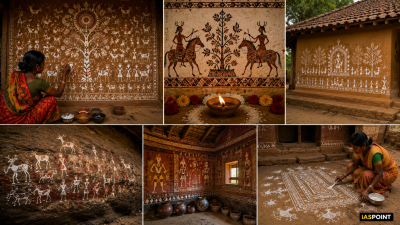
Tribal paintings in India, categorized under “Vernacular Art,” are intrinsic to the socio-religious fabric of indigenous communities. Unlike classical art forms that follow codified texts (like the Chitra Sutra), tribal art is guided by oral traditions, ancestral memory, and ecological surroundings. These paintings are primarily functional, serving as offerings to deities, records of history, or markers of life-cycle rituals.
Geographical Clusters and Major Art Forms
The diversity of tribal art is deeply linked to the geographical distribution of Scheduled Tribes across India.
Central Indian Cluster (Madhya Pradesh, Chhattisgarh, Jharkhand)
- Gond Art (Madhya Pradesh): Created by the Gond tribe, particularly the Pardhan Gonds. It is characterized by the use of “Signature Patterns”—unique arrangements of dots and lines that create a sense of movement. Central themes include the “Tree of Life” and various forest deities.
- Sohrai and Khovar (Jharkhand): These are traditional mural arts practiced by women. Sohrai is a harvest art celebrating fertility and cattle, while Khovar (meaning “cave-room”) is a matrimonial art practiced during weddings. Both received the Geographical Indication (GI) Tag in 2020.
- Paitkar Painting (Jharkhand/West Bengal): Often called the “Scroll Paintings of the East,” these are practiced by the Santhal tribe and were traditionally used by wandering storytellers to narrate moral and religious tales.
Western Indian Cluster (Maharashtra, Gujarat, Rajasthan)
- Warli Painting (Maharashtra): Practiced by the Warli and Malkhar Koli tribes. This art uses a rudimentary graphic vocabulary: circles (Sun/Moon), triangles (Mountains/Trees), and squares (Sacred enclosures). The central motif is usually the goddess of fertility, Palaghat.
- Pithora Painting (Gujarat/Madhya Pradesh): A ritualistic wall painting practiced by the Rathwa and Bhilala tribes. It is an offering to the god Pithora Dev. The presence of a horse is the defining feature of a Pithora mural.
- Bhil Art (Rajasthan/Gujarat/MP): Recognized by its distinctive “multi-colored dots” technique. Every pattern is built using dots, which symbolize prayers or ancestral spirits.
Eastern and Southern Indian Cluster (Odisha, Andhra Pradesh, Tamil Nadu)
- Saora Art (Odisha): Practiced by the Lanjia Saora tribe, these murals are called Iditals. They bear a visual resemblance to Warli art but focus heavily on rectangular frames and ancestor worship.
- Kurumba Art (Tamil Nadu): A rare form of painting by the Kurumba tribe of the Nilgiris, traditionally used to decorate the exterior of houses with motifs of forest honey-gathering and local flora.
Techniques, Materials, and Indigenous Chemistry
Tribal artists utilize materials sourced directly from their immediate environment, ensuring an eco-friendly and sustainable artistic practice.
- Pigments:
- White: Sourced from rice paste (Pithau) or kaolin (white clay).
- Red/Brown: Derived from hematite, red oxide, or burnt soil (Geru).
- Black: Obtained from soot, lampblack, or powdered charcoal.
- Yellow: Sourced from turmeric or local yellow stones.
- Binders: Natural resins, gum arabic, or a mixture of cow dung and clay are used to ensure the paint adheres to the mud walls.
- Brushes: Handmade brushes are crafted from chewed twigs of Neem or Babul, or bundles of local grass and bamboo slivers.
Comparative Matrix: Key Tribal Art Forms
| Art Form | Primary Tribe | State | Key Motif / Technique | Ritual Significance |
| Gond | Gond (Pardhan) | Madhya Pradesh | Dots and Lines (Signature Patterns) | Worship of nature and spirits. |
| Warli | Warli | Maharashtra | Geometric shapes (Triangle/Circle) | Fertility and “Palaghat” worship. |
| Pithora | Rathwa | Gujarat | Horse iconography | Fulfillment of vows (Mannat). |
| Sohrai | Santhal/Munda | Jharkhand | Comb-cutting (clay layering) | Harvest and cattle festival. |
| Saora | Lanjia Saora | Odisha | Iditals (Spirit Houses) | Appeasing ancestors. |
| Paitkar | Santhal | Jharkhand | Scroll format | Storytelling and folklore. |
Symbolism and Iconography in Tribal Art
Tribal art is a symbolic language where every shape conveys a specific cosmic or social meaning.
- The Circle and Square: In Warli and Saora art, the circle represents the timeless nature of the sun and moon, while the square (Chauk) represents the ordered, man-made world as opposed to the chaotic forest.
- The Tree of Life: A universal motif in Gond and Bhil art, representing the vertical link between the underworld (roots), the human world (trunk), and the heavens (branches).
- The Horse: In Pithora art, the horse is the vehicle of the gods and a symbol of power, speed, and divine presence.
- The Peacock: Often found in Meena Mandana (Rajasthan), it symbolizes beauty, monsoon, and protection from evil spirits.
Fact Sheet for UPSC Prelims
- Jangarh Singh Shyam: The legendary Gond artist who pioneered the transition of Gond art from mud walls to paper and canvas, leading to the “Jangarh Kalam” school of art.
- Bhuri Bai: A prominent Bhil artist who was awarded the Padma Shri for her contribution to tribal art, transitioning from a construction worker to a world-renowned painter.
- Geographical Indication (GI) Status: Sohrai-Khovar (Jharkhand), Pithora (Gujarat), and Warli (Maharashtra) are major tribal arts recognized for their unique regional identity.
- The ‘Comb-Cut’ Technique: Unique to Khovar art, where a dark base coat is covered by a light coat, and designs are scraped out using a comb or fingers while the top layer is wet.
- Ethno-Aesthetics: Tribal paintings are often “ephemeral,” meaning they are created for a specific ritual and allowed to fade or be covered by a new layer during the next cycle of festivals.
- Lakhara: The traditional title given to the male artists who are authorized to paint the ritualistic Pithora murals.
Current Conservation and Challenges
While tribal art has gained international commercial success, it faces challenges regarding cultural appropriation and the loss of traditional context.
- Commercialization: Transitioning from walls to canvas has provided livelihoods but sometimes dilutes the ritualistic meaning of the motifs.
- Government Initiatives: TRIFED (Tribal Co-operative Marketing Development Federation of India) and the “Tribes India” outlets play a crucial role in marketing these arts globally.
- Digitization: Efforts are underway to document the oral myths associated with each painting to preserve the “intangible heritage” alongside the visual art.