
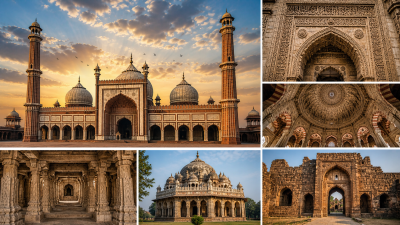
Indo-Islamic architecture emerged in India with the establishment of the Delhi Sultanate in the late 12th century. It is not a purely imported style but a composite aesthetic resulting from the fusion of Persian, Central Asian, and Arabic influences with the existing Indian (Trabeate) architectural traditions. This synthesis was facilitated by the use of local Indian craftsmen who adapted their traditional stone-working skills to the requirements of Islamic patrons, such as the avoidance of human and animal figures and the introduction of the arch and dome.
Fundamental Architectural Elements and Differences
The transition from Ancient to Medieval Indian architecture was marked by a shift from the Trabeate (post-and-beam) method to the Arcuate (arch-and-dome) method.
Structural Innovations
- Arch and Dome: These allowed for the spanning of large spaces without the need for numerous supporting pillars, creating vast, unobstructed interiors.
- Minarets: Vertical towers used for the call to prayer and as symbols of power.
- Mortar: The widespread use of lime-plaster as a binding agent allowed for quicker and more stable construction compared to dry masonry.
Decorative Techniques
- Calligraphy: Verses from the Quran were used as decorative elements on walls and gateways.
- Arabesque: Rhythmic linear patterns of scrolling and interlacing foliage.
- Jali Work: Intricate stone lattice screens that provided ventilation while filtering sunlight and ensuring privacy.
- Pietra Dura: A later Mughal innovation involving the inlay of precious and semi-precious stones (like lapis lazuli and jade) into marble.
Chronological Evolution of Styles
The Delhi Sultanate (1206–1526 CE)
This period is divided into five dynasties, each contributing distinct architectural characteristics.
- Slave (Mamluk) Dynasty: Focused on the conversion of existing temples. The Quwwat-ul-Islam Mosque and the Qutub Minar (started by Qutb-ud-din Aibak) are primary examples.
- Khalji Dynasty: Introduced the “True Arch” and scientific dome. The Alai Darwaza is the most significant structure, showcasing red sandstone and white marble contrasts.
- Tughlaq Dynasty: Characterized by “Batter” or sloping walls for strength. Architecture was more austere with less ornamentation. Key sites include Tughlaqabad and the Tomb of Ghiyasuddin Tughlaq.
- Sayyid and Lodi Dynasties: Introduced Double Domes and octagonal tomb plans. The Lodi Gardens in Delhi represent the peak of this phase.
The Provincial Schools
While Delhi was the center, independent regional kingdoms developed unique local styles.
| School | Region | Characteristics | Key Example |
| Bengal School | Gaur/Pandua | Extensive use of brick and “Bangla roofs” (curved eaves). | Adina Mosque, Eklakhi Mausoleum |
| Jaunpur School | Uttar Pradesh | Massive sloping pylons (propylon) flanking the gateways. | Atala Masjid |
| Malwa School | Mandu | Use of colored tiles, high plinths, and large windows. | Jahaz Mahal, Rani Roopmati’s Pavilion |
| Bijapur School | Deccan | Characterized by bulbous domes and “whispering galleries.” | Gol Gumbaz |
The Mughal Empire (1526–1857 CE)
The Mughals brought Indo-Islamic architecture to its zenith, focusing on symmetry, extensive gardens (Charbagh), and the use of white marble.
- Humayun’s Tomb: The first substantial Mughal structure, introducing the Charbagh layout and the high double dome in India.
- Akbar’s Style: Used red sandstone extensively. Notable for the Buland Darwaza (world’s highest gateway) and the city of Fatehpur Sikri.
- Shah Jahan’s Style: The “Golden Age” of Mughal architecture. Transitioned to white marble. Masterpieces include the Taj Mahal, Red Fort, and Jama Masjid.
Comparison of Architectural Techniques
| Feature | Trabeate (Traditional Indian) | Arcuate (Indo-Islamic) |
| Structural Basis | Pillars and horizontal beams | Arches, Vaults, and Domes |
| Roofing | Flat or Pyramidal (Shikhara) | Hemispherical Domes |
| Materials | Stone and dry masonry | Stone, Brick, and Lime-mortar |
| Ornamentation | Sculptures of living beings | Geometry, Flora, and Calligraphy |
Secular and Specialized Structures
Indo-Islamic architecture was not limited to mosques (Masjids) and tombs (Maqbaras); it extended into civil engineering and leisure.
- Sarais: Rest houses built along trade routes (like the Grand Trunk Road) for travelers and merchants.
- Hammams: Public baths modeled after Persian traditions, featuring sophisticated water heating and drainage systems.
- Baolis: While existing in India, stepwells were refined with Islamic arches and decorative pavilions during this period.
- Charbagh: The four-quadrant garden style, symbolizing the gardens of Paradise, often surrounded the tombs.
Important Facts and Trivia for Prelims
- First True Arch: Found in the Tomb of Balban (Delhi Sultanate).
- Double Dome: First appeared in the Tomb of Sikandar Lodi and was perfected in Humayun’s Tomb.
- UNESCO Sites: The Taj Mahal, Humayun’s Tomb, Qutub Minar, Fatehpur Sikri, Red Fort, and the Historic City of Ahmedabad are all recognized world heritage sites.
- Gol Gumbaz: Located in Bijapur, it possesses the second-largest dome in the world after St. Peter’s Basilica, featuring a “Whispering Gallery” where sound echoes multiple times.
- Pietra Dura: While often associated with the Taj Mahal, the first extensive use of Pietra Dura was in the Tomb of Itmad-ud-Daula (Agra), built by Nur Jahan.
- Symmetry: A core tenet of Mughal architecture; if a building was built on one side of a garden, a “Jawab” (mirror image) was often built on the other side for balance.