
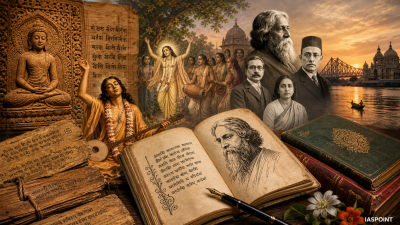
Bengali literature, one of the most prolific and globally recognized literary traditions of India, evolved from the Magadhi Apabhramsha. It is characterized by a seamless transition from mystic Buddhist verses to devotional Bhakti poetry, and finally to a robust modern era that spearheaded the Indian Renaissance.
The Ancient and Early Medieval Foundation (10th – 14th Century)
The origins of Bengali literature are linked to the development of the Eastern Indo-Aryan languages.
The Charyapada
- Significance: Discovered by Haraprasad Shastri in the Royal Library of Nepal in 1907, the Charyapada is a collection of 47 mystic poems (Padas).
- Authorship: Composed by Siddhacharyas (Buddhist tantric practitioners) between the 10th and 12th centuries.
- Language: Written in “Sandhya Bhasha” (Twilight Language), an ancestral form of Bengali, Assamese, and Odia.
The Medieval Period: Mangal-Kavyas and the Bhakti Movement
This era (15th–18th century) was dominated by narrative poems and the profound influence of Sri Chaitanya Mahaprabhu.
Mangal-Kavya Tradition
These are long narrative poems dedicated to indigenous deities, usually depicting their struggle to establish worship among humans.
- Manasamangal: The oldest of the genre, depicting the story of the snake goddess Manasa and Behula. Notable poet: Vijay Gupta.
- Chandimangal: Focused on the goddess Chandi. Notable poet: Mukundaram Chakravarti (Kavikankan).
- Dharmamangal: Centered on the deity Dharmathakur, unique to the Rarh region of Bengal.
- Annadamangal: Written by Bharatchandra Ray, the court poet of Krishna Chandra Majumdar. It represents the transition toward modern literary aesthetics.
Vaishnava Padavali and Chaitanya Influence
The 16th-century Bhakti movement led by Sri Chaitanya Mahaprabhu transformed Bengali literature.
- Shrikrishna Kirtana: Composed by Borun Chandidas, it is the earliest representation of the Radha-Krishna legend in Bengali.
- Biographies: The Chaitanya Charitamrita by Krishnadasa Kaviraja and Chaitanya Bhagavata by Vrindavana Das Thakur are seminal hagiographic works.
Translation Movement
Medieval Bengali poets adapted Sanskrit epics into the local vernacular, making them accessible to the masses.
- Krittivasi Ramayan: Composed by Krittibas Ojha, it is often called the “Bible of Bengal.”
- Mahabharata: Translated by Kasiram Das.
The Bengali Renaissance and the Modern Era (19th Century)
The 19th century witnessed a paradigm shift due to the influence of the Fort William College and the socio-religious reform movements.
Pioneers of Prose and Poetry
- Raja Ram Mohan Roy: The “Father of Modern India” laid the groundwork for Bengali prose through his theological and social reform essays.
- Ishwar Chandra Vidyasagar: Standardized the Bengali alphabet and prose style (the “Vidyasagari” style).
- Michael Madhusudan Dutt: Introduced blank verse and the sonnet to Bengali. His epic Meghnad Badh Kavya reinterpreted the Ramayana from a modern, tragic perspective.
- Bankim Chandra Chattopadhyay: Known as the “Emperor of Literature” (Sahitya Samrat). He wrote Anandamath, which contains the national song Vande Mataram.
The Tagore Era
Rabindranath Tagore elevated Bengali literature to the global stage.
- Achievements: The first non-European to win the Nobel Prize in Literature (1913) for Gitanjali.
- Contributions: He pioneered the modern short story, psychological novels (Ghare Baire, Chokher Bali), and composed the national anthems of both India and Bangladesh.
The Post-Tagore Period: Kallol and Modernism
Post-1920, writers sought to move away from Tagorean romanticism toward social realism and experimentalism.
- The Kallol Group: A literary movement that introduced modernism and focused on the lives of the urban poor and marginalized.
- Sarat Chandra Chattopadhyay: Known for his sensitive portrayal of rural Bengal and social issues in works like Devdas, Srikanta, and Pather Dabi.
- Kazi Nazrul Islam: The “Rebel Poet” (Bidrohi Kavi) who wrote fiery nationalist poetry and Nazrul Geeti.
Bengali Jnanpith Award Winners
Bengali literature has the distinction of receiving multiple Jnanpith Awards, reflecting its deep cultural impact.
| Year | Recipient | Key Contribution / Notable Work |
| 1966 | Tarashankar Bandyopadhyay | Ganadevata (Focus on rural society and transformation). |
| 1971 | Bishnu Dey | Smriti Satta Bhabishyat (Marxist and modernist poetry). |
| 1976 | Ashapoorna Devi | Pratham Pratishruti (First woman to win the Jnanpith). |
| 1994 | Subhash Mukhopadhyay | Padatik (People’s poet). |
| 1996 | Mahasweta Devi | Aranyer Adhikar, Hazar Churashir Maa (Focus on tribal rights). |
| 2016 | Sankha Ghosh | Mukh Dekhe Rajhastay (Deeply lyrical and political poetry). |
Key Facts and Trivia for UPSC Prelims
- Classical Language Debate: Despite its rich history and the Charyapada’s antiquity, Bengali was only recently granted Classical Language status by the Union Cabinet in October 2024.
- Fort William College (1800): Established in Calcutta; its Pandits (like William Carey and Mrityunjay Vidyalankar) were instrumental in creating the first Bengali textbooks and prose.
- Muslim Contribution: Medieval Muslim poets like Alaol (author of Padmavati) contributed significantly to Bengali literature, showcasing the region’s syncretic culture.
- Pather Panchali: Written by Bibhutibhushan Bandyopadhyay, this novel became a global landmark after Satyajit Ray’s film adaptation.
- Trio of Modern Poets: Post-Tagore modernism was led by the “Pancha-Pandavas”: Jibanananda Das, Bishnu Dey, Amiya Chakravarty, Buddhadeb Basu, and Sudhindranath Dutta. Among them, Jibanananda Das is celebrated as the greatest poet of nature after Tagore.