
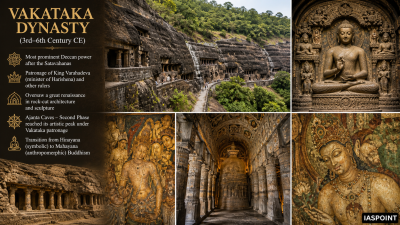
The Vakataka dynasty (3rd–6th century CE) was the most significant power in the Deccan following the Satavahanas. Under the patronage of King Varahadeva (minister of Harishena) and other royal figures, the Vakatakas oversaw a phenomenal renaissance in rock-cut architecture and sculpture. This period is primarily defined by the second phase of Ajanta, where the transition from Hinayana (symbolic) to Mahayana (anthropomorphic) Buddhism reached its artistic peak.
The Ajanta Renaissance: Mahayana Phase
While the early caves at Ajanta date to the Satavahana era, the vast majority of the sculptural work belongs to the Vakataka period (specifically the 5th century CE).
- Shift in Iconography: The Vakataka period introduced the massive Buddha figures in the sanctum sanctorum (Garbhagriha) of the Viharas.
- The Main Buddha Image: Typically depicted in the Pralambapadasana (seated with feet hanging down) or Padmasana, with the hands in Dharmachakra Pravartana Mudra.
- Bodhisattva Cult: Large-scale sculptures of Avalokiteshvara and Vajrapani appear as door guardians (Dvarapalas) to the shrines.
- Narrative Reliefs: The walls and pillars of the later caves (Caves 1, 2, 16, 17, 19, and 26) feature intricate relief carvings of Jataka stories and scenes from the life of Buddha.
Masterpieces of Vakataka Sculpture at Ajanta
The Vakataka artisans moved away from the flat reliefs of the Shunga era toward a profound sense of volume and three-dimensionality.
- The Mahaparinirvana of Buddha (Cave 26): A colossal 7-meter-long reclining Buddha representing his death. The sculpture is flanked by mourning followers below and celestial musicians above, capturing a complex range of human and divine emotions.
- Temptation of Mara (Cave 26): A large relief panel depicting the Buddha’s resistance against the daughters of Mara and his demonic army. It is noted for its dynamic composition and variety of grotesque and beautiful figures.
- Naga King and Queen: Found in Cave 19 (a Chaitya hall), this sculpture shows a Naga deity seated with his consort, demonstrating the integration of local folk deities into the Buddhist pantheon with classic Vakataka grace.
The Vakataka-Gupta Synthesis
The Vakatakas were related to the Imperial Guptas through marriage (Prabhavatigupta, daughter of Chandragupta II, married Rudrasena II). This facilitated a “stylistic crossover” between the North and the Deccan.
- Physicality: Vakataka sculptures are more robust and “earthy” compared to the ethereal, slender Sarnath school.
- Ornate Pillars: Unlike the plain shafts of the Mauryas, Vakataka pillars at Ajanta are highly decorative, featuring fluted shafts, “Purna-ghata” (overflowing vase) capitals, and bracket figures of Salabhanjikas.
- Jewelry and Headdress: Elaborate detailing of “Jata-mukuta” (matted hair crowns) and heavy pearl necklaces (Muktavalas) characterize the figures.
Sculpture Beyond Ajanta: Mansar and Ramtek
While Ajanta is the most famous, the Vakataka heartland in Vidarbha (Maharashtra) has yielded significant standalone sculptures that reveal the dynasty’s Brahmanical (Hindu) leanings.
- Mansar Shiva: An extraordinary sculpture of “Shiva-Gana” or “Shiva-Vamana” (dwarfish Shiva) found near Nagpur. It shows a seated, pot-bellied deity with intricate ornaments, reflecting a unique local aesthetic.
- Trivikrama Vishnu (Ramtek): Life-sized stone images from the Ramtek hill complex showcase the early iconography of the avatars of Vishnu, characterized by powerful, rigid stances and heavy proportions.
- Ganga and Yamuna: The Vakatakas popularized the placement of personified river goddesses at temple entrances, a tradition that became a staple of later Indian temple architecture.
Technical and Stylistic Comparison
| Feature | Hinayana Phase (Satavahana) | Mahayana Phase (Vakataka) |
| Object of Worship | Symbols (Stupa, Footprints) | Human Buddha Image |
| Buddha Pose | Absent | Seated (Dharmachakra/Abhaya Mudras) |
| Relief Depth | Shallow/Low Relief | Bold/High Relief (3D effect) |
| Pillar Style | Simple Octagonal | Elaborately carved with brackets |
| Key Caves | Caves 9, 10 | Caves 1, 16, 17, 19, 26 |
Fact Sheet for UPSC Prelims
- Royal Patronage: King Harishena was the most prominent patron of the later Ajanta caves.
- The Varahadeva Inscription: Found in Cave 16 at Ajanta, it provides the genealogical history of the Vakatakas and credits the minister for the cave’s excavation.
- Material: Primarily Basalt (Deccan Trap) for rock-cut sculptures, which is harder than the sandstone used by the Guptas, requiring superior chiseling skills.
- Secular Life: Sculptures of the Vakataka period are a primary source for understanding 5th-century court life, hairstyles, and costumes.
- Transition to Ellora: The sculptural style of the Vakatakas at Ajanta served as the direct precursor to the Early Kalachuri and Chalukyan styles seen at Ellora and Badami.
- Prabhavatigupta’s Role: As a regent, she brought Gupta craftsmen to the Vakataka court, leading to the “Gupta-Vakataka” style seen at Nagardhan.