
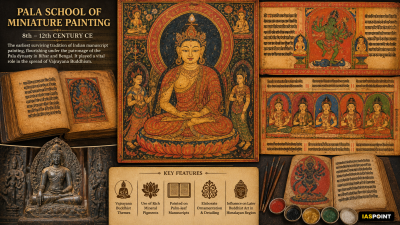
The Pala School of Miniature Painting marks the beginning of the “Early Medieval” phase of Indian art, flourishing between the 8th and 12th centuries CE. Centered in the regions of present-day Bihar and West Bengal, this tradition developed under the direct patronage of the Pala dynasty, particularly during the reigns of Dharmapala and Devapala. It represents the earliest surviving examples of manuscript painting in India and served as a vital vehicle for the propagation of Vajrayana Buddhism.
Technical Specifications: Material and Methodology
The Pala miniatures are synonymous with the transition from large-scale murals to portable, delicate manuscripts.
- Medium (Palm Leaf): The primary substrate was the Tala-patra (Palm leaf). These leaves were dried, boiled, and smoothed before use.
- Physical Format: Manuscripts were typically long and narrow (approx. 22 inches by 2 inches). Holes were bored through the leaves to bind them with a cord, protected by wooden covers called Patlis.
- Pigment Sourcing: Artists used a natural palette comprising Orpiment (yellow), White (lime/kaolin), Indigo (blue), Lampblack (black), and Cinnabar (red).
- Binding Agent: A mixture of gum or resin was used to ensure the pigments adhered to the non-porous palm leaf surface.
Artistic Characteristics and Stylistic Lineage
The Pala School is often described as a “bridge” between the classical mural traditions of Ajanta and the later Western Indian miniature styles.
- Continuity of Ajanta: The figures exhibit the same sinuous lines, rounded forms, and subtle modeling found in Ajanta, albeit on a much smaller scale.
- Sinuous Lineage: The emphasis is on graceful, flowing lines and the use of the Tribhanga (triple-bend) posture to denote movement.
- Symbolism and Iconography: Paintings are highly codified according to Buddhist tantric texts, featuring specific mudras (hand gestures), asanas (postures), and symbolic colors for various deities.
- Composition: Central figures are usually larger, surrounded by smaller attendant figures or scenes from the life of Buddha, following the principle of “hierarchical proportion.”
Key Manuscripts and Themes
The Pala miniatures were primarily used to illustrate Buddhist texts, making them “visual commentaries” for monks and students.
- Astasahasrika Prajnaparamita: The most famous illustrated text, it translates to “The Perfection of Wisdom in Eight Thousand Lines.”
- Pancharaksha: A collection of five protective spells/deities, frequently illustrated for ritual purposes.
- Karandavyuha: A text dedicated to the virtues of Avalokiteshvara.
- Mahamayuri: A tantric text focused on protection against snakebites and poisons.
- Common Themes: Scenes from the “Eight Great Miracles” (Ashtamahapratihara) of Buddha’s life, such as the Birth at Lumbini, Enlightenment at Bodh Gaya, and the Descent from Sankissa.
The Influence of Nalanda and Vikramshila
The Pala School was not just a court art but was deeply rooted in the great Buddhist monastic universities (Mahaviharas).
- Centers of Production: Nalanda, Vikramshila, Odantapuri, and Somapura served as the primary workshops where monk-artists produced these manuscripts.
- Bronze Casting Parallel: The painting style closely mimics the contemporary Pala Bronze Sculpture tradition (notably the works of Dhiman and Vitapala). The painted figures often look like “flat” versions of these bronzes.
- Dissemination: These portable manuscripts were carried by scholars and pilgrims to Nepal, Tibet, and Southeast Asia, directly influencing the development of the Thangka painting tradition in Tibet.
Comparison: Pala School vs. Western Indian School
| Feature | Pala School (Eastern) | Western Indian School (Apabhramsha) |
| Region | Bengal and Bihar. | Gujarat and Rajasthan. |
| Religion | Primarily Vajrayana Buddhism. | Primarily Jainism (Shvetambara). |
| Period | 8th – 12th Century CE. | 11th – 15th Century CE. |
| Stylistic Traits | Rounded forms, graceful, Ajanta-like. | Angular lines, protruding eyes, sharp features. |
| Fate | Ended with the Islamic invasions of 1199 CE. | Evolved into the Rajput and Mughal schools. |
The End of an Era: The Turko-Afghan Invasions
The Pala School came to an abrupt end in the late 12th century.
- Destruction of Viharas: The invasion by Bakhtiyar Khalji in 1199 CE led to the destruction of Nalanda and Vikramshila, effectively ending the institutional support for Pala art.
- The Migration to Nepal and Tibet: Following the collapse of the Pala and Sena dynasties, many artists fled to the Himalayas. Consequently, the Pala style survived and evolved into the Newari art of Nepal and the Monastic styles of Tibet.
Fact-File for UPSC Prelims
- Patron Kings: Specifically Gopala, Dharmapala, and Devapala are credited with fostering this tradition.
- Dhiman and Vitapala: These are the only two artists from the Pala period whose names are recorded in history (by the Tibetan historian Taranatha). They were masters of both casting and painting.
- Patli Paintings: While the palm leaves contain the main text and small miniatures, the wooden covers (Patlis) often feature larger, more elaborate narrative scenes.
- Vajrayana Context: The Pala school is the primary visual record of the transition of Buddhism from a philosophy to a complex tantric religion involving many deities like Tara, Manjushri, and Hevajra.
- Longevity of Material: Despite the humid climate of Bengal, several hundred Pala manuscripts survive today, largely because they were preserved in the cold, dry libraries of Tibetan monasteries.
Legacy in Indian Art History
The Pala School of Miniature Painting is a landmark in the “Democratization of Art.” By moving away from fixed cave walls to portable manuscripts, art became more accessible to individuals and traveling scholars. It represents the final flowering of classical Buddhist art in India before its disappearance from the mainland, ensuring that the aesthetic DNA of the Guptas and Vakatakas was preserved and transmitted to the rest of the Buddhist world.
Last Modified: May 4, 2026