
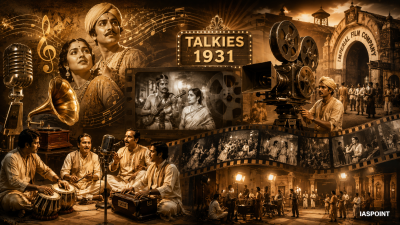
The year 1931 marked a tectonic shift in Indian Art and Culture with the introduction of synchronized sound. This transition was not merely technological but cultural, as it integrated India’s rich oral, musical, and linguistic traditions into the cinematic medium. The introduction of sound necessitated a more organized production method, leading to the “Studio System” era.
The First Talkie: Alam Ara (1931)
Produced by Imperial Movietone and directed by Ardeshir Irani, Alam Ara (The Ornament of the World) premiered on March 14, 1931, at the Majestic Cinema in Bombay.
- Technological Shift: The film used the Tanar Sound System. It was shot mostly at night to avoid the noise of passing trains and city traffic, as soundproofing was non-existent.
- Musical Legacy: It introduced the first film song, “De De Khuda Ke Naam Pe”, sung by W.M. Khan. This established the “Song-and-Dance” formula as a permanent feature of Indian cinema.
- Linguistic Impact: The film used Hindustani (a mix of Hindi and Urdu), which helped cinema reach a pan-Indian audience, transcending regional linguistic barriers.
Regional Pioneers of Sound
Following the success of Alam Ara, regional industries rapidly adopted sound technology to cater to linguistic identities.
| Language | First Talkie Film | Year | Key Personality |
| Bengali | Jamai Sasthi | 1931 | J.F. Madan (Madan Theatres) |
| Telugu | Bhakta Prahlada | 1932 | H.M. Reddy |
| Tamil | Kalidas | 1931 | H.M. Reddy (Produced by Ardeshir Irani) |
| Marathi | Ayodhyecha Raja | 1932 | V. Shantaram (Prabhat Film Co.) |
| Kannada | Sati Sulochana | 1934 | Y.V. Rao |
The Rise of the Studio System (1930s–1940s)
The Studio System in India mirrored the Hollywood model of the time, where a single entity owned the equipment, sets, and kept actors and technicians on a fixed monthly salary. This era is considered the “Golden Age of Disciplined Filmmaking.”
New Theatres (Calcutta)
Founded by B.N. Sircar in 1931, this studio was known for its literary adaptations and high aesthetic values.
- Contribution: It introduced the Playback Singing technique in the film Bhagya Chakra (1935).
- Key Figures: P.C. Barua, K.L. Saigal, and Nitin Bose.
- Notable Film: Devdas (1935), which defined the “tragic hero” archetype.
Prabhat Film Company (Kolhapur/Pune)
Established in 1929 by V. Shantaram, S. Fatelal, and V.G. Damle, it moved to Pune in 1933.
- Significance: Known for technical excellence and socially conscious films.
- Notable Film: Sant Tukaram (1936), the first Indian film to win an award at the Venice International Film Festival.
Bombay Talkies (Malad, Bombay)
Founded in 1934 by Himanshu Rai and Devika Rani, it was the most “international” studio, employing German technicians like Franz Osten.
- Contribution: It acted as a finishing school for future legends like Dilip Kumar, Madhubala, and Raj Kapoor.
- Notable Film: Achhut Kannya (1936), which dealt with the social taboo of untouchability.
Key Characteristics of the Studio Era
- Genre Diversification: Beyond mythologicals, studios explored “Socials” (addressing caste, women’s rights, and poverty), Stunt films (Fearless Nadia), and Historicals.
- In-house Talent: Writers, musicians, and actors were permanent employees, ensuring a distinct “house style” for each studio.
- Technical Standardization: The period saw the refinement of editing, lighting, and the integration of classical music and folk theatre (Parsi Theatre style) into films.
Major Milestones and Trivia for UPSC
Social Impact and Censorship
- Bhakta Vidur (1921): Although a silent film, its impact was felt in the talkie era as the first film to face a ban for its political allegory to Mahatma Gandhi.
- Duniya Na Mane (1937): A Prabhat Film Co. production that challenged the practice of old men marrying young girls.
Evolution of Color
- Sairandhri (1933): V. Shantaram’s attempt at color, processed in Germany, but was not commercially successful.
- Kisan Kanya (1937): Produced by Ardeshir Irani and directed by Moti Gidwani, it is officially recognized as India’s first indigenously made color film (using the Cinecolor process).
International Recognition
- Neecha Nagar (1946): Directed by Chetan Anand, it won the Grand Prix (now Palme d’Or) at the first Cannes Film Festival, highlighting the social realism of Indian cinema.
Transition to the Independent Producer System
By the late 1940s, the Studio System began to collapse due to:
- World War II: Scarcity of film raw stock and rising costs.
- Star System: Leading actors began demanding higher fees, moving away from monthly salaries to per-film contracts.
- Freelancing: Technicians and directors preferred working across different banners rather than being tied to one studio.
This led to the “Star-driven” era, which eventually transformed into the contemporary Indian film industry.
Last Modified: May 7, 2026