
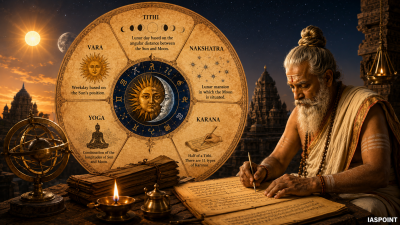
The term Panchangam is derived from the Sanskrit words Pancha (Five) and Anga (Limbs). It refers to the traditional Hindu almanac that serves as a vital tool for time reckoning in India. While a modern calendar focuses solely on dates, a Panchangam integrates astronomical data to determine the quality of time, primarily for religious, social, and agricultural purposes. It synchronizes the movements of the Sun and the Moon to provide a holistic view of the “Five Limbs of Time.”
The Five Limbs (Angas) of Panchangam
Each limb represents a specific astronomical movement or a mathematical relationship between celestial bodies.
1. Vara (Solar Weekday)
Vara refers to the seven-day week, with each day governed by a specific celestial body (Graha).
- Ravivara: Sunday (Sun/Surya)
- Somavara: Monday (Moon/Chandra)
- Mangalavara: Tuesday (Mars/Mangala)
- Budhavara: Wednesday (Mercury/Budha)
- Guruvara: Thursday (Jupiter/Guru)
- Shukravara: Friday (Venus/Shukra)
- Shanivara: Saturday (Saturn/Shani)
2. Tithi (Lunar Day)
Tithi is the duration in which the longitudinal angle between the Moon and the Sun increases by 12°.
- There are 30 Tithis in a lunar month, divided into two fortnights: Shukla Paksha (Waxing) and Krishna Paksha (Waning).
- Unlike a 24-hour civil day, a Tithi’s duration varies from 19 to 26 hours.
- Fact: A festival is traditionally celebrated on the day when the required Tithi prevails at the time of sunrise (Udaya Tithi).
3. Nakshatra (Lunar Mansion)
Nakshatra represents the stellar constellation in which the Moon is positioned.
- The ecliptic is divided into 27 equal segments of 13° 20′ each.
- The Moon traverses approximately one Nakshatra per day.
- Significance: It is the primary limb used for determining the Janma Nakshatra (birth star) and for finding auspicious marriage dates.
4. Yoga (Luni-Solar Relationship)
Yoga is a mathematical sum of the longitudes of the Sun and the Moon.
- The total 360° circle is divided into 27 Yogas, each covering 13° 20′.
- Common Yogas include Siddhi, Shubha, and Vyatipata.
- Purpose: It is used to identify the general “flavor” or auspiciousness of the day for specific activities.
5. Karana (Half a Tithi)
A Karana is equivalent to half of a Tithi (a 6° difference between the Sun and the Moon).
- There are two Karanas in every Tithi, totaling 60 Karanas in a lunar month.
- The system uses 11 unique Karanas: 7 are “movable” (Chara) and 4 are “fixed” (Sthira).
- Movable Karanas: Bava, Balava, Kaulava, Taitila, Gara, Vanija, and Vishti.
- Fixed Karanas: Shakuni, Chatushpada, Naga, and Kimstughna.
Summary Table of the Five Limbs
| Limb | Basis of Calculation | Total Count | Primary Utility |
| Vara | Solar Day | 7 | General planning |
| Tithi | Sun-Moon Angle (12°) | 30 | Religious festivals/Vratas |
| Nakshatra | Moon’s Position in Stars | 27 | Personal astrology/Muhurta |
| Yoga | Sum of Sun & Moon Longitude | 27 | Determining day quality |
| Karana | Half of a Tithi (6°) | 11 | Precise ritual timing |
Astronomical and Cultural Significance
The Panchangam is more than a religious book; it is a complex astronomical manual.
- Regional Variations: There are two main systems—Amanta (month ends on New Moon, common in South India) and Purnimanta (month ends on Full Moon, common in North India).
- Seasonal Alignment: Through the use of the Adhik Masa (Intercalary Month), the Panchangam ensures that lunar months remain aligned with the solar seasons.
- Agricultural Utility: Farmers use the Maha Nakshatras (Rainy mansions) mentioned in the Panchangam to time the sowing and harvesting of crops.
Important Terminologies for Aspirants
- Muhurta: An auspicious window of time calculated using the five limbs. A standard Muhurta is 48 minutes.
- Abhijit Muhurta: A highly auspicious period around local noon, generally considered free from most astrological defects.
- Rahukaal: A specific period of the day (approx. 90 minutes) governed by Rahu, considered inauspicious for starting new ventures.
- Panchak: A period of approximately five days when the Moon stays in the last five Nakshatras (Dhanishta to Revati), often avoided for certain domestic activities.
Fact File: Historical Treatises
- Vedanga Jyotisha: The foundational text for early Panchangam calculations.
- Surya Siddhanta: The most authoritative astronomical text used for modern traditional Panchangams.
- Siddhanta Shiromani: Authored by Bhaskaracharya, it refined the mathematical precision of the five limbs.
- Grahalaghava: A 16th-century manual by Ganesh Daivajna that simplified calculations, still widely used by Panchangam makers today.