
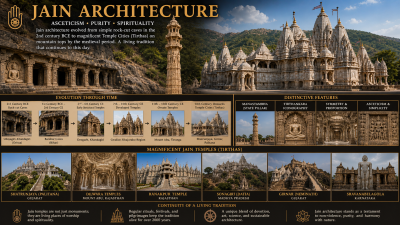
Jain architecture, while sharing aesthetic similarities with Buddhist and Hindu styles, is distinguished by its unique iconographic requirements and emphasis on asceticism, structural purity, and the “Manastambha.” It evolved from simple rock-cut caves in the 2nd century BCE to magnificent “Temple Cities” (Tirthas) on mountain tops by the medieval period. Unlike Buddhist architecture, which declined in India, Jain architectural traditions have remained continuous and functional to the present day.
Core Components and Principles
Jain architecture is governed by the principles of Pratima-vijnana (iconography) and the specific needs of the Digambara and Shvetambara sects.
- Manastambha: A distinctive “Pillar of Honor” erected in front of Jain temples. These are often more ornate than the temple itself, featuring four Tirthankara images at the top facing the cardinal directions.
- Ayagapata: Votive tablets used for offerings, common in early Jain art (Mathura), featuring the Tirthankara image or symbols like the Swastika.
- Chaumukha Design: A unique Jain concept where the sanctum has four openings or four images placed back-to-back, allowing the Tirthankara to be visible from all four cardinal directions.
- Temple Cities: The concept of Tirthas—building large complexes on hills (mountains are considered sacred) to create “Cities of Gods,” such as Palitana or Sammed Shikharji.
Rock-Cut Jain Architecture
The earliest Jain structures were caves intended for the residence of monks (Viharas), characterized by austerity and absence of large congregational halls.
Udayagiri and Khandagiri Caves (Odisha)
- Patronage: King Kharavela of the Mahameghavahana dynasty (2nd Century BCE).
- Features: These are the earliest Jain rock-cut shelters. They are not deep halls like Buddhist Chaityas but small cells with low ceilings.
- Hathigumpha Cave: Contains the famous Brahmi inscription of Kharavela.
- Ranigumpha: A two-storied structure with elaborate friezes depicting Jain mythology and daily life.
Ellora Jain Caves (Maharashtra)
- Chronology: 9th to 10th Century CE (Caves 30–34).
- Indra Sabha (Cave 32): The most famous Jain cave at Ellora. It is a two-storied monolithic shrine with a courtyard containing a free-standing elephant and a monolithic Manastambha.
- Jagannath Sabha (Cave 33): Noted for its fine carvings of the Tirthankaras and the goddess Ambika.
Sittanavasal Caves (Tamil Nadu)
- Significance: A rare 7th-century Jain cave featuring exquisite mural paintings.
- Art: The ceiling paintings depict a “Samavasarana” (the celestial audience hall of a Tirthankara) with a lotus pond, monks, and animals.
Structural Jain Temples
As the community grew wealthy through trade, Jain architecture transitioned into grand structural temples, primarily in the Nagara style (North India) and later the Maru-Gurjara style.
The Dilwara Temples (Mount Abu, Rajasthan)
- Period: 11th to 13th Century CE.
- Material: Exclusively white marble, brought from Makrana.
- Vimal Vasahi Temple: Dedicated to Lord Rishabhdev; famous for its circular ceiling with 16 “Vidyadevis” (Goddesses of Knowledge).
- Luna Vasahi Temple: Dedicated to Lord Neminath; renowned for its “pendant” lotus carvings in the dome, which are carved so thinly they are translucent.
Maru-Gurjara Style (Solanki Style)
This style is characterized by the absence of mortar, the use of interlocking stones, and incredibly dense ornamentation.
- Ranakpur Temple (Rajasthan): Dedicated to Adinatha. It is a “Chaumukha” temple featuring 1,444 uniquely carved pillars, no two of which are identical.
- Palitana Temple Complex (Gujarat): Located on Shatrunjaya Hill, it consists of over 800 temples. It is considered the most sacred Shvetambara pilgrimage site.
Jain Architecture in South India
In the Deccan and further south, Jain architecture adopted Dravidian elements, particularly under the Western Gangas and Hoysalas.
- Shravanabelagola (Karnataka): Home to the Statue of Gommateshwara (Bahubali).
- Fact: Carved out of a single block of granite in 981 CE under the patronage of Chavundaraya (minister of Ganga King Rajamalla).
- Record: It is one of the tallest free-standing monolithic statues in the world (approx. 57 feet).
- Basadis: The term for Jain temples in Karnataka.
- Saavira Kambada Basadi (Moodabidri): Known as the “1000 Pillar Temple,” showing a fusion of indigenous and Vijayanagara styles.
Comparison of Sectarian Architectural Influence
| Feature | Digambara Architecture | Shvetambara Architecture |
| Idol Representation | Unadorned, “Digambara” (sky-clad), meditative downcast eyes. | Adorned with jewelry and glass eyes (Angi decoration). |
| Temple Layout | Often simpler, focus on the monolithic Manastambha. | Complex “Temple Cities,” heavy use of marble and intricate domes. |
| Major Sites | Shravanabelagola, Khajuraho (Parsvanath). | Dilwara, Palitana, Ranakpur. |
Significant Jain Sites and Facts for UPSC
- Khajuraho (Madhya Pradesh): Contains a group of Jain temples (Parsvanath, Adinath) built by the Chandelas. They are stylistically identical to the Hindu temples there but lack erotic sculptures.
- Deogarh (Uttar Pradesh): A major center for early medieval Jain art with numerous “Manastambhas.”
- Karkala and Venur: Known for monolithic statues of Bahubali, similar to Shravanabelagola but smaller in scale.
- Jain Bronze Images: The Akota Bronzes (Gujarat) and Chausa Bronzes (Bihar) represent the sophisticated metallurgical traditions of Jain craftsmen during the Gupta and post-Gupta periods.
Key Trivia for Prelims
- First Tirthankara: Adinatha (Rishabhdev) is the most frequent subject of early Jain structural temples.
- The 24th Tirthankara: Mahavira is often depicted with his lion symbol in the pedestal.
- Symbolism: Jain temples often feature the “Ashtamangala” (eight auspicious symbols), which include the Swastika, Shrivatsa, and Kalasha.
- Samavasarana: Many Jain temple ceilings are designed to represent the Samavasarana, the divine preaching hall of a Tirthankara.