
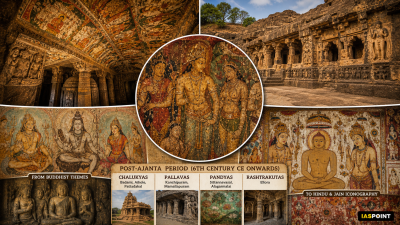
The period following the decline of the Vakataka dynasty and the completion of the Ajanta murals (6th century CE onwards) did not mark the end of Indian mural traditions, but rather their diversification. As the Gupta influence waned, regional dynasties such as the Chalukyas, Pallavas, Pandyas, and Rashtrakutas patronized distinct artistic styles. This era is characterized by a transition from the purely Buddhist themes of Ajanta to a more inclusive repertoire featuring Brahmanical (Hindu) and Jain iconography.
Bagh Caves: The Closest Successor to Ajanta
Located on the banks of the Baghini River in the Dhar district of Madhya Pradesh, the Bagh Caves represent the immediate chronological and stylistic extension of the Ajanta tradition.
- Chronology and Patronage: Developed during the 5th–6th century CE, likely under the patronage of the Guptas or local Vakataka feudatories.
- Thematic Focus: Unlike Ajanta’s meditative focus, Bagh murals are more secular and “joyous” in nature. They depict contemporary social life, including the famous “Hallisaka” (a group dance performance).
- Technical Variance: The plaster at Bagh was more fragile than Ajanta’s, leading to significant degradation. The style is more materialistic, with a greater emphasis on the modeling of figures.
- Key Masterpiece: The “Rang Mahal” (Cave 4) features a large mural of a procession with elephants and horses, showcasing the grandeur of the era.
Badami Cave Paintings: The Chalukyan Splendor
The Badami caves in Karnataka serve as the earliest evidence of Brahmanical (Hindu) mural paintings in India.
- Historical Context: Executed under the patronage of the Early Chalukyas, specifically King Mangalesha (son of Pulakeshin I), in the late 6th century CE.
- Key Cave: Cave 4 (a Vaishnava cave) contains the most significant remnants of these murals.
- Thematic Elements: Depictions of Lord Vishnu, the palace scene of Kirtivarman, and Indra with his consort.
- Stylistic Features: The figures exhibit “fluidity of line” and elongated eyes, bearing a strong resemblance to the late Mahayana style of Ajanta but adapted for Hindu themes.
Sittanavasal: The Jain Mural Tradition
Sittanavasal in the Pudukkottai district of Tamil Nadu is the premier site for Jain rock-cut architecture and painting in South India.
- Patronage: Originally attributed to the Pallavas, recent scholarship suggests the murals were extensively renovated or created under the Pandyan King Avanipasekhara (9th century CE).
- Key Masterpiece: The ceiling of the Verandah depicts a “Lotus Pond” (Samavasarana), a celestial audience hall in Jainism.
- Distinctive Motifs: The pond is shown with monks gathering lotuses, surrounded by buffaloes, elephants, fish, and birds. The famous “Dancing Apsara” of Sittanavasal is noted for its rhythmic movement and expressive eyes.
- Technical Detail: These are “Fresco-secco” paintings applied over a thin lime-plastered surface on the rock.
Comparison of Major Post-Ajanta Mural Sites
| Site | Location | Primary Religion | Key Dynasty | Unique Feature |
|---|---|---|---|---|
| Bagh | Madhya Pradesh | Buddhist | Gupta/Vakataka | Secular themes; Hallisaka dance. |
| Badami | Karnataka | Brahmanical (Hindu) | Early Chalukyas | Earliest Hindu cave murals. |
| Sittanavasal | Tamil Nadu | Jain | Pandyas/Pallavas | Lotus Pond motif; Jain cosmology. |
| Armamalai | Tamil Nadu | Jain | Pandyas | Located in a natural cave; depictions of Astadikpalas. |
| Ellora | Maharashtra | Hindu/Jain/Buddhist | Rashtrakutas | Linear outlines; sharp facial features. |
Export to Sheets
The Mural Tradition at Ellora (Kailashnath Temple)
While Ellora is world-renowned for its monolithic architecture, its paintings represent a significant stylistic departure.
- Chronology: Primarily 8th to 10th century CE under the Rashtrakutas.
- Stylistic Shift: Ellora murals introduce a “Angular Style.” Unlike the rounded, voluminous figures of Ajanta, Ellora figures feature sharp noses, protruding eyes, and more rigid outlines.
- Thematic Reach: Painted in multiple layers. The most famous murals are found in the Kailashnath Temple (Cave 16) and the Jain caves (Indra Sabha), depicting battles, processions, and the flight of Vidhyadharas.
Pallava and Chola Contributions: Panamalai and Tanjore
As the mural tradition moved further south, it became deeply integrated into temple architecture.
- Panamalai (Pallava): The Talagirishwara temple features a 7th-century mural of Goddess Parvati, noted for its delicate shading and the use of the Tribhanga pose.
- Brihadisvara Temple (Chola): Located in Thanjavur (11th century), these murals were discovered beneath a later layer of Nayaka paintings.
- Thematic Focus: Lord Shiva as Tripurantaka and the story of Saint Sundarar.
- Evolution: Chola murals represent the zenith of medieval South Indian painting, characterized by grand scale and high narrative intensity.
Fact-File for UPSC Prelims
- Lepakshi (Andhra Pradesh): A late medieval (Vijayanagara) mural site famous for its “hanging pillar” and the largest mural of Virabhadra in India.
- The “Angular Style”: The sharp features observed at Ellora and later Jain manuscripts are often cited as the precursors to the Western Indian School of Miniature Painting.
- Discovery of Sittanavasal: Often associated with the efforts of French researcher G. Jouveau-Dubreuil.
- Fragmentation: Unlike the contiguous narratives of Ajanta, post-Ajanta murals are often fragmentary due to the nature of the rock surfaces and centuries of weathering.
- Pigment Transition: While natural earth colors remained dominant, there was an increasing use of brighter palettes in the later Chola and Vijayanagara periods compared to the sober tones of early murals.
Summary of Stylistic Transition
The transition from Ajanta to the Post-Ajanta period signifies a move from Classicist Naturalism (rounded forms, subtle shading) to Medieval Linearism (sharp edges, stylized features). This evolution provided the technical and aesthetic bridge to the later era of Indian Miniatures, where the grand scale of the cave wall was condensed onto the delicate surfaces of palm leaves and paper.
Last Modified: May 4, 2026