
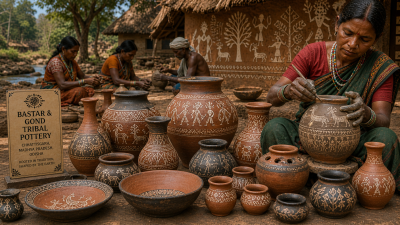
The tribal regions of Bastar (Chhattisgarh) and the Gond belts (Madhya Pradesh and Odisha) represent a primary locus of India’s indigenous ceramic heritage. In these societies, pottery is not merely a utilitarian craft but a sacred medium connecting the community to the “Bhum” (Earth). This tradition is primarily upheld by the Kumhar community, who work in close cultural synergy with the Gond and Maria tribes. The pottery of this region is characterized by its “Earthenware” nature, utilizing local silt and clay from the Indravati and Mahanadi tributaries.
Ritualistic Significance: The Terrakotta of the Gods
In Bastar and Gond cultures, clay figures serve as votive offerings. Unlike urban pottery, these items are often “sacrificed” or placed under sacred groves (Sarnas) to appease local deities and ancestral spirits.
- Votive Animals: Clay horses, elephants, and tigers are the most common offerings. These are believed to be the “Vahanas” (vehicles) for the spirits that protect the village boundaries.
- Aama Thali: Specialized ritual plates used during harvest festivals to offer the first grains to the Earth goddess.
- Memorial Pillars: In certain Maria Gond traditions, clay is used to supplement stone in creating memorial structures for the deceased, often decorated with motifs of the sun, moon, and agricultural life.
Technical Process and Raw Materials
The tribal pottery of Central India relies on ancient techniques that pre-date modern kilns and synthetic glazes.
- Clay Preparation: The soil is sourced from local termite mounds or riverbeds, believed to have superior binding properties. It is tempered with rice husk and ash to prevent cracking during firing.
- Hand-Modeling and Wheel Work: While the base of larger pots is thrown on a stone wheel, the intricate ornamentation and animal figures are entirely hand-modeled using the pinch and coil method.
- The Sgraffito Technique: Artisans use sharp bamboo splints to incise patterns onto the wet clay, a hallmark of Gond aesthetic expression.
- Open Pit Firing (Bhatti): The pottery is stacked in a circular pit, covered with layers of straw, dung, and leaves, and fired for 12–15 hours. The lack of a chimney creates a localized reduction atmosphere, often resulting in unique smoky patches on the red surface.
Distinctive Motifs and Design Elements
The iconography of Bastar and Gond pottery is deeply symbolic, reflecting the Animistic belief systems of the tribes.
- Nature Spirits: Recurrent motifs of the Mahua tree, snakes, and stylized birds.
- Tribal Life: Scenes of dancing (Bison Horn Maria dance), hunting, and communal gathering are often incised on the shoulders of large storage jars.
- Geometric Patterns: Triangles representing hills and wavy lines representing the Indravati river are ubiquitous.
Comparative Overview: Bastar Pottery vs. Gond Ceramic Styles
| Feature | Bastar Tribal Pottery | Gond Regional Pottery |
| Primary Focus | Votive figures and ritual icons. | Large storage vessels and decorative tiles. |
| Common Motif | The Horse and the Elephant. | The Tree of Life and birds. |
| Texture | Rough, rustic, and unglazed. | Smoother, often featuring white clay (Khadi) wash. |
| Geographic Hub | Kondagaon and Jagdalpur. | Mandla, Dindori, and Jhabua. |
| Dominant Tribe | Maria, Muria, and Bhatra. | Gond and Baiga. |
Functional Varieties of Tribal Ware
Tribal pottery is designed for the specific climatic and dietary needs of the region.
- Handia: A specialized vessel with a narrow neck used for fermenting “Handia” (rice beer), a staple in tribal social and religious life.
- Dohri: Large, double-layered storage jars used to keep grains safe from pests and moisture.
- Jhari: A water pitcher with a long spout, often modeled in the shape of a bird, used for ceremonial pouring of water or liquor.
Socio-Economic Impact and Modern Adaptation
While the ritualistic use of clay remains intact, tribal pottery has transitioned into the contemporary art market through various government interventions.
- Craft Clusters: The town of Kondagaon in Bastar has emerged as a major hub, often referred to as the “Shilpgram” of Chhattisgarh.
- TRIFED and Tribes India: These organizations provide a platform for tribal potters to sell decorative items like lamps, wall hangings, and masks to urban consumers.
- Eco-Tourism: The “Anthropological Circuit” of Chhattisgarh promotes visits to potter hamlets, providing direct revenue to the Kumhar and Gond artisans.
Key Factoids for UPSC Prelims
- The Bison Horn Motif: Often found on clay masks and vessels in Bastar, representing the Bison Horn Maria tribe’s traditional headgear.
- Kondagaon: Recognized as the “Craft Capital” of Bastar, famous for both Terracotta and Bell Metal (Dhokra) art.
- Gadhwa and Kumhar Synergy: There is a unique overlap where clay models are used as cores for the “Lost Wax” casting process in Dhokra metalwork.
- Terracotta Temples: While the region is famous for tribal art, the influence of temple architecture is seen in the clay “Shikharas” made by potters for local shrines.
- Natural Pigments: Tribal potters rarely use synthetic colors; the red comes from high iron oxide in the soil, and the black comes from localized smoking in the pit.
Current Challenges and Conservation
The tradition faces threats from the influx of cheap aluminum and plastic utensils in tribal haats (markets). Additionally, the displacement of tribes from forest lands has led to a scarcity of traditional clay sources and firewood for kilns. To combat this, the Chhattisgarh State Handloom and Handicraft Development Federation is introducing Electric Wheels and Improved Up-draught Kilns to increase productivity without compromising the tribal aesthetic.
Last Modified: May 5, 2026