
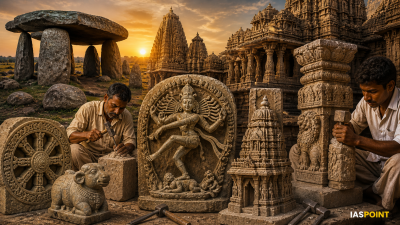
The tradition of stone handicrafts in India reflects a continuous journey from the megalithic structures of the Neolithic age to the sophisticated architectural marvels of the medieval period. Stone craft in India is not merely an artistic endeavor but a repository of geological knowledge and spiritual expression.
Major Techniques in Stone Crafting
Indian artisans employ various techniques to manipulate stone, ranging from soft soapstone to hard granite and marble.
- Pietra Dura (Parchin Kari): An architectural technique involving the inlay of cut, polished, colored stones (such as lapis lazuli, jade, and jasper) into white marble. This reached its zenith during the Mughal era, most notably in the Taj Mahal.
- Jali Work (Lattice Work): The art of carving intricate, perforated geometric or floral patterns into stone slabs. It serves both aesthetic and functional purposes, providing ventilation and filtered light.
- Bas-relief and High-relief: Techniques where figures are carved into a flat stone surface. Bas-relief (low relief) is common in Sanchi Stupa, while High-relief is prominent in the Khajuraho temples.
- Turning: Used for soapstone and soft stones to create circular objects like bowls, vases, and candle holders.
Regional Specializations and Key Clusters
Stone craft is heavily dependent on the local availability of lithic resources, leading to distinct regional styles.
| Region/State | Type of Stone | Famous Craft/Technique | Key Features |
| Agra (Uttar Pradesh) | Marble | Pietra Dura & Jali | Miniature replicas of the Taj Mahal and decorative inlay plates. |
| Odisha (Puri/Konark) | Sandstone & Soapstone | Temple Carvings | Based on the Kalinga school of architecture; intricate religious figurines. |
| Rajasthan (Makrana) | White Marble | Architectural Carving | Use of high-quality metamorphic marble for idols and flooring. |
| Tamil Nadu (Mamallapuram) | Granite | Monolithic Sculpture | Derived from Pallava art; known for large-scale granite carvings. |
| Karnataka (Hampi/Halebidu) | Soapstone (Chloritic Schist) | Intricate Hoysala Style | Extremely fine, jewelry-like details on temple walls and pillars. |
| Bihar (Gaya) | Black Stone | Patharkatti Craft | Use of black stone (Kasauti) for Buddhist and Hindu deities. |
Architectural Schools and Stone Usage
The evolution of stone handicrafts is intrinsically linked to the major temple-building styles of ancient India.
- The Nagara School: Predominantly used sandstone and pink stone in Northern India (e.g., Sun Temple, Konark).
- The Dravidian School: Primarily utilized granite and hard volcanic rocks in South India (e.g., Brihadisvara Temple, Thanjavur).
- The Vesara School: A hybrid style that often utilized soft soapstone, allowing for the minute carvings seen in Belur and Halebidu.
Geographical Indications (GI) in Stone Handicrafts
The GI tag protects the traditional authenticity of stone-based products associated with specific geographic origins.
- Varanasi Soft Stone Jali Work (UP): Known for delicate carving on “Gorara” stone (a type of pyrophyllite).
- Mahabalipuram Stone Sculpture (Tamil Nadu): Recognized for the continuity of the 7th-century Pallava stone-cutting traditions.
- Durgi Stone Carvings (Andhra Pradesh): Utilizes local soft limestone to create intricate decorative pieces.
- Patharkatti Stone Craft (Bihar): Specialized in the use of dark blue/black stone for carving high-quality Buddhist icons.
Miscellaneous Stone Crafts of India
- Shazar Stone (Banda, UP): A unique variety of Agate stone found in the Ken River, featuring moss-like or tree-like internal patterns (dendrites) formed by mineral deposits.
- Stone Pottery of Manipur: Found in Longpi, this craft uses a mixture of black serpentine stone and clay to create functional, heat-resistant cookware.
- Soapstone Carvings of Bastar: Tribal artisans in Chhattisgarh carve soapstone to depict local deities and daily life scenes.
Facts and Trivia for UPSC Aspirants
- The Ashokan Pillars: Represent the earliest examples of polished stone craft in India, made from monolithic Chunar sandstone. The “Mauryan Polish” remains a metallurgical mystery.
- The Iron Pillar of Delhi: While metallic, its stone pedestal and context within the Qutub Complex highlight the integration of stone and metal crafts in the Gupta period.
- Rock-cut Architecture: The Ellora Caves represent one of the largest monolithic rock-cut monastery-temple complexes in the world, carved vertically from the Sahyadri basaltic hills.
- Makrana Marble: This stone was used for the Taj Mahal and is globally recognized as a “Global Heritage Stone Resource” by the International Union of Geological Sciences.
Institutional Framework for Preservation
The Government of India promotes stone handicrafts through various initiatives aimed at skill modernization and market access.
- Centre for Development of Stones (CDOS): An autonomous organization in Rajasthan dedicated to the development of the stone industry.
- Ambedkar Hastshilp Vikas Yojana: Provides cluster-based support for stone carvers in Odisha and Uttar Pradesh for technology up-gradation.
- Export Promotion Council for Handicrafts (EPCH): Facilitates the global export of stone-based decorative items, which contribute significantly to India’s foreign exchange earnings.