

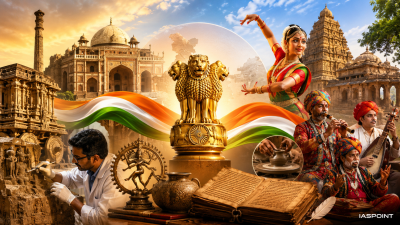
The Ministry of Culture is the nodal agency in India responsible for the preservation, promotion, and dissemination of the nation’s rich cultural heritage. Its mandate covers both tangible heritage (monuments, archaeology) and intangible heritage (performing arts, oral traditions, and literature).
Attached Offices: Executive Pillars
Attached offices are responsible for implementing the policies of the Ministry and providing executive direction.
Archaeological Survey of India (ASI)
- Established: 1861 by Sir Alexander Cunningham (first Director-General).
- Mandate: Prime organization for archaeological research and protection of cultural heritage.
- Legal Framework: Operates under the Ancient Monuments and Archaeological Sites and Remains (AMASR) Act, 1958 and the Antiquities and Art Treasures Act, 1972.
- Key Functions: Maintenance of over 3,600 centrally protected monuments, underwater archaeology, epigraphy research, and managing site museums.
- Trivia: The ASI’s headquarters in New Delhi is known as Dharohar Bhawan.
National Archives of India (NAI)
- Established: 1891 (as Imperial Record Department) in Calcutta; shifted to New Delhi in 1911.
- Role: Repository of non-current records of the Government of India for use by administrators and scholars.
- Holdings: Records dating back to 1748 in languages including English, Arabic, Persian, Sanskrit, and Urdu.
- Digital Initiative: The Abhilekh-Patal portal provides online access to digitized records.
Subordinate Offices: Specialized Institutions
Subordinate offices function as field establishments or specialized agencies responsible for detailed execution.
| Institution | Location | Key Fact |
| Anthropological Survey of India (AnSI) | Kolkata | World’s only anthropological research unit within a government setup (Est. 1945). |
| National Museum | New Delhi | Houses over 2 lakh artifacts spanning 5,000 years, including Harappan relics. |
| National Gallery of Modern Art (NGMA) | New Delhi | Premier institution for modern Indian art (since 1850); housed in Jaipur House. |
| National Library | Kolkata | Largest library in India; designated to receive a copy of every publication in India. |
| National Research Laboratory for Conservation (NRLC) | Lucknow | Provides technical assistance and research for conserving cultural property. |
Autonomous Bodies: The Three Akademies and Beyond
Autonomous bodies are funded by the Ministry but operate independently to foster creativity and specialized research.
The Three National Akademies
- Sangeet Natak Akademi (1953): National academy for music, dance, and drama. It confers the prestigious ‘Akademi Ratna’ and ‘Akademi Puraskar’.
- Sahitya Akademi (1954): Dedicated to the promotion of literature in 24 languages (22 Scheduled languages + English and Rajasthani).
- Lalit Kala Akademi (1954): National Academy of Art focused on visual arts like painting, sculpture, and graphics.
Research and Resource Centers
- Indira Gandhi National Centre for the Arts (IGNCA): Established in 1987 as a center for research, academic pursuit, and dissemination in the field of the arts.
- Centre for Cultural Resources and Training (CCRT): Focuses on linking education with culture; provides training to school teachers to integrate cultural education.
- National School of Drama (NSD): One of the foremost theatre training institutions in the world.
Statutory Bodies and Zonal Centers
- National Monuments Authority (NMA): Established under the AMASR (Amendment and Validation) Act, 2010. It manages the “prohibited” (100m) and “regulated” (200m) areas around centrally protected monuments.
- Zonal Cultural Centres (ZCCs): Seven centers (Patiala, Udaipur, Thanjavur, Kolkata, Allahabad, Dimapur, and Nagpur) established to promote regional cultures and “Ek Bharat Shreshtha Bharat.”
Facts for UPSC Prelims
- Intangible Cultural Heritage: The Ministry of Culture is the nodal agency for nominating elements to the UNESCO Representative List of the Intangible Cultural Heritage of Humanity (e.g., Durga Puja, Yoga, Vedic Chanting).
- National Mission for Manuscripts (NMM): Launched in 2003 to survey, catalog, and preserve India’s vast manuscript wealth (estimated at 10 million).
- Museum Reform: The Ministry recently launched the Jatan software to create a digital inventory of all artifacts in Indian museums.
- Trivia: The National Library of India in Kolkata was formerly the Imperial Library, and its origins trace back to the Calcutta Public Library (1836).