
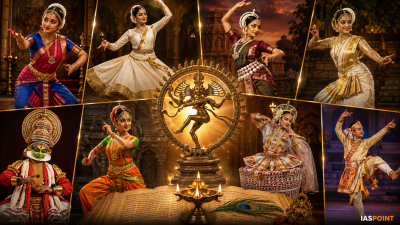
Indian classical dances are governed by the principles of the Natya Shastra and are recognized by the Sangeet Natak Akademi (India’s National Academy for Music, Dance, and Drama). While the Ministry of Culture occasionally includes Chhau in this list, the Akademi officially recognizes eight distinct forms. These dances are characterized by their spiritual connection, rigorous technical grammar, and the use of the Navarasa (nine emotions).
1. Bharatanatyam (Tamil Nadu)
Considered the oldest classical dance form, it was formerly known as Sadir or Dasi Attam as it was performed by Devadasis in temples.
- Key Features: It is characterized by the Fire Dance element (symbolizing the metaphysical manifestation of fire in the human body). It emphasizes the Ekaharya style, where one dancer plays many roles.
- Technical Elements: Focuses on the Abhinaya Darpana and features the Araimandi (half-sitting) posture.
- Sequence: Alarippu (invocation), Jatiswaram (pure dance), Shabdam (expression), Varnam (the core/longest part), Padam, and Tillana (finale).
- Proponents: Rukmini Devi Arundale (revived it), Padma Subrahmanyam, Tanjore Quartette.
2. Kathak (Uttar Pradesh/North India)
The name is derived from the word Kathakar (storyteller). It evolved from a temple dance to a courtly art form during the Mughal era.
- Key Features: It is the only classical dance associated with Hindustani music. It is famous for intricate footwork (Tatkar), lightning-fast spins (Chakkars), and the absence of any exaggerated knee-bending.
- Gharanas: Lucknow (emphasis on expression), Jaipur (emphasis on technical footwork), and Benaras.
- Technical Elements: Jugalbanti (competitive play between the dancer and the tabla player) and Gat Nikas (graceful gait).
- Proponents: Birju Maharaj, Lacchu Maharaj, Sitara Devi.
3. Kathakali (Kerala)
A “story-play” characterized by high drama, elaborate costumes, and vibrant face masks. It is traditionally performed by men.
- Key Features: It symbolizes the element of Sky/Ether. The dance depicts the conflict between good and evil, drawing themes from the Ramayana and Mahabharata.
- Make-up (Vesham): Different colors represent character types: Pacha (Green) for noble protagonists, Kathi (Knife) for royalty with evil streaks, and Thadi (Beard) where Red represents evil and White represents pious characters (like Hanuman).
- Technical Elements: It relies heavily on Netra Abhinaya (eye movements) and hand gestures (Hastas).
- Proponents: Kalamandalam Gopi, V.N. Menon (revived it via Kerala Kalamandalam).
4. Kuchipudi (Andhra Pradesh)
Originally a dance-drama performed by groups of Brahmin men (Bhagavatulu), it evolved into a solo form in the 20th century.
- Key Features: It symbolizes the element of Earth. It is unique for its combination of speech, singing, and dance.
- Special Sequences: Tarangam (dancing on the edges of a brass plate) and Jala Chitra Nrityam (drawing pictures on the floor with toes while dancing).
- Technical Elements: Features the Manduka Shabdam (story of the frog king) and Bhamakalapam (story of Satyabhama).
- Proponents: Vempati Chinna Satyam, Raja and Radha Reddy.
5. Odissi (Odisha)
Derived from the Odra-Magadhi style mentioned in the Natya Shastra, it was historically performed by Maharis (temple servants).
- Key Features: It symbolizes the element of Water. It is characterized by the Tribhanga posture (three-fold bending of the body at the neck, waist, and knee) and the Chowk (square posture).
- Themes: Primarily focuses on the Gita Govinda of Jayadeva and the love of Radha-Krishna.
- Sequence: Mangalacharan (invocation), Batu Nritya (pure dance), Pallavi, and Moksha (salvation).
- Proponents: Kelucharan Mohapatra (credited with its revival), Sonal Mansingh.
6. Kathak (Sattriya – Assam)
Introduced by the great Vaishnava saint Srimanta Sankaradeva in the 15th century CE as a means of propagating the Bhakti movement.
- Key Features: It is performed in Sattras (monasteries). It was recognized as a classical dance as recently as 2000.
- Styles: Includes Gayan-Bhayan (singing and playing drums) and Ankiya Nat (one-act plays).
- Technical Elements: Performers wear traditional Assamese silk (Muga silk) and the dance is accompanied by Borgeets and instruments like the Khol and Cymbals.
- Proponents: Srimanta Sankaradeva, Sharodi Saikia.
7. Manipuri (Manipur)
Distinct from other forms, it is a lyrical dance that avoids harsh movements or sharp angles, emphasizing fluid, serpentine motions.
- Key Features: It symbolizes the element of Space/Wind. The focus is on the Raslila (the cosmic dance of Krishna and the Gopis).
- Technical Elements: The dancer wears a stiff, barrel-shaped skirt called a Kumil. It features the Pung Cholom (drum dance) where the dancer plays the drum while performing.
- Styles: Includes the Sankirtana (devotional singing and dancing, inscribed in UNESCO’s Intangible Cultural Heritage list).
- Proponents: Guru Bipin Singh, Jhaveri Sisters (Nayana, Ranjana, Suverna, Darshana).
8. Mohiniyattam (Kerala)
The “Dance of the Enchantress,” referring to the Mohini avatar of Lord Vishnu. It is a solo feminine dance.
- Key Features: It symbolizes the element of Air. It is known for its graceful, swaying movements that mimic the palm trees and the backwaters of Kerala.
- Costume: Distinguished by the white or off-white sari with a prominent gold-colored border (Kasavu).
- Technical Elements: It follows the Lasya style (graceful and elegant) exclusively. It uses the Atavakul or Atavus (basic dance steps).
- Proponents: Sunanda Nair, Kalamandalam Kalyanikutty Amma (the “Mother of Mohiniyattam”).
Comparative Fact Sheet of Classical Dances
| Dance Form | State | Primary Element | Main Treatise / Influence |
| Bharatanatyam | Tamil Nadu | Fire | Natya Shastra, Abhinaya Darpana |
| Kathak | North India | – | Hindustani Music, Persian Influence |
| Kathakali | Kerala | Sky (Ether) | Epic Narratives (Itihasa) |
| Kuchipudi | Andhra Pradesh | Earth | Bhagavat Purana |
| Odissi | Odisha | Water | Natya Shastra, Odra-Magadhi |
| Sattriya | Assam | – | Bhakti Movement, Ankiya Nat |
| Manipuri | Manipur | Space | Vaishnavism, Raslila |
| Mohiniyattam | Kerala | Air | Vishnu’s Mohini Avatar |
UPSC Prelims Trivia
- The Ninth Dance: While the Sangeet Natak Akademi recognizes eight, the Ministry of Culture recognizes Chhau (a tribal martial dance of Odisha, WB, and Jharkhand) as the ninth classical dance.
- UNESCO Connection: Both Kathakali and Sankirtana (a component of Manipuri) are part of the UNESCO Representative List of the Intangible Cultural Heritage of Humanity.
- Commonalities: All eight forms utilize the Mudra system (hand gestures) and the Ghungroo (ankle bells), though the weight and number of bells vary by style.
- Revivalists: The 1930s saw a massive “Classical Revival” where dance was moved from temples to the proscenium stage to counter colonial stigma. Key figures include E. Krishna Iyer (Bharatanatyam) and V.N. Menon (Kathakali).