
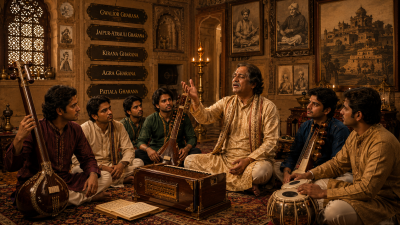
The Gharana system is a unique socio-cultural organization in Indian Classical Music (Hindustani branch) where a specific lineage of learners adheres to a particular musical style. Derived from the Hindi word ‘Ghar’ (House), it signifies a family of musicians or a “school” of thought. This system gained prominence after the fall of the Mughal Empire when musicians migrated to princely states like Gwalior, Jaipur, and Baroda, developing localized stylistic identities.
Characteristics of a Musical Gharana
A tradition must typically satisfy three criteria to be recognized as a Gharana:
- Vansha (Lineage): A minimum of three generations of established disciples or family members.
- Gayaki (Style): A distinct method of rendering notes (swaras), rhythm (laya), and ornamentation (harkat).
- Innovation: The introduction of unique compositions (Bandish) or interpretation of Ragas that differentiates it from others.
Major Gharanas of Hindustani Vocal Music (Khayal)
The Khayal style is the primary vehicle for the Gharana system. Each school is distinguished by its emphasis on melody, rhythm, or emotional depth.
| Gharana | Founder/Key Proponents | Distinctive Features |
| Gwalior Gharana | Nanthan Khan, Hassu Khan, Haddu Khan | The oldest Gharana; emphasizes simplicity, use of Akara (singing with ‘Ah’ sound), and straight-forward Raga elaboration. |
| Agra Gharana | Haji Sujan Khan, Faiyaz Khan | Known as the ‘Rangeela’ Gharana; emphasizes Nom-Tom Alap (Dhrupad influence) and powerful, masculine voice culture. |
| Kirana Gharana | Abdul Karim Khan, Abdul Wahid Khan | Focuses on Swara (melody) and emotional intensity; famous for extreme slow-tempo (Vilambit) singing. |
| Jaipur-Atrauli | Alladiya Khan | Known for complex, rare Ragas (Aprachalit Ragas) and a continuous, wavy pattern of notes without breaks. |
| Patiala Gharana | Bade Ghulam Ali Khan | Incorporates intricate Taan patterns and influences from Punjabi folk and Thumri. |
| Mewati Gharana | Ghagge Nazir Khan (Popularized by Pt. Jasraj) | Focuses on the spiritual and devotional aspect of music; emphasizes clarity of lyrics. |
Instrumental Gharanas (Senia and Others)
Instrumental traditions often trace their roots back to Tansen, the legendary musician in Akbar’s court. These are generally classified based on the instrument played.
The Senia Tradition
Named after Mian Tansen, this lineage is divided into two main branches:
- Rababiyahs: Descendants of Tansen’s son, Bilas Khan (players of the Rabab).
- Binkars: Descendants of Tansen’s daughter, Saraswati Devi (players of the Veena).
Table of Major Instrumental Gharanas
- Etawah (Imdadkhani) Gharana: Founded by Imdad Khan; the most prominent Gharana for Sitar and Surbahar, focusing on the Gayaki Ang (vocal style on strings).
- Maihar Gharana: Founded by Allauddin Khan; associated with Pt. Ravi Shankar (Sitar) and Ali Akbar Khan (Sarod). It is known for its structural discipline.
- Farrukhabad Gharana: A prominent Tabla Gharana founded by Haji Vilayat Ali Khan, known for its poetic and delicate strokes.
- Benaras Tabla Gharana: Developed by Pt. Ram Sahai; characterized by a powerful sound capable of accompanying both vocal and Kathak dance.
Instrumental Specializations and Lineages
Sarod Gharanas
- Shahjahanpur Gharana: Traces its roots to Afghan soldiers who brought the Rabab to India.
- Lucknow/Gwalior Sarod: Heavily influenced by the Dhrupad style of singing.
Sitar Gharanas
- Indore Gharana: Founded by Ustad Amir Khan; though primarily vocal, it influenced Sitar through the “Beenkar” style.
- Bishnupur Gharana: The only major Gharana from Bengal, it maintained a strict adherence to the Dhrupad tradition even in Sitar.
The Role of Institutionalization vs. Tradition
Historically, the Gharana system relied on the Guru-Shishya Parampara, an oral tradition where knowledge was passed in a residential setting. However, in the 20th century, the system faced transitions due to:
- Public Concerts: Musicians began performing for the masses rather than royal patrons, leading to a “hybridization” of styles.
- Music Colleges: The establishment of institutions like Gandharva Mahavidyalaya shifted the focus from secret family techniques to standardized curricula.
- Technology: Recording devices allowed students to learn from multiple Gharanas simultaneously, leading to the emergence of the “Individual Style” over strict Gharana loyalty.
Key Facts for Competitive Examinations
- Tansen’s Real Name: Ramtanu Pandey. He was a disciple of Swami Haridas.
- The Trinity of Kirana: Abdul Karim Khan, Sawai Gandharva, and Bhimsen Joshi.
- Thumri and Gharanas: While Khayal is the center of the Gharana system, Thumri (semi-classical) also has distinct schools, primarily the Benaras and Lucknow Thumri Gharanas.
- First Gharana: The Gwalior Gharana is considered the “Mother of all Gharanas” because many later schools evolved from its core principles.
- Dhrupad Lineages: Unlike Khayal Gharanas, Dhrupad is organized into Vanis, such as Dagari Vani, Khandari Vani, Nauhari Vani, and Gauhar Vani.