
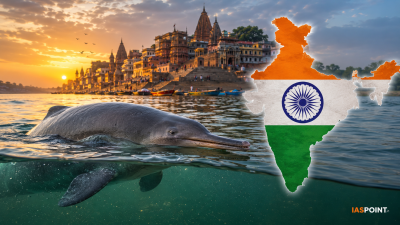
The Ganges River Dolphin (Platanista gangetica) was officially declared the National Aquatic Animal of India on October 5, 2009. This decision was taken during the first meeting of the National Ganga River Basin Authority (NGRBA) to highlight the critical state of the species and the health of the Indian river systems.
- Date of Declaration: October 5, 2009.
- National Dolphin Day: In 2022, the Ministry of Environment, Forest and Climate Change designated October 5 as ‘National Dolphin Day’ to generate awareness for its conservation.
- Legal Protection: It is placed under Schedule I of the Wildlife (Protection) Act, 1972, providing it the highest degree of protection against hunting and trade.
- IUCN Status: Categorized as Endangered on the IUCN Red List of Threatened Species.
Biological and Ecological Characteristics
The Ganges River Dolphin is a unique freshwater cetacean that has evolved specific traits to survive in the silt-heavy waters of the Ganges-Brahmaputra-Meghna and Karnaphuli-Sangu river systems.
- Susu (Blind Dolphin): It is functionally blind and hunts using echolocation (ultrasonic sounds). It is locally known as ‘Susu’ due to the noise it makes while breathing through its blowhole.
- Physical Features: It has a long pointed snout, visible teeth even when the mouth is closed, and a stocky body with large flippers. It lacks a true dorsal fin, having a triangular hump instead.
- Habitat Indicator: It is a reliable indicator species for the health of the entire river ecosystem. Its presence signifies a clean and well-oxygenated aquatic environment.
- Breeding: They are slow breeders, giving birth to a single calf every two to three years, which makes their population recovery difficult.
Geographical Distribution
The species is endemic to the Indian subcontinent and is found in a limited number of river systems across India, Nepal, and Bangladesh.
- Primary Rivers: The Ganges, Yamuna, Chambal, Brahmaputra, and their tributaries.
- Indian States: Its distribution is primarily across Uttarakhand, Uttar Pradesh, Bihar, Jharkhand, West Bengal, and Assam.
- Vikramshila Gangetic Dolphin Sanctuary (VGDS): Located in the Bhagalpur district of Bihar, it is the only sanctuary in India dedicated specifically to the conservation of this National Aquatic Animal.
Conservation Initiatives and Projects
To prevent the extinction of the Ganges River Dolphin, the Government of India has launched several dedicated missions.
- Project Dolphin: Announced by the Prime Minister on August 15, 2020, on the lines of Project Tiger. It aims to conserve both river and marine dolphins using modern technology (like GPS mapping) and community involvement.
- Namami Gange Integration: Conservation of the dolphin is a key component of the Namami Gange programme, focusing on maintaining the “Aviral Dhara” (continuous flow) and “Nirmal Dhara” (unpolluted flow) of the river.
- Conservation Action Plan (2010–2020): A roadmap prepared by the Ministry of Environment to identify threats like accidental entanglement in fishing nets (bycatch), poaching for oil, and habitat fragmentation due to dams and barrages.
- Dolphin Jalaj Safaris: Launched at six locations across the country to promote eco-tourism and provide livelihood to local “Ganga Praharis.”
Comparison with Other River Dolphins
| Feature | Ganges River Dolphin | Indus River Dolphin (Platanista minor) |
| Common Name | Susu | Bhulan |
| Location in India | Ganga-Brahmaputra Basin | Beas River (Punjab) |
| National Status | National Aquatic Animal of India | State Aquatic Animal of Punjab |
| Endemic To | India, Nepal, Bangladesh | India (Beas), Pakistan (Indus) |
Fact Sheet for UPSC Aspirants
- First Sightings: Ancient texts and Mughal chronicles, including the Baburnama, mention the presence of dolphins in the Ganges.
- Species Identification: It is one of the four freshwater dolphins in the world. The other three are the Baiji (extinct, Yangtze River, China), the Bhulan (Indus River, Pakistan), and the Boto (Amazon River, South America).
- The “Tiger of the Ganges”: Just as the Tiger is the apex predator of the forest, the Gangetic Dolphin is considered the apex predator of the river system.
- Threat of Noise Pollution: Since they rely on echolocation, underwater noise from ships and motorboats interferes with their ability to communicate and hunt, leading to accidental collisions.
- CITES Status: Listed in Appendix I of the Convention on International Trade in Endangered Species (CITES), prohibiting international commercial trade.