
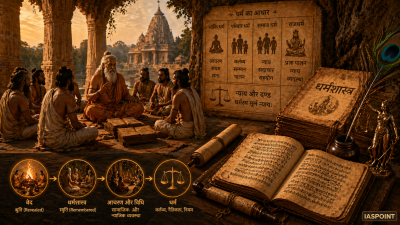
The Dharmashastras are a vast body of Sanskrit theological and legal texts that provide a comprehensive framework for Dharma (righteousness, duty, and law). They represent the codification of social norms, ethical conduct, and civil/criminal law in ancient Indian society. Unlike the Vedas, which are Shruti (revealed), the Dharmashastras are categorized as Smriti (remembered), signifying their human authorship and adaptability to different eras (Yugas).
Evolution and Chronology
The literature evolved through three distinct stages, transitioning from brief aphorisms to expansive poetical verses and eventually to detailed legal commentaries.
- Dharmasutras (600–200 BCE): The earliest layer, written in concise prose sutras. They are closely linked to the Kalpa Vedanga. Key texts include those by Gautama, Apastamba, Baudhaya, and Vashistha.
- Dharmashastras (200 BCE–900 CE): Written in verse (shlokas), these expanded the scope of the Sutras to include elaborate civil and criminal laws. The Manusmriti and Yajnavalkya Smriti are the primary pillars of this era.
- Nibandhas and Tikas (900 CE–1800 CE): These are digests and commentaries written to reconcile contradictions between different Smritis and adapt laws to regional medieval contexts. Examples include Medhatithi’s commentary on Manu and Vijnaneshwara’s Mitakshara.
Key Texts and Their Significance
| Text | Author/Sage | Unique Features |
| Manusmriti | Manu | Also called Manava-Dharmashastra. The most influential and controversial; covers cosmogony, sacraments, and the duties of a king. |
| Yajnavalkya Smriti | Yajnavalkya | More systematic and concise than Manu. It is the basis for the Mitakshara school of Hindu law. |
| Narada Smriti | Narada | Unique for being purely legalistic; it does not focus on rituals or penance but strictly on judicial procedure (Vyavahara). |
| Parashara Smriti | Parashara | Traditionally regarded as the most authoritative text for the current Kali Yuga. |
| Vishnu Smriti | – | Contains a strong focus on Bhakti (devotion) and is one of the few Smritis written in prose. |
Core Philosophical and Legal Concepts
The Dharmashastras operate on the principle that social stability is maintained through the adherence to individual and collective duties.
The Purusharthas and Ashramas
The texts provide a roadmap for the four goals of life (Dharma, Artha, Kama, Moksha) and the four stages of life (Brahmacharya, Grihastha, Vanaprastha, Sannyasa). The Grihastha (householder) stage is lauded as the most critical as it supports all other stages.
Varna and Jati
The Shastras define the duties (Varnadharma) of the four classes:
- Brahmins: Teaching and priesthood.
- Kshatriyas: Protection and administration.
- Vaishyas: Trade, agriculture, and cattle rearing.
- Shudras: Service to the other three varnas.
Vyavahara (Legal Procedure)
The texts divide law into 18 titles (Vivadopadas), including:
- Rina-dana: Recovery of debt.
- Sva-pala-vivada: Disputes between owners and herders.
- Stritatva-dharma: Duties of husband and wife.
- Dayabhaga: Inheritance and partition.
Schools of Inheritance and Modern Law
Two major medieval interpretations of the Dharmashastras formed the basis of Hindu Personal Law during the British Raj and influenced post-independence legislation.
- Mitakshara School: Authored by Vijnaneshwara (commentary on Yajnavalkya Smriti). It prevails across most of India. A son acquires a right in ancestral property by birth.
- Dayabhaga School: Authored by Jimutavahana. It prevails in West Bengal and Assam. The son’s right to property arises only after the death of the father.
Administrative and Political Philosophy
The Dharmashastras outline the Rajadharma (Duties of a King), emphasizing that the king is not above the law but is the protector of Dharma.
- Danda (Punishment): The concept that justice and order are maintained through the fear of legitimate punishment.
- Saptanga Theory: While detailed in the Arthashastra, the Dharmashastras also support the seven limbs of the state: Swamin (King), Amatya (Ministers), Janapada (Territory/Population), Durga (Fort), Kosa (Treasury), Danda (Army), and Mitra (Ally).
Facts and Trivia for Prelims
- The Kalpa Sutras: Dharmasutras are a part of the Kalpa Sutras, which also include Srautasutras (Vedic sacrifices) and Grihyasutras (domestic rituals).
- Apad-dharma: A unique concept in Dharmashastras that allows individuals to follow the duties of a different Varna during times of extreme distress or calamity.
- Stridhana: The texts recognize a woman’s right to certain types of property, primarily gifts received during marriage, known as Stridhana.
- The First Commentary: Medhatithi (9th century CE) is regarded as the oldest and most famous commentator on the Manusmriti.
- Influence on SE Asia: The principles of Dharmashastras traveled to Southeast Asia, influencing the legal codes of ancient kingdoms in Java, Bali, and Thailand (the Thammasat).