
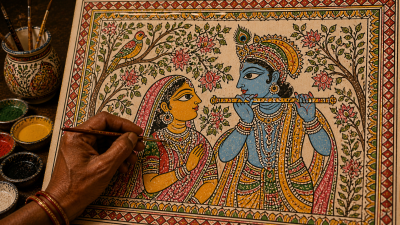
Madhubani painting, also known as Mithila art, originates from the Mithila region of Bihar and the neighboring Terai region of Nepal. Traditionally practiced by women, this art form was originally a type of wall art (Bhitti Chitra) intended to seek divine blessings during festivals and ceremonies. It remained largely unknown to the outside world until 1934, when William Archer, a British colonial officer, discovered the paintings on the walls of houses exposed by a massive earthquake in Bihar.
Distinctive Styles and Social Stratification
Historically, Madhubani painting was categorized into five distinct styles, which were initially influenced by the caste system and social hierarchy of the region.
- Bharni: Traditionally practiced by Brahman women, it focuses on rich, vibrant colors and religious themes, primarily depicting Hindu deities.
- Kachni: Characterized by intricate line work and a monochromatic or limited color palette. This style relies on hatching and stippling rather than solid color filling.
- Tantric: Specifically deals with tantric themes and symbols, including the representation of Shakti and various Yantras.
- Godna: Traditionally practiced by the Dalit community, it mimics tattoo patterns. It often uses repetitive geometric circles and representations of nature.
- Kohbar: A specialized form of painting done in the bride’s room (Kohbar Ghar) to symbolize fertility and a happy married life.
Technical Specifications and Materials
The authenticity of Mithila art lies in its use of locally sourced materials and the absence of modern synthetic tools.
- Tools: Artists use fingers, twigs, brushes, nib-pens, and even matchsticks. No sketching or tracing is done beforehand.
- Pigments: Only natural dyes are used. Black is obtained from soot mixed with cow dung; yellow from turmeric or pollen; blue from indigo; and red from the juice of the Kusuma flower or sandalwood.
- Canvas: Originally done on freshly plastered mud walls, the art has now transitioned to handmade paper, canvas, and textiles for commercial purposes.
- Double Borders: A hallmark of this tradition is the use of ornate double borders that enclose the central narrative.
- Negative Space: The artists leave no gaps; every inch of the canvas is filled with motifs of flowers, birds, or geometric patterns.
Iconography and Symbolic Motifs
Every element in a Madhubani painting carries a specific symbolic meaning, often rooted in the principles of fertility and prosperity.
- Fish: Represents fertility, procreation, and good luck.
- Peacock: Symbolizes beauty, romance, and rebirth.
- Serpents (Nagas): Represent protection and divine energy.
- Sun and Moon: Symbolize long life and the presence of cosmic power.
- Lotus: A symbol of feminine energy and purity.
- Bamboo: Represents the male lineage and strength.
Comparative Analysis: Bhitti Chitra vs. Aripana
While Madhubani is famous for wall art, it also encompasses floor art, each serving different ritualistic functions.
| Feature | Bhitti Chitra (Wall Art) | Aripana (Floor Art) |
| Location | Interior and exterior walls | Courtyards and doorsteps |
| Occasions | Weddings, Upanayana (Thread ceremony) | Daily rituals, Vratas (Fasts) |
| Medium | Pigments mixed with gum | Rice paste (Pithar) mixed with water |
| Primary Focus | Narratives and Deities | Geometric patterns and symbols |
| Durability | Semi-permanent | Temporary (cleansed daily) |
Evolution and Modern Recognition
The transition from walls to paper occurred in the late 1960s during a severe drought in Bihar. The All India Handicrafts Board encouraged women to paint on paper to create a source of non-agricultural income.
- Geographical Indication (GI): Madhubani painting was granted GI status in 2005, ensuring the protection of its traditional methods and regional identity.
- Global Reach: The Mithila Museum in Tokamachi, Japan, houses over 15,000 Madhubani paintings, showcasing the international appeal of the craft.
- Key Personalities:
- Jagdamba Devi: The first artist to receive the Padma Shri in 1975.
- Mahasundari Devi: Renowned for her contribution to the development of the art form and the cooperative movement.
- Sita Devi and Baua Devi: Instrumental in bringing the Kachni and Bharni styles to international prominence.
Fact Sheet for UPSC Aspirants
- Region: Madhubani, Darbhanga, and parts of Nepal.
- Key Feature: The use of “Double Lines” for all outlines and the absence of empty spaces.
- Themes: Heavily influenced by the Ramayana, Mahabharata, and the life of Krishna.
- Nature Connection: Plants like Tulsi and animals like turtles and elephants are frequently depicted to show the harmony between man and nature.
- Social Reform: The art form has been used as a tool for social awareness, including environmental conservation (painting trees to prevent deforestation) and women’s empowerment.