
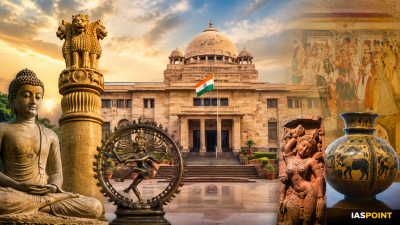
The National Museum, New Delhi, is the premier cultural institution in India, housing a collection of over 2,00,000 artifacts spanning 5,000 years of Indian and world history. It functions as a subordinate office under the Ministry of Culture. The museum serves as the definitive repository for Indian heritage, showcasing the evolution of Indian civilization from the prehistoric era to the modern period.
Historical Genesis and Evolution
The museum’s origin is tied to the “Exhibition of Indian Art” held at Burlington House, London, in 1947–48.
- Inauguration: The collection was first displayed at Rashtrapati Bhawan in 1949 and formally inaugurated by C. Rajagopalachari, the then Governor-General of India.
- Permanent Building: The foundation stone of the current building on Janpath was laid by Pandit Jawaharlal Nehru on May 12, 1955.
- Public Opening: The first phase of the museum building was opened to the public on December 18, 1960.
- Central Vista Redevelopment: As part of the Central Vista project, the museum’s collection is slated for relocation to the Yuge Yugeen Bharat National Museum, which will be housed in the North and South Blocks of Raisina Hill.
Major Galleries and Key Collections
The museum is organized into thematic and chronological galleries that provide a 360-degree view of Indian art history.
| Gallery/Section | Notable Highlights |
| Pre-Historic & Harappan | The “Dancing Girl” (Bronze), “Priest-King” (Steatite), Mother Goddess figurines, and Harappan jewelry. |
| Archaeology (Maurya, Shunga, Satavahana) | The Bharhut Stupa railings and the Lion Capital remnants. |
| Buddhist Art | The Sacred Relics of Lord Buddha (from Piprahwa), Gandhara and Mathura school sculptures. |
| Gupta & Post-Gupta Art | Masterpieces of the “Golden Age,” including the iconic Standing Buddha and Vishnu sculptures. |
| Decorative Arts | Ivory carvings, jade objects, and metalware including the “Ganjifa” playing cards. |
| Manuscripts | Rare copies of the Baburnama, Padshahnama, and illustrated Bhagavad Gita. |
| Coins (Numismatics) | Extensive collection ranging from punch-marked coins to Gupta gold dinars and Mughal currency. |
Specialized Departments and Functions
The National Museum is not merely a display center but a hub for academic and technical excellence in museology.
- Conservation Laboratory: One of the finest in Asia, responsible for the chemical preservation and structural restoration of organic and inorganic artifacts.
- Education and Outreach: Conducts “Guided Gallery Tours,” “Object of the Month” initiatives, and specialized workshops for students and teachers.
- National Museum Institute (NMI): An autonomous “Deemed to be University” situated within the museum premises, offering M.A. and Ph.D. programs in History of Art, Conservation, and Museology.
- Photography and Digitization: Managed through the JATAN software, creating a digital inventory of the entire collection for public and scholarly access.
Significant Artifacts for UPSC Prelims
- The Dancing Girl: A 10.5 cm high bronze statue from Mohenjo-daro, representing the lost-wax casting technique.
- Buddhist Relics: The museum houses the bone fragments of Buddha recovered from Piprahwa (Kapilavastu), which are given sovereign honors during international expositions.
- Tanjore and Mysore Paintings: A dedicated section showcasing South Indian gold-leaf painting traditions.
- Pre-Columbian and Western Art: A rare collection of artifacts from Central and South America, donated by Nasli and Alice Heeramaneck.
- Naurasnama: A rare manuscript on music and aesthetics written by Ibrahim Adil Shah II of Bijapur.
Important Museological Initiatives
- Anubhav Gallery: A tactile gallery specifically designed for visually impaired visitors to experience the texture and form of replica artifacts.
- International Exhibitions: The museum acts as the nodal agency for “Exhibitions of India” abroad and hosts prestigious traveling exhibitions like “The India and the World” (in collaboration with the British Museum).
- Virtual Tours: In collaboration with Google Cultural Institute, the museum offers high-resolution digital access to its primary galleries.
Facts and Trivia
- Architectural Style: The building was designed by architect G.B. Deolalikar, blending modern functionalism with Indian motifs.
- The Chariot: The museum houses the famous Bronze Chariot from Daimabad, an important Late Harappan archaeological find.
- The Library: The museum library is one of the richest in the country, containing over 60,000 books and journals on art, history, and archaeology.
- The Statue of Gomateshwara: A magnificent early medieval sculpture in the courtyard representing the Jain Tirthankara Bahubali.