
Ritual theatre in India represents the transitional phase between pure religious liturgy and formalized drama. Under the Indian Theatre unit of Art and Culture, these forms are categorized as “Sacred Spaces” because the performance is not merely entertainment but an act of devotion (Yagna) intended to invoke the divine, ensure community welfare, or commemorate cosmic events.
Characteristics of Ritual Theatre
- Liminality of Space: Performances often take place in “Sacred Spaces” such as temple courtyards (Koothambalams), sacred groves (Kavu), or temporary enclosures built on sanctified ground.
- Performer as Medium: The actor often undergoes a ritual transformation, where through elaborate makeup and masks, they are believed to be possessed by the deity.
- Community Participation: Unlike classical theatre, the boundary between the audience and the performer is fluid; the community participates in chants, processions, and offerings.
- Time and Duration: Many ritual plays are governed by the lunar calendar and can last from a single night to 41 days (e.g., Koodiyattam).
Major Forms of Ritual Theatre in India
Koodiyattam (Kerala)
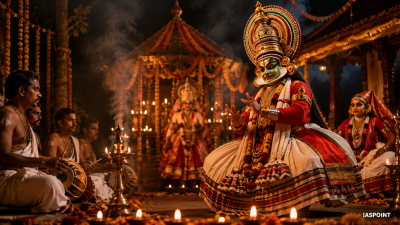
Koodiyattam is the oldest surviving link to ancient Sanskrit theatre and is recognized by UNESCO as a Masterpiece of the Oral and Intangible Heritage of Humanity.
- Sacred Space: Performed exclusively in Koothambalams, specialized temple theatres within Kerala’s temple complexes.
- Key Feature: It is the only surviving tradition that performs Sanskrit drama in its original form, though with a highly stylized Kerala local flair.
- The Mizhavu: The primary percussion instrument is a large copper drum called the Mizhavu, which is treated as a sacred object and given “burial rites” when it breaks.
Mudiyettu (Kerala)
Another UNESCO-recognized ritual dance drama, Mudiyettu depicts the mythological battle between the goddess Kali and the demon Darika.
- Ritual Context: Performed in Bhadrakali temples after the harvest season.
- The Kalam: The performance begins with Kalam Ezhuthu, the drawing of the deity on the floor using natural colored powders. The “spirit” of the deity is believed to be transferred from the drawing to the performer.
Theyyam (Northern Kerala)
Theyyam is a socio-religious ritual that blurs the line between theatre and shamanism.
- Social Significance: Most Theyyam performers belong to the marginalized castes, yet during the performance, they are worshipped as gods by all sections of society, including Brahmins and chieftains.
- Visuals: Characterized by massive, ornate headgears (Mudi) and intricate face painting.
Ramlila and Raslila (North India)
- Ramlila: A ritual enactment of the Ramayana. The Varanasi (Ramnagar) Ramlila is world-famous for utilizing the entire town as a “Sacred Space,” moving the audience from one geographic location to another to mirror Rama’s journey.
- Raslila: Centered in Vrindavan and Mathura, it focuses on the life of Krishna. It is considered a form of Bhakti (devotion) where the young actors (Swaroops) are treated as living embodiments of Krishna and Radha.
Comparative Overview of Ritual Theatre Forms
| Form | Region | Primary Deity/Theme | Unique Aspect |
| Koodiyattam | Kerala | Sanskrit Epics | Performed in Koothambalams; UNESCO recognized. |
| Mudiyettu | Kerala | Bhadrakali | Battle with Darika; involves Kalam (floor art). |
| Theyyam | Kerala/Karnataka | Ancestral spirits/Deities | Performer is treated as a living God. |
| Bhagavata Mela | Tamil Nadu (Thanjavur) | Vishnu (Narasimha) | Performed by Telugu-speaking Brahmins in Varahur. |
| Ankia Naat | Assam | Vishnu/Krishna | Started by Sankaradeva; uses Bhaona (performance style). |
| Dashavatara | Maharashtra/Goa | Ten incarnations of Vishnu | Folk-ritual blend performed in Konkan region. |
Architectural Sacred Spaces: The Koothambalam
The Koothambalam is a testament to the scientific approach to acoustics and sacred geometry in Indian theatre.
- Structure: Rectangular or square buildings located within the temple premises.
- The Stage: Known as the Rangamandapam, it is usually a raised platform with four carved pillars.
- Acoustics: The wooden ceilings are often carved with figures of the Dikpalas (Guardians of Directions) and designed to amplify the actor’s voice without modern equipment.
Ankia Naat and the Sattras of Assam
Initiated by the saint-reformer Srimanta Sankaradeva in the 15th-16th century, this ritual theatre served as a vehicle for the Neo-Vaishnavite movement.
- Sacred Space: Performed in Namghars (prayer halls) associated with Sattras (monasteries).
- Bhaona: The actual performance is called Bhaona, where the Sutradhara (narrator) plays a critical role in weaving the story and religious philosophy together.
- Language: Uses a special literary language called Brajavali (a mix of Assamese and Maithili).
Important Facts for UPSC Prelims
- Sutradhara: While the Sutradhara exists in classical Sanskrit drama, in ritual theatre (like Ankia Naat or Yakshagana), he often acts as a bridge between the mortal audience and the divine characters.
- Masks (Mukha): Used extensively in ritual theatre (e.g., Purulia Chhau, Seraikella Chhau, and Bhaona) to represent supernatural beings, as human facial expressions are considered insufficient to depict divine or demonic energy.
- The Ritual Curtain: In many South Indian forms, the main character is initially hidden behind a handheld curtain (Tirassila), which is slowly lowered to build anticipation and symbolize the unveiling of divine presence.
- UNESCO Intangible Heritage List: Aspirants should remember that Koodiyattam, Mudiyettu, Ramlila, Vedic Chanting, and Chhau Dance are all part of this prestigious list and have deep ritualistic roots.