

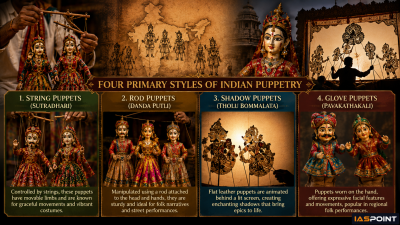
The Indian Puppetry Unit categorizes the traditional art form into four primary styles based on their physical manipulation, structural design, and regional aesthetics. Each style represents a unique confluence of local craftsmanship, religious storytelling, and technical ingenuity.
1. String Puppetry (Marionettes)
String puppets, or marionettes, are characterized by their wooden limbs joined by strings, allowing for fluid and complex movements. India has one of the richest traditions of string puppetry in the world.
- Kathputli (Rajasthan): Carved from a single piece of wood, these puppets feature large eyes and elongated faces. They lack legs and are draped in long, trailing skirts (ghagras). The puppeteer uses a single string looped around their fingers and produces a whistling sound using a bamboo device called a ‘boli’.
- Kundhei (Odisha): Made of light wood, these puppets have more joints than Kathputli, providing greater flexibility. The costumes resemble those of the Jatra traditional theater.
- Gombeyatta (Karnataka): These puppets are highly stylized and modeled after the characters of Yakshagana theater. They are heavy and require intricate stringing, often involving multiple strings attached to a circular wooden prop.
- Bommalattam (Tamil Nadu): This is the most technically advanced form, combining features of both string and rod puppetry. The strings are attached to an iron ring worn by the puppeteer on their head, while rods are used to move the puppet’s hands.
2. Shadow Puppetry
Shadow puppetry involves flat, translucent figures made of leather, pressed against a screen with a light source behind them. This form is most prevalent in the southern and eastern regions of India.
- Tholu Bommalata (Andhra Pradesh): These are life-sized puppets with jointed waist, shoulders, elbows, and knees. They are painted with vegetable dyes and are known for their intricate perforations that create a lace-like effect on the screen.
- Togalu Gombeyatta (Karnataka): These puppets vary in size according to the social status of the character. The performance is usually accompanied by a small ensemble of musicians.
- Ravanachhaya (Odisha): Unique for being made of deerskin and having no joints. They cast bold, opaque shadows. The puppets represent not just characters but also trees, mountains, and animals to create a complete scenic landscape.
- Tholpavakoothu (Kerala): Traditionally performed in the Koothambalams (temple theaters), these puppets depict stories from the Kamba Ramayana.
3. Rod Puppetry
Rod puppets are an extension of glove puppets but are much larger and supported by rods from below. This style is primarily found in West Bengal and Bihar.
- Putul Nautch (West Bengal): These wooden puppets are nearly the size of a human and are dressed in the style of the Jatra theater. The puppeteer stands behind a curtain, supporting the main rod in a hub tied to their waist.
- Yampuri (Bihar): Made of wood and typically non-jointed. These puppets are used to depict scenes from the court of Yama (the God of Death), serving as a medium for moral and ethical education.
- Danger Putul Nautch (Tripura): A rare form of rod puppetry where the puppets are often used to portray social contemporary themes alongside mythological stories.
4. Glove Puppetry
Also known as sleeve puppets, these are the most intimate form of puppetry, where the puppeteer’s hand directly becomes the mechanism for movement.
- Pavakoothu (Kerala): Originating in the 18th century, this form is heavily influenced by Kathakali. The puppets feature the same elaborate headgear and facial paint. The manipulation involves the index finger moving the head, and the thumb and middle finger moving the arms.
- Sakhi Kundhei (Odisha): Frequently used to depict the Radha-Krishna leela. The puppeteer often plays a musical instrument with one hand while manipulating the puppet with the other.
Comparative Summary of Puppetry Styles
| Style | Key Region | Primary Material | Unique Feature |
| String | Rajasthan, Karnataka | Wood, Cloth | Use of Sutradhara (string holder) for fluid motion. |
| Shadow | Andhra, Kerala | Treated Leather | Use of light, shadow, and translucency. |
| Rod | West Bengal, Bihar | Wood, Bamboo | Support from below; large, heavy figures. |
| Glove | Kerala, Odisha | Wood, Paper Mache | Direct hand manipulation; close interaction with audience. |
Technical Facts and Prelims Trivia
- The Fifth Veda: Historically, puppetry was referred to as a “Fifth Veda” because it made complex philosophical truths accessible to the common masses through visual storytelling.
- Silappadikaram: This 2nd-century Tamil epic provides one of the earliest literary references to “marionettes moved by strings.”
- Sangeet Natak Akademi: The premier national institution for the performing arts in India, which houses the specialized Puppetry Unit to document and revitalize these “dying” art forms.
- Asoka’s Use of Puppetry: Some historical accounts suggest that Emperor Asoka utilized traveling puppet troupes to spread Buddhist Dhamma across the Mauryan Empire.
- The “Boli”: The distinctive whistling sound in Rajasthani Kathputli is achieved by a small bamboo reed held in the puppeteer’s mouth, symbolizing the “voice” of the puppet.