
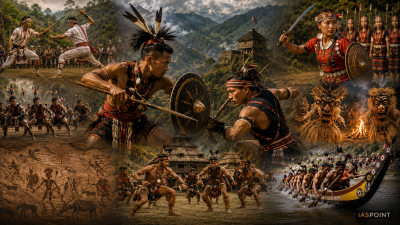
The North-Eastern frontier of India, characterized by its diverse tribal demographics and rugged terrain, has fostered a unique martial culture. These arts evolved not only as systems of combat for tribal defense and territorial sovereignty but also as spiritual disciplines integrated into local animistic and religious rituals. Under the Martial Arts and Traditional Sports Unit of Indian Art, Culture and Heritage, these forms are recognized for their role in preserving the “intangible history” of the Seven Sister States and Sikkim.
Huyen Lallong: The Dual Pillar of Manipur
Manipur stands as the epicenter of North-Eastern martial traditions. The overarching term for its combat system is Huyen Lallong (The Method of Safeguarding), which is split into two distinct disciplines.
Thang-Ta (The Armed Component)
Thang-Ta is the art of the Thang (Sword) and Ta (Spear). It is renowned for its fluid, dance-like movements that mask lethal strikes.
- Three Functional Levels: Ritualistic (performed in temples), Demonstrative (spectacle for festivals), and Combat (actual warfare).
- The Spear Dance: Known as Ta-Khousaba, it involves intricate rhythmic patterns mimicking the movements of animals to confuse opponents.
- Sanamahi Influence: The art is deeply rooted in the indigenous Sanamahi religion, where movements represent the cosmic creation.
Sarit Sarak (The Unarmed Component)
Sarit Sarak is the “soft” art used when a warrior is disarmed.
- Technical Focus: It emphasizes dodging, parrying, and using an opponent’s momentum to neutralize them.
- Holistic Integration: In traditional Meitei military training, Sarit Sarak was never taught in isolation but as a survival extension of Thang-Ta.
Weaponry and Combat Styles of the Seven Sisters
Each state in the North-East contributed specialized techniques based on their unique flora (bamboo) and historical adversaries.
| Martial Art / Style | State of Origin | Key Features and Weapons |
| Hiyang Taba | Manipur | Traditional boat racing with martial elements and coordination drills. |
| Inbuan | Mizoram | A form of folk wrestling that forbids kicking or stepping outside a designated circle. |
| Kirip / Khomlainai | Arunachal Pradesh | Indigenous wrestling styles practiced by the Galo and Bodo tribes respectively. |
| Muan | Nagaland | A specialized form of Naga wrestling emphasizing upper-body strength and balance. |
| Thang-Ta | Manipur | Use of the Arambai (poisoned darts) and Chungoi (shield). |
Mizoram’s Inbuan: The Art of Balance
Inbuan is the traditional wrestling of the Mizo people, dating back to the 18th century. It is characterized by strict rules of engagement that emphasize leverage over brute force.
- Core Rule: A wrestler loses if any part of their body other than the feet touches the ground.
- Techniques: It involves lifting the opponent off their feet using the belt or waist grip.
- Cultural Context: Historically used to determine the strongest youth in a village (Lusei tradition), it is now a mainstay of the Chapchar Kut festival.
Naga Wrestling: The Warrior’s Test
Practiced primarily by the Angami, Chakhesang, and Zeliang tribes, Naga wrestling is a test of sheer endurance and communal honor.
- The Mechanism: Wrestlers wear a cloth belt around the waist; the objective is to bring the opponent down by catching the belt.
- Horbill Festival: The Hornbill Festival in Nagaland serves as the primary modern stage for this ancient martial sport.
- Social Status: In tribal history, victory in wrestling bouts was often a prerequisite for tribal leadership roles.
Tribal Archery and Specialized Warfare
Archery is the common thread across the North-East, particularly in Meghalaya and Arunachal Pradesh.
Siamese/Khasi Archery (Teer)
- Thoh Tim: A unique blend of martial skill and gambling found in Meghalaya (Shillong).
- Spiritual Connection: Archery is considered a gift from the deities; the bows are crafted from specific species of seasoned bamboo.
The Arambai of the Meitei Cavalry
- Weapon Profile: Small, lightweight poisoned darts or arrows thrown by hand while on horseback.
- Tactical Advantage: Manipuri cavalry was feared for the Arambai, which allowed them to strike retreating enemies with high precision, a technique that famously troubled the invading Burmese and British forces.
UPSC Prelims Fact File and Trivia
- Aparajita Puja: Before campaigns, Manipuri warriors performed this ritual to invoke victory, a practice similar to the Shastra Puja of the Rajputs.
- UNESCO Relevance: Thang-Ta is frequently highlighted in India’s Intangible Cultural Heritage dossiers due to its unbroken Guru-Shishya lineage.
- Khelo India Integration: Thang-Ta was officially inducted into the Khelo India Youth Games in 2021 to provide a national platform for North-Eastern martial athletes.
- The Bodhidharma Legend: Some historians suggest that the “internal” breathing techniques of North-Eastern arts share a common ancestry with those carried to China by Bodhidharma.
- Bamboo Versatility: In almost all North-Eastern martial arts, the bamboo staff (Kamboo) serves as the primary training tool before practitioners graduate to steel weapons.
The Role of Martial Arts in Performing Arts
In the North-East, the line between combat and choreography is blurred.
- Pung Cholom (Manipur): A drum dance that utilizes the acrobatic leaps and stances of Thang-Ta.
- Hojagiri (Tripura): Incorporates balance and core stability drills derived from ancient self-defense movements.
- Bihu (Assam): While primarily agricultural, certain movements in the dance mimic the defensive stances used during village protection drills.