
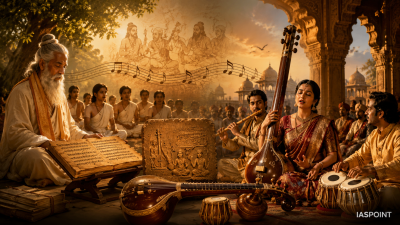
The origins of Indian classical music are rooted in the Vedas, specifically the Samaveda, which is considered the foundational text for musical chanting. Ancient Indian music transitioned from religious hymns to a sophisticated secular and courtly art form through centuries of codification.
Vedic Origins and Early Classifications
The Vedic period established the primacy of sound (Nada) as a manifestation of the divine. The transformation of Sanskrit hymns into melodic chants marked the beginning of the Indian musical system.
- Samaveda: The primary source of Indian music. It consists of hymns from the Rigveda set to melody, known as Samagayana.
- Saptaswara: The concept of seven notes originated here, initially referred to as Udatta, Anudatta, and Swarita (high, low, and medium pitch).
- Gandharva Veda: Regarded as the Upaveda of the Samaveda, it is the specialized ancient treatise on music, dance, and drama.
- Marga vs. Desi: Early classifications distinguished between Marga (classical, celestial, and path-bound music) and Desi (regional, folk, and terrestrial music).
Key Ancient Treatises and Authors
The structural framework of Indian music—including Raga (melody), Tala (rhythm), and Swara (notes)—was codified in several seminal texts between 200 BCE and 800 CE.
| Text | Author | Period | Significance |
| Natya Shastra | Bharata Muni | 200 BCE – 200 CE | The “Fifth Veda”; detailed the theory of Rasa, Bhava, and the classification of musical instruments. |
| Brihaddeshi | Matanga Muni | 6th – 8th Century CE | The first text to explicitly define the word Raga and discuss regional (Desi) influences. |
| Dattilam | Dattila | Ancient Period | Focused on the technicalities of Swaras and Grama (musical scales). |
| Naradiya Shiksha | Narada | Ancient Period | Discussed the relationship between Vedic chants and the secular musical scale. |
Concepts of Swara, Grama, and Murcchana
Ancient music was built upon a rigorous mathematical and tonal structure.
The Seven Swaras (Musical Notes)
The ancient system identified seven notes derived from the sounds of nature:
- Sa (Shadja): Peacock
- Ri (Rishabha): Bull/Chakravaka bird
- Ga (Gandhara): Goat
- Ma (Madhyama): Heron
- Pa (Panchama): Cuckoo/Nightingale
- Dha (Dhaivata): Horse
- Ni (Nishada): Elephant
Grama and Murcchana
- Grama: The basic scale or “village” of notes. There were three primary Gramas: Shadja-grama, Madhyama-grama, and the now-extinct Gandhara-grama.
- Murcchana: The practice of starting a scale from different notes within a Grama to create new melodies; this was the precursor to the modern Thaat or Melakarta system.
Classification of Musical Instruments (Atodya)
Bharata Muni’s Natya Shastra provided the world’s oldest systematic classification of musical instruments, a system still used globally today.
- Tata Vadya (Chordophones): Stringed instruments like the Veena or Ektara.
- Sushira Vadya (Aerophones): Wind instruments like the Venu (flute) or Shankh (conch).
- Avanaddha Vadya (Membranophones): Percussion instruments with a stretched skin, like the Mridangam or Pushkara.
- Ghana Vadya (Idiophones): Solid instruments made of metal or wood that do not require tuning, like Cymbals (Manjira).
The Doctrine of Rasa
The fundamental goal of ancient Indian music was the evocation of Rasa (aesthetic emotion). Bharata Muni identified eight Rasas, while later scholars added Shanta (peace) as the ninth.
- Shringara: Love/Erotic
- Hasya: Humorous
- Karuna: Pathetic/Sorrow
- Raudra: Anger
- Veera: Heroic
- Bhayanaka: Fearful
- Bibhatsa: Disgust
- Adbhuta: Wonder
Key Historical Trivia for Prelims
- Kudumiyanmalai Inscription: A 7th-century rock-cut inscription in Tamil Nadu that serves as one of the earliest recorded evidences of musical notations in India.
- The Veena: Mentioned in the Yajur Veda, it is the oldest stringed instrument associated with Saraswati, the goddess of learning.
- Panini’s Ashtadhyayi: While a grammar text, it contains references to musical terminology and instruments of the 4th Century BCE.
- The Gandharvas and Kinnaras: Mythological celestial musicians often depicted in ancient Indian sculpture (like Sanchi and Amaravati) reflecting the social integration of music.