
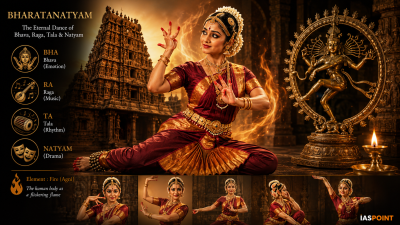
Bharatanatyam is the oldest among all classical dance forms in India, originating in the temples of Tamil Nadu. Its name is conventionally derived from the conjunction of Bha (Bhava/Emotion), Ra (Raga/Music), Ta (Tala/Rhythm), and Natyam (Drama). Philosophically, it is associated with the element of Fire (Agni), representing the metaphysical manifestation of the human body as a flickering flame.
Historical Evolution and Social Context
The dance form has transitioned from sacred temple corridors to the modern proscenium stage through distinct historical phases.
The Devadasi Tradition
Originally known as Sadir or Dasi Attam, it was performed by Devadasis (servants of God) in Hindu temples. These women were dedicated to deities and maintained the art form for centuries under the patronage of the Chola and Pandya dynasties.
The Tanjore Quartette
During the 19th century, four brothers—Chinnayya, Ponnayya, Sivanandam, and Vadivelu—codified the modern Bharatanatyam repertoire. They structured the performance sequence (Margam) that is followed by dancers even today.
Revivalist Movement
In the early 20th century, the dance faced social stigma due to the “Anti-Nautch” movement. It was revived by:
- E. Krishna Iyer: A freedom fighter who performed in female attire to break the stigma.
- Rukmini Devi Arundale: Founded Kalakshetra at Adyar (Chennai) in 1936, giving the dance a formal institutional structure and global recognition.
Technical Features and Grammar
Bharatanatyam is governed by the principles of the Natya Shastra and the Abhinaya Darpana.
Postures and Movements
- Araimandi: The signature half-sitting posture where the knees are bent sideways, forming a diamond shape.
- Sama-bhanga: A standing posture where the body weight is equally distributed.
- Muzhumandi: A full-squatting position.
- Adavus: The basic rhythmic units of dance, combining footwork, body posture, and hand gestures.
Elements of Expression
- Ekaharya Lasyanga: A characteristic style where a single dancer takes on multiple roles in a story, changing expressions and body language to signify different characters.
- Mudra System: Extensive use of Hastas (hand gestures), divided into Asamyuta (single hand) and Samyuta (double hand).
The Standard Performance Sequence (Margam)
The traditional repertoire is structured to move from abstract rhythm to complex narrative and finally to spiritual liberation.
| Sequence | Type | Description |
| Alarippu | Nritta | A rhythmic invocation and warm-up; signifies the flowering of the body. |
| Jatiswaram | Nritta | Pure technical dance without expression, focusing on intricate footwork and melody. |
| Shabdam | Nritya | Introduction of expression (Abhinaya); usually dedicated to a deity or king. |
| Varnam | Nritya | The centerpiece and longest part; involves complex combinations of Nritta and Nritya. |
| Padam | Nritya | Slower tempo; focuses entirely on deep emotional expression and Bhakti. |
| Ashtapadi | Nritya | Interpretations of Jayadeva’s Gita Govinda, focusing on the love of Radha and Krishna. |
| Tillana | Nritta | The finale; fast-paced rhythmic sequence showing statuesque poses. |
| Mangalam | – | A concluding prayer for the well-being of the audience and the universe. |
Musical and Visual Accompaniment
- Music: The dance is set to Carnatic Music. The lyrics are typically in Tamil, Telugu, Kannada, or Sanskrit.
- The Nattuvanar: The conductor of the performance who plays the Cymbals and recites the rhythmic syllables (Sollukattu).
- Instruments: Flute, Violin, Veena, and the Mridangam (primary percussion).
- Costume: Traditionally made of Kanchipuram silk with a pleated “fan” in the center that opens during the Araimandi posture. Dancers wear temple jewelry and Ghungroos (ankle bells).
Significant Facts and Trivia for UPSC
- The Fire Element: Among the five elements (Panchabootham), Bharatanatyam represents Fire, while Mohiniyattam represents Air, and Odissi represents Water.
- Archaeological Proof: The gopurams of the Chidambaram Nataraja Temple contain stone carvings of all 108 Karanas (basic dance units) mentioned in the Natya Shastra.
- Bha-Ra-Ta: While commonly linked to “Bhava-Raga-Tala,” some scholars believe the name also honors the legendary sage Bharata Muni.
- Global Recognition: It was the first Indian dance to be performed in the proscenium stage format globally during the mid-20th century.
Eminent Proponents
- Past Masters: Meenakshisundaram Pillai (Pandanallur style), Tanjore Quartette.
- Revivalists: Rukmini Devi Arundale, Balasaraswati (known for her mastery of Abhinaya).
- Modern Dancers: Padma Subrahmanyam (developed ‘Bharata Nrityam’), Sonal Mansingh, Yamini Krishnamurthy, Mrinalini Sarabhai, and Mallika Sarabhai.