

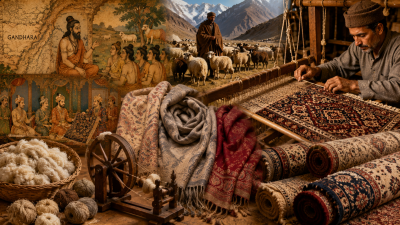
The tradition of woolen textiles in India, known as Urna in ancient Sanskrit texts, dates back to the Vedic period. The Rig Veda mentions the “God of Shepherds” and the fine wool of the Gandhara region (modern-day North-West India/Pakistan). India’s woolen heritage is deeply tied to its diverse agro-climatic zones, ranging from the high-altitude Himalayan plateaus, which produce the world’s finest pashmina, to the arid plains of Rajasthan, known for sturdy carpet wool. Historically, woolen shawls and carpets were prized commodities on the Silk Road and received significant royal patronage during the Mughal and Sikh empires.
Classification of Indian Wool Varieties
India produces a wide spectrum of wool, categorized by the breed of sheep or goat and the altitude of the region.
| Wool Variety | Source Animal | Primary Region | Characteristics |
| Pashmina | Changthangi Goat | Ladakh (Changthang) | Ultra-fine, soft, and highly insulating; approx. 12–15 microns. |
| Shahtoosh | Chiru (Tibetan Antelope) | High Himalayas | “King of Wools”; extremely fine but currently banned globally. |
| Angora | Angora Rabbit | Himachal Pradesh, Uttarakhand | Exceptionally silky, white, and fluffy fibers. |
| Desi Wool | Indigenous Sheep | Rajasthan, Gujarat, Haryana | Coarse and durable; ideal for carpets, rugs, and heavy blankets. |
| Kullu/Chamba | Local Hill Sheep | Himachal Pradesh | Sturdy and warm; used for the famous patterned caps and shawls. |
Major Woolen Weaving Clusters and Traditions
1. The Kashmir Highland Traditions
Kashmir is the global epicenter for luxury woolen textiles. The craftsmanship involves a distinct division of labor between the Rafoogars (menders) and Wasta (master weavers).
- Kani Shawls: Woven using small wooden needles called Kanis. The patterns are coded in a written script known as Talim. It is one of the oldest known weaving techniques in Kashmir.
- Amlikar Shawls: Instead of weaving the pattern into the fabric, the design is created using fine needlework embroidery (Soin work) over a plain pashmina base.
- Namda: A felted woolen rug made by hydrating and pressing wool fibers rather than weaving them. It is primarily decorated with Aari (hook) embroidery.
2. Himachal Pradesh: Geometric Precision
Woolen craft in Himachal is essential for survival against the cold and is characterized by vibrant, geometric motifs.
- Kullu Shawls: Distinguished by their colorful geometric borders, often featuring the Doru (checks) and Gudma (heavy soft blanket) styles.
- Kinnauri Shawls: Known for highly intricate, five-colored geometric patterns representing religious and local symbols. These are among the most expensive and time-consuming shawls to weave.
- Pattu: A traditional heavy woolen drape worn by local women, often featuring white and black checks or plain earthy tones.
3. Rajasthan and Gujarat: Tribal and Pastoral Crafts
The Western belt focuses on functional wool used by nomadic and semi-nomadic communities like the Rabaris.
- Dhabla: A traditional woolen blanket/shawl woven by the Vankar community of Kutch. It features extra-weft techniques and is often adorned with pom-poms and mirrors.
- Bikaner Woolens: Rajasthan produces nearly 40% of India’s raw wool. Bikaner is a major hub for woolen yarn and hand-knotted carpets.
- Kharad Weaving: An ancient craft using goat and camel hair to create sturdy floor mats and saddlebags, primarily practiced in the Kutch region.
Technical Terminology and Processes
- Shearing: The process of removing the wool fleece from the animal, usually done twice a year (spring and autumn).
- Carding: Aligning the wool fibers to prepare them for spinning.
- Spinning (Charkha): Transforming raw wool into yarn. For Pashmina, this is traditionally done by hand to maintain fiber integrity.
- Felting: A non-woven process where wool fibers are matted together using moisture and pressure (e.g., Namda).
- Extra-Weft: A technique where additional threads are inserted during weaving to create raised patterns, common in Kullu and Kutch traditions.
Fact Sheet for UPSC Prelims
- Chirality of Shahtoosh: Shahtoosh is legally banned under the CITES (Convention on International Trade in Endangered Species) because the Chiru must be killed to obtain the wool.
- GI Tagged Woolens: Kashmir Pashmina, Kullu Shawl, Kinnauri Shawl, and Kutch Dhabla all hold Geographical Indication (GI) status.
- Central Wool Development Board (CWDB): Headquartered in Jodhpur, Rajasthan, it is the nodal agency for the growth and development of the wool sector.
- The Pashmina Goat: The Changthangi goat thrives at altitudes above 14,000 feet; the extreme cold triggers the growth of the fine undercoat used for pashmina.
- Panipat: Known as the “Cast-off Capital” or “Weaving City,” it is a major hub for recycling woolen rags and producing heavy blankets (Lohis).
Cultural Significance and Motifs
Woolen textiles often carry motifs that reflect the local ecology and spirituality.
- The Chinar Leaf: A ubiquitous motif in Kashmiri woolen embroidery representing the local Chinar tree.
- Temple Borders: Triangular patterns in Himachal shawls representing the Himalayan peaks.
- Tree of Life: A common motif in woolen carpets and shawls symbolizing the connection between heaven and earth.
- Animal Motifs: Kutch woolens often feature stylized camels and birds, reflecting the pastoral life of the Thar Desert.
Contemporary Challenges
The Indian woolen industry faces competition from synthetic “Cashmilon” and imported wool from Australia and New Zealand. Government initiatives like the Integrated Wool Development Programme (IWDP) aim to improve indigenous sheep breeds and provide modern processing facilities to traditional weavers. Promoting “Ahimsa” or sustainable shearing practices is also becoming a key focus for the export-oriented woolen craft sector.
Last Modified: May 6, 2026