
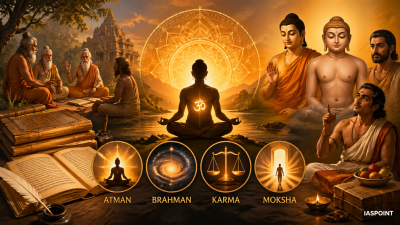
Hindu philosophy, or Sanatana Dharma philosophy, is traditionally categorized into two broad streams based on the acceptance of Vedic authority: Astika (Orthodox) and Nastika (Heterodox). While the Astika schools acknowledge the Vedas as the supreme revealed scriptures, the Nastika schools (such as Buddhism, Jainism, and Charvaka) reject Vedic primacy. Hindu philosophy primarily focuses on the concepts of Atman (Soul), Brahman (Ultimate Reality), Karma (Action), and Moksha (Liberation).
The Shad-Darshanas: Six Orthodox Schools
The Astika branch consists of six major systems known as the Shad-Darshanas. These schools developed over centuries, evolving from the Sutra period to detailed commentaries (Bhashyas).
| School | Founder/Sage | Key Text | Core Philosophy |
| Samkhya | Kapila | Samkhya Sutra | Dualism between Purusha (Consciousness) and Prakriti (Matter). |
| Yoga | Patanjali | Yoga Sutra | Practical path for mind control and union with the divine. |
| Nyaya | Gautama | Nyaya Sutra | Logical quest for god; emphasizes Pramanas (sources of knowledge). |
| Vaisheshika | Kanada | Vaisheshika Sutra | Atomic theory; classification of all objects into categories (Padarthas). |
| Mimamsa | Jaimini | Mimamsa Sutra | Focus on ritualism and the dharma mentioned in the Brahmanas. |
| Vedanta | Badarayana | Brahmasutra | Philosophical culmination of the Vedas (Upanishads). |
Samkhya: The Oldest Philosophical School
Samkhya is a strongly dualistic and atheistic (in its early form) philosophy.
- Purusha vs. Prakriti: It posits that the universe consists of two realities: Purusha (eternal, unchanging consciousness) and Prakriti (primordial matter/nature).
- The Three Gunas: Prakriti is composed of three attributes: Sattva (goodness/balance), Rajas (passion/activity), and Tamas (ignorance/inertia).
- Salvation: Liberation is achieved when Purusha realizes it is distinct from Prakriti.
- Scientific Contribution: It explains the theory of causation (Satkaryavada), suggesting the effect pre-exists in the cause.
Yoga: The Path of Discipline
Yoga serves as the practical application of Samkhya metaphysics. It focuses on the cessation of mental fluctuations (Chitta-Vritti-Nirodha).
- Ashtanga Yoga: The “Eight-Fold Path” includes Yama (restraint), Niyama (observance), Asana (posture), Pranayama (breath control), Pratyahara (withdrawal of senses), Dharana (concentration), Dhyana (meditation), and Samadhi (absorption).
- Theistic Element: Unlike early Samkhya, Yoga introduces Ishwara as a personal god who acts as a facilitator for the practitioner.
Nyaya and Vaisheshika: Logic and Atomism
These two schools are often treated together due to their shared interest in logic and the physical world.
Nyaya (School of Logic)
- Epistemology: Recognizes four valid sources of knowledge: Pratyaksha (Perception), Anumana (Inference), Upamana (Comparison), and Shabda (Testimony).
- Methodology: Uses a five-membered syllogism to reach logical conclusions, which influenced the development of Indian legal and scientific reasoning.
Vaisheshika (Atomic Pluralism)
- Anu (Atoms): Sage Kanada proposed that all physical objects are made of indivisible atoms. There are four types of atoms: Earth, Water, Light, and Air.
- Padarthas: It classifies all existence into seven categories, including substance, quality, activity, and inherence.
- Scientific Significance: Regarded as the precursor to Indian physics and chemistry.
Mimamsa: The Philosophy of Rituals
Also known as Purva Mimamsa, it emphasizes the earlier portion of the Vedas (the Samhitas and Brahmanas).
- Dharma: Defines Dharma as the performance of Vedic rituals. It argues that the Vedas are eternal and “unauthored” (Apaurusheya).
- Objective: To attain heaven (Svarga) through the precise execution of sacrificial rites.
- Philology: This school led to the development of Sanskrit linguistics and the science of interpretation.
Vedanta: The End of Knowledge
Vedanta, or Uttara Mimamsa, focuses on the Upanishads and the nature of Brahman. It is the most influential school in modern Hinduism.
Key Sub-schools of Vedanta
- Advaita Vedanta (Shankaracharya): Propounds absolute monism. Brahman is the only reality; the world is Maya (illusion). The individual soul (Atman) is identical to Brahman.
- Vishishtadvaita (Ramanujacharya): Qualified monism. The soul and the world are real but exist as attributes of the Supreme Being (Vishnu).
- Dvaita (Madhvacharya): Dualism. Maintains a strict distinction between God, the individual souls, and matter.
- Shuddhadvaita (Vallabhacharya): Pure non-dualism; identifies Krishna as the supreme Brahman.
Essential Concepts and Trivia
- Pramanas: The means of attaining accurate knowledge. Different schools accept different numbers of Pramanas (e.g., Charvaka accepts only perception, while Mimamsa accepts six).
- Purusharthas: The four goals of human life—Dharma (Righteousness), Artha (Wealth), Kama (Desire), and Moksha (Liberation).
- Theory of Karma: The law of cause and effect where every action has a corresponding reaction, influencing the cycle of rebirth (Samsara).
- The Concept of Brahman: In Hindu philosophy, Brahman is the infinite, all-pervading reality, distinct from the deity Brahma (the creator).