
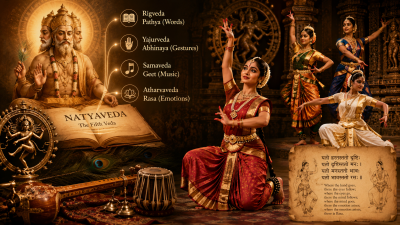
The origins of Indian dance are deeply rooted in the transition from the Vedic period to the classical era, blending spiritual philosophy with physical expression. According to Indian mythology, Lord Brahma created the Natyaveda (the fifth Veda) by distilling elements from the four existing Vedas: Pathya (words) from Rigveda, Abhinaya (gestures) from Yajurveda, Geet (music) from Samaveda, and Rasa (emotions) from Atharvaveda.
Canonical Texts and Treatises
The evolution of Indian dance is codified in two primary ancient texts that serve as the foundation for all classical forms today.
Natya Shastra by Bharata Muni
Dated between 200 BCE and 200 CE, this is the foundational treatise on performing arts. It describes dance not merely as entertainment but as a path to liberation (Moksha).
- Concept of Rasa: The text identifies eight primary Rasas (sentiments) and Bhavas (emotions).
- Technique: It details 108 Karanas (basic dance units) and Angaharas (combinations of Karanas).
- The Tandava and Sukumara: It distinguishes between the vigorous, masculine Tandava and the gentle, feminine Sukumara (later known as Lasya).
Abhinaya Darpana by Nandikeshwara
A later but equally influential text (circa 5th–4th century BCE or later medieval interpretations), it focuses heavily on the “grammar” of dance.
- Body Movements: It classifies movements into Nritta (pure dance), Nritya (expressive dance), and Natya (drama).
- Mudras: It provides an exhaustive list of Asamyuta Hastas (single-hand gestures) and Samyuta Hastas (combined-hand gestures).
Core Components of Indian Classical Dance
All classical dances originating from the Indian subcontinent share a tripartite structure of expression.
| Component | Description | Focus |
| Nritta | Abstract, rhythmic, and repetitive movements. | Technical skill, speed, and patterns. |
| Nritya | Interpretative dance involving facial expressions and gestures. | Conveying a story or theme. |
| Natya | The dramatic element or the play itself. | Characterization and narrative flow. |
Archaeological and Epigraphic Evidence
The antiquity of dance in India is validated by several key historical findings used frequently in UPSC examinations.
- Dancing Girl of Mohenjo-daro: A bronze figurine from the Indus Valley Civilization (c. 2500 BCE) depicting a girl in a dance-like posture with bangles, proving the existence of rhythmic arts in proto-historic India.
- Bhimbetka Rock Shelters: Mesolithic cave paintings in Madhya Pradesh show community dancing, highlighting dance as a social ritual.
- Temple Sculptures: The gopurams of Chidambaram (Tamil Nadu) and the walls of Khajuraho (Madhya Pradesh) and Konark (Odisha) depict various Karanas and Mudras described in the Natya Shastra.
Evolution of the Devadasi System
Historically, the preservation of dance was the responsibility of the Devadasis (servants of God).
- Sacred Role: Dance originated as a ritual performance in the Garbagriha (sanctum sanctorum) or the Natyamandapa of Hindu temples.
- Patronage: Early dynasties like the Cholas, Pandyas, and Pallavas provided land and wealth to maintain these dancers, viewing dance as a royal and spiritual offering.
- Decline and Revival: During the colonial era, the system faced social stigma and legal bans (e.g., Anti-Nautch Movement). Post-independence, pioneers like Rukmini Devi Arundale and E. Krishna Iyer worked to formalize these traditions into the modern classical formats recognized today.
Philosophical Foundations: Tandava and Lasya
The duality of Indian dance is reflected in the cosmic dance of Shiva and Parvati.
- Tandava: Associated with Lord Shiva (Nataraja). It emphasizes power, energy, and the cycle of creation and destruction. It is characterized by sharp, forceful movements and cosmic rhythm.
- Lasya: Associated with Goddess Parvati. It emphasizes grace, bhava (emotion), and beauty. It is the foundation for the more lyrical aspects of forms like Mohiniyattam and Odissi.
Fact Sheet for Quick Reference
- Lord of Dance: Shiva is worshipped as Nataraja, symbolizing the five activities (Panchakritya): Creation, Preservation, Destruction, Illusion, and Salvation.
- First Performance: Mythology suggests the first play performed was “Asura Parajaya” (The Defeat of Demons).
- Sangeet Natak Akademi: The official body in India that recognizes classical dance forms (currently recognizing 8, while the Ministry of Culture recognizes 9, including Chhau).
- Ghungroo (Salangai): The mandatory ankle bells used by dancers to emphasize the rhythmic footwork (Tala).