
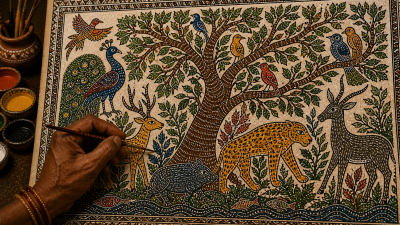
Gond art is a form of painting from the folk and tribal art that is practiced by one of the largest tribes in India—the Gond community, predominantly in Madhya Pradesh, but also in pockets of Andhra Pradesh, Maharashtra, Chhattisgarh, and Odisha. The word ‘Gond’ comes from the Dravidian expression ‘Kond’, meaning ‘the green mountain’.
Evolution from Bhitti Chitra to Canvas
Traditionally, Gond artists decorated the mud walls and floors of their houses during festivals like Nag Panchami and Diwali. This was known as Bhitti Chitra. In the 1980s, Jangarh Singh Shyam, a legendary Gond artist, brought this art from the walls of village huts to paper and canvas, initiating a new school of art called “Jangarh Kalam.” This transition allowed for finer details and the use of acrylic and poster colors.
Distinctive Styles and Technical Traits
- Signatures of Dots and Lines: The most defining feature of Gond art is the use of “signature patterns.” Every artist creates their own unique pattern consisting of dots, dashes, fine lines, or fish scales to fill the larger shapes.
- The Illusion of Movement: These patterns are not merely decorative; they are designed to give a sense of movement and vibration to the static figures.
- Natural Pigments: Traditionally, colors were derived from charcoal, colored soil (Khadi), plant sap, leaves, and cow dung. Yellow is obtained from Ramraj soil, and red from Geru.
- The Concept of “Seeing”: For the Gonds, everything is inhabited by a spirit. The art seeks to represent this “inner soul” rather than just the outward appearance of the subject.
Iconic Themes and Symbology
- Nature and Wildlife: Trees are the central motif, often depicted with interlocking branches housing birds and animals.
- Mythology and Folklore: Themes often revolve around the deity Bara Deo (the Great God) and local folk songs.
- The Saja Tree: Frequently depicted as it is considered the sacred abode of their primary deity.
Bhil Painting: The Pithora Tradition
The Bhil tribe, the second-largest tribal community in India, residing mainly in Madhya Pradesh, Gujarat, Rajasthan, and Maharashtra, practices a unique form of ritualistic painting. Unlike the decorative nature of many folk arts, Bhil painting is often an act of “offering” to the gods.
Pithora Art: The Sacred Mural
The most famous subset of Bhil art is the Pithora painting. These are not merely artworks but are considered a “written” record of a ritual performed to seek a boon from God Pithora.
- The Role of the Lakharas: The paintings are executed by professional male painters called Lakharas.
- Sacred Enclosure: The painting is always done on the main wall of the house that faces the courtyard. The wall is first prepared with a mixture of cow dung and white clay.
Characteristic Features and Techniques
- The Use of Dots: Bhil paintings are characterized by the use of multi-colored dots that cover the entire background and the figures. These dots are often arranged in patterns that represent a specific rhythm or story.
- Vibrant Palette: Bhil art uses bright, primary colors like red, blue, and yellow to create high-contrast visuals.
- Uniformity of Figures: Figures of horses and elephants are common, usually depicted in a stylized, simplified manner with large, expressive bodies.
Themes and Symbolism
- The Horse: The horse is the most prominent motif in Pithora art, representing the vehicle of the gods.
- Daily Survival: Themes include fields, trees, lightning, and agricultural activities, reflecting the tribe’s dependence on the land.
- Modern Elements: Interestingly, Bhil artists often incorporate modern symbols like airplanes, trucks, and watches into their traditional murals, showcasing the evolution of their world.
Comparative Analysis: Gond vs. Bhil Art
| Feature | Gond Painting | Bhil Painting |
| Primary Region | Madhya Pradesh (Dindori, Mandala) | MP, Gujarat, Rajasthan (Jhabua) |
| Core Element | Unique “Signature” patterns (lines/dots) | Uniform multi-colored dots (Pithora) |
| Purpose | Narrative and Decorative | Ritualistic and Offering |
| Common Motif | The Saja Tree and Animals | The Horse and the Sun/Moon |
| Famous Artist | Jangarh Singh Shyam | Bhuri Bai (Padma Shri recipient) |
Fact Sheet for UPSC Prelims: Tribal Art Traditions
- Jangarh Kalam: A specific style of Gond art named after Jangarh Singh Shyam, who pioneered the use of paper and canvas.
- Bhuri Bai: She is the first Bhil artist to paint on paper and was awarded the Padma Shri in 2021 for her contribution to Bhil art.
- Pithora Ritual: The Pithora painting is completed only after a ritual sacrifice and a feast, supervised by the Badwa (the chief priest).
- GI Tag Status: Both Gond Painting (Madhya Pradesh) and the Pithora paintings of the region have been subject to Geographical Indication protections to preserve their tribal authenticity.
- The “Flying Elephant”: A common motif in Gond art symbolizing the belief that elephants once had wings and were the protectors of the sky.
- Animistic Beliefs: Both art forms are deeply rooted in animism—the belief that all natural objects, including plants and stones, possess a spiritual essence.
- Parchment and Medium: While traditional Bhil art is wall-bound, modern iterations use canvas and acrylics, popularized by art centers like Bharat Bhavan in Bhopal.