
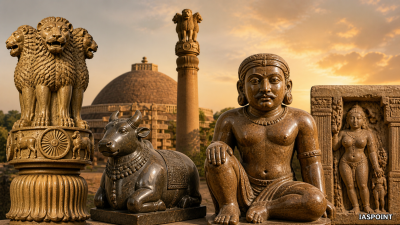
Mauryan art (4th to 2nd century BCE) marks a significant transition from the use of perishable materials like wood and clay to the permanent medium of stone. Under the patronage of Chandragupta Maurya and later Ashoka, Indian sculpture achieved a high degree of sophistication characterized by “Mauryan Polish”—a mirror-like finish on sandstone that remains a technological mystery. The art of this period is broadly classified into Court Art (state-sponsored) and Popular Art (individual/local initiatives).
Court Art: The Pillars and Capitals
The Ashokan pillars represent the pinnacle of Mauryan state art. Carved typically from Chunar sandstone (quarried near Varanasi), these monolithic pillars were inscribed with royal edicts to spread Dhamma.
Components of a Mauryan Pillar
- Shaft: A single piece of tapering sandstone, circular in cross-section, and highly polished.
- Capital: The top portion of the pillar, usually featuring a lotus or bell-shaped base (influenced by Achaemenid styles but distinct in its execution).
- Abacus: A circular or rectangular base supporting the animal figure.
- Crowning Animal: Masterfully carved figures of lions, bulls, or elephants symbolizing power and Buddhist tenets.
Notable Examples of Pillar Capitals
| Site | Crowning Animal | Significance |
| Sarnath | Four Lions (Lion Capital) | India’s National Emblem; depicts the ‘Dharmachakra Pravartana’. |
| Sanchi | Four Lions | Similar to Sarnath but slightly less refined in detail. |
| Rampurva | Bull & Lion | Two pillars; the Bull capital is now in Rashtrapati Bhavan. |
| Lauriya Nandangarh | Single Lion | Notable for the preservation of the original shaft and polish. |
| Sankissa | Elephant | Represents the descent of Buddha from Tushita Heaven. |
Popular Art: Yaksha and Yakshini Figures
Independent of royal patronage, local artisans continued the tradition of monumental stone carving, focusing on folk deities associated with fertility and protection.
- Didarganj Yakshini: Found near Patna, this life-sized fly-whisk (Chauri) bearer is the most celebrated example of Mauryan secular art. It exhibits the characteristic mirror-polish and detailed anatomical proportions.
- Parkham Yaksha: A massive figure from Mathura, representing the early evolution of the anthropomorphic form in Indian art.
- Lohanipur Torsos: Two nude male torsos found in Patna, often identified as early Jain Tirthankaras, showcasing the religious diversity of Mauryan sculpture.
Rock-Cut Architecture and Sculpture
The Mauryan period initiated the rock-cut cave tradition in India, primarily for the Ajivika sect.
- Barabar and Nagarjuni Caves: Located in Bihar, these were gifted by Ashoka and his grandson Dasharatha.
- Lomas Rishi Cave: Famous for its facade carved like a wooden thatched hut. The entrance features a semicircular frieze of elephants moving toward a stupa, demonstrating early relief sculpture.
- Dhauli Elephant: Carved out of a live rock in Odisha, this represents the forepart of an elephant. It symbolizes the “Gajottama” (The Best Elephant), representing Buddha’s birth.
Terracotta and Minor Arts
Terracotta figurines were produced on a large scale for common use. Unlike the Court Art, these were often handmade or molded and focused on domestic themes.
- Pataliputra and Bulandibagh: These sites have yielded exquisite terracotta figures of dancing girls, smiling children, and animals.
- Characteristics: Use of intricate hairstyles, heavy jewelry, and elaborate drapery. Some figures show evidence of being painted with natural pigments.
Technological and Stylistic Attributes
The Mauryan Polish
The most distinctive feature of Mauryan stone sculpture is the lustrous polish. Despite centuries of exposure, the surface remains smooth and reflective. Scholars debate whether this was achieved through specialized abrasives or a specific chemical treatment of the sandstone.
Influence: Indigenous vs. Foreign
- Achaemenid (Persian) Influence: The use of polished stone, bell-shaped capitals, and the concept of inscribed pillars suggest contact with Persia.
- Distinct Indian Features: Mauryan pillars are monolithic (single stone), whereas Persian pillars are constructed in segments. Mauryan shafts are smooth and independent, while Persian shafts are fluted and integrated into buildings.
Fact Sheet for UPSC Prelims
- Material: Almost all major Mauryan sculptures used Chunar Sandstone (grey/buff colored).
- Patronage Transition: Shifting from wood (Pataliputra palace) to stone (Ashokan edicts).
- Dhauli Inscription: The Dhauli elephant sculpture is located at the site of the Kalinga War, marking Ashoka’s conversion to non-violence.
- Animal Symbols: In Buddhist tradition, the Elephant represents Buddha’s birth, the Bull represents his zodiac (Taurus), the Horse represents his renunciation (Kanthaka), and the Lion represents his sovereignty and the Shakya clan.
- Secular Art: The Didarganj Yakshini remains one of the earliest examples of the feminine “Shalabhanjika” motif in Indian art.