
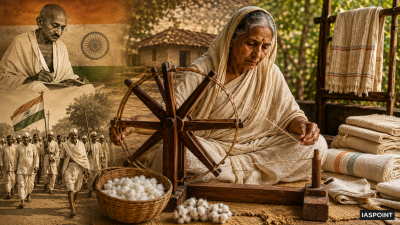
Khadi, derived from the term “Khaddar,” refers to hand-spun and hand-woven cloth. While hand-spinning has existed in India for millennia, Khadi was transformed from a humble rural fabric into a powerful political tool by Mahatma Gandhi during the Non-Cooperation Movement in the 1920s. Gandhi promoted Khadi as a symbol of Swadeshi (self-reliance) and a means to boycott British-made mill textiles. It became the “fabric of Indian independence,” representing the dignity of labor and the decentralization of industry.
Technical Specifications and Production Process
Khadi is distinct from regular handloom because both the yarn and the fabric are processed manually. This double-manual process gives Khadi its unique texture and environmental credentials.
- Spinning: The raw fibers (cotton, silk, or wool) are spun into thread on a spinning wheel called the Charkha.
- Weaving: The hand-spun yarn is سپس woven on traditional looms.
- Physical Attributes: The fabric is known for its rugged texture, high breathability, and “isothermic” properties—keeping the wearer cool in summer and warm in winter.
- Raw Materials: While predominantly cotton, Khadi is also produced using silk (Khadi Silk) and wool (Woolen Khadi).
Varieties of Khadi and Regional Centers
India produces diverse types of Khadi based on the raw material and regional weaving traditions.
| Variety | Region/Center | Notable Features |
| Ponduru Khadi | Andhra Pradesh | Produced from a rare indigenous variety of hill cotton; known for its extreme fineness. |
| Muslin Khadi | West Bengal | Extremely lightweight and fine-count cotton Khadi, reviving the ancient Muslin traditions. |
| Pashmina Khadi | Jammu & Kashmir | Hand-spun and hand-woven using fine pashmina wool. |
| Khadi Silk | Bihar and Jharkhand | Often utilizes Tussar silk, giving it a rich, golden-beige texture. |
| Vallabh Vidyanagar | Gujarat | A major hub for heavy-duty cotton Khadi used for upholstery and khadi denim. |
Institutional Framework and Governance
The sector is strictly regulated to maintain the authenticity of the “Khadi” brand and to support the millions of rural artisans involved.
- Khadi and Village Industries Commission (KVIC): A statutory body formed under the KVIC Act of 1956. It functions under the Ministry of Micro, Small and Medium Enterprises (MSME).
- Legal Protection: The “Khadi Mark” is a mandatory certification for all Khadi products to distinguish them from spurious mill-made fabrics.
- Certification: KVIC is the sole authority to grant “Khadi Certificates” to institutions wishing to manufacture or sell Khadi.
Modern Government Initiatives and Innovations
To make Khadi globally competitive and youth-centric, the Government of India has launched several modernization programs.
- Solar Charkha Mission: Introduced to harness solar energy for spinning, thereby increasing the productivity and income of women artisans without losing the “hand-spun” essence.
- Khadi Reform and Development Programme (KRDP): Funded by the Asian Development Bank (ADB), it focuses on the revitalization of the 500-odd Khadi institutions in India.
- Khadi Denim: A collaboration between KVIC and major textile players to produce high-fashion denim using Khadi processes, appealing to the global sustainable fashion market.
- Zero Effect Zero Defect (ZED): Ensuring Khadi production remains environmentally sustainable while maintaining high quality.
Socio-Economic Impact and Sustainability
Khadi remains a vital component of India’s rural economy due to its unique labor-intensive nature.
- Employment: It provides livelihood opportunities to over 10 lakh people, predominantly in rural areas where alternative employment is scarce.
- Gender Parity: More than 80% of Khadi spinners are women, making it a major driver of rural women’s empowerment.
- Eco-Friendly Footprint: Khadi production has a near-zero carbon footprint as it does not require electricity or fuel for spinning and weaving. It also consumes significantly less water compared to mill-produced cotton.
UPSC Prelims Facts and Trivia
- National Flag: According to the Flag Code of India, the National Flag of India must be made of hand-spun and hand-woven Khadi bunting (cotton, silk, or wool).
- Indigenous Cotton: The production of Ponduru Khadi involves the use of the “Konda Pathi” variety of cotton and the jawbone of the Valuga fish for cleaning the cotton fibers.
- Global Recognition: Khadi is the only fabric in the world that is both hand-spun and hand-woven, making it a unique Intellectual Property of India.
- Khadi institutions: These are primarily non-profit organizations registered under the Societies Registration Act, 1860, ensuring that profits are cycled back to the artisans.