
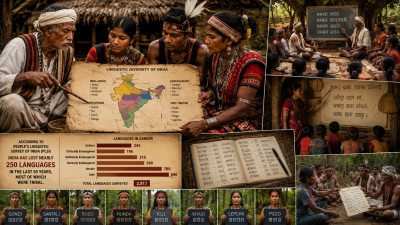
The linguistic diversity of India is profoundly anchored in its tribal populations, who speak hundreds of distinct languages and thousands of dialects. These languages are categorized into four major linguistic families. According to the People’s Linguistic Survey of India (PLSI), India has lost nearly 250 languages in the last 50 years, most of which were tribal, making the preservation of this heritage a critical cultural priority.
Classification of Tribal Language Families
Tribal languages in India are not a monolithic group but are divided based on their philological roots and geographical distribution.
Austro-Asiatic Family (Munda Branch)
This is considered one of the oldest language families in India, primarily spoken by tribes in the Chota Nagpur Plateau and parts of Northeast India.
- Key Languages: Santali, Mundari, Ho, Khasi, and Jaintia.
- Geographic Spread: Jharkhand, Odisha, West Bengal, and Meghalaya.
- Distinction: Santali is the only tribal language in this family included in the Eighth Schedule of the Indian Constitution.
Tibeto-Burman Family
Spoken by the tribal communities residing in the Himalayan belt and the North-Eastern states.
- Key Languages: Bodo, Meitei (Manipuri), Naga dialects (Ao, Angami, Konyak), Mizo, Adi, and Nyishi.
- Geographic Spread: The “Seven Sister” states, Ladakh, and Himachal Pradesh.
- Distinction: Bodo and Meitei are included in the Eighth Schedule.
Dravidian Family
While associated with South India, several significant tribal groups in Central India speak Dravidian languages.
- Key Languages: Gondi, Kurukh (Oraon), Kui (Kondh), and Toda.
- Geographic Spread: Madhya Pradesh, Chhattisgarh, Odisha, and the Nilgiri Hills of Tamil Nadu.
- Fact: Gondi is one of the most widely spoken tribal languages but lacks official status under the Eighth Schedule.
Indo-Aryan Family
Many tribes, especially in Western and Northern India, speak languages derived from Indo-Aryan roots, often as a result of long-term cultural contact.
- Key Languages: Bhili (the most spoken tribal language in India), Halbi, and Lambadi.
- Geographic Spread: Rajasthan, Gujarat, Maharashtra, and Madhya Pradesh.
Indigenous Scripts and Literature
Traditionally, tribal languages were exclusively oral (shrutis), but the 20th century saw the emergence of indigenous scripts developed to preserve tribal identity.
| Language | Script Name | Inventor / Origin |
| Santali | Ol Chiki | Pandit Raghunath Murmu (1925) |
| Ho | Warang Chiti | Lako Bodra |
| Sora | Sorang Sompeng | Mangei Gomango |
| Mundari | Mundari Bani | Rohidas Singh Nag |
| Gondi | Gunjala Gondi Lipi | Discovered in Gunjala village (Telangana) |
The Constitutional and Legal Framework
The Indian Constitution provides specific safeguards to protect the linguistic rights of tribal “minorities.”
- Article 29: Protects the right of any section of citizens to conserve their distinct language, script, or culture.
- Article 350A: Directs states to provide adequate facilities for instruction in the mother tongue at the primary stage of education to children belonging to linguistic minority groups.
- Article 350B: Provides for a Special Officer for Linguistic Minorities to investigate all matters relating to constitutional safeguards.
- Eighth Schedule: Currently includes four tribal/folk-related languages: Santali (added by 92nd Amendment, 2003), Bodo, Dogri, and Maithili.
Characteristics of Tribal Linguistic Heritage
- Agglutination: Many Munda languages are agglutinative, where complex words are formed by stringing together distinct morphemes.
- Ecological Lexicon: Tribal languages possess an incredibly rich vocabulary for flora, fauna, and forest topographies that are often absent in mainstream languages.
- Oral Epics: Linguistic heritage is preserved through oral epics like the Mibu Abang of the Adis or the Kherwal Bansha Dharam Puthi of the Santhals.
- Language Isolates: Some languages, like Nihali (spoken in Maharashtra/MP) and the Andamanese languages, are considered “language isolates” as they show no genetic relationship to any other known language family.
Challenges: Endangerment and Extinction
UNESCO classifies languages based on their vulnerability. A significant number of India’s “Critically Endangered” languages belong to the Andamanese and Nicobarese groups.
- Great Andamanese: Nearly extinct; the death of Boa Sr in 2010 marked the end of the Bo language.
- Majhi Language: Spoken in Sikkim, it is on the verge of extinction with only a handful of speakers left.
- Linguistic Imperialism: The dominance of state official languages (Hindi, Odia, Bengali) often leads to “subtractive bilingualism” among tribal youth.
360° Fact Sheet for UPSC Prelims
- Highest Number of Speakers: According to the 2011 Census, Bhili/Bhilodi is the most spoken non-scheduled language in India, followed by Gondi.
- The ‘Toto’ Language: Spoken by the small Toto tribe in West Bengal, it is considered a critically endangered language. A script was recently developed for it by Dhaniram Toto.
- Kudmali Language: A language of the Kudumi Mahato community in Jharkhand/Odisha, which is currently the subject of movements for inclusion in the Eighth Schedule.
- Scheme for Protection and Preservation of Endangered Languages (SPPEL): Instituted by the Ministry of Education to document languages spoken by fewer than 10,000 people.
- Linguistic Survey of India (LSI): Originally conducted by G.A. Grierson, it remains the foundational text for studying Indian tribal dialects.
- Toda Language: Unique for its complex phonetic system, including many types of trills and sibilants, reflecting the tribe’s isolation in the Nilgiris.