
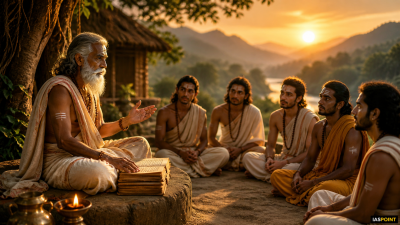
The Upanishads represent the final stage of the Vedic corpus and are collectively known as Vedanta (the end of the Vedas). The term is derived from the Sanskrit roots Upa (near), Ni (down), and Shad (to sit), signifying “sitting down near a teacher” to receive secret, spiritual instruction. Unlike the ritual-heavy Brahmanas, the Upanishads shift the focus from external sacrifices to internal meditation and the quest for ultimate truth.
Classification and Chronology
There are traditionally 108 Upanishads, as listed in the Muktika Upanishad. They were composed primarily between 800 BCE and 500 BCE, though some minor Upanishads were written as late as the medieval period.
The Mukhya Upanishads
Adi Shankara provided commentaries on eleven principal Upanishads, known as the Mukhya Upanishads, which are considered the most authoritative:
- Isha: Focuses on the unity of the world and the divine.
- Kena: Explores the nature of the “efficient cause” behind the senses.
- Katha: Features the famous dialogue between the boy Nachiketa and Yama (God of Death).
- Prashna: Deals with six metaphysical questions asked by disciples to Sage Pippalada.
- Mundaka: Contains the source of India’s national motto, Satyameva Jayate.
- Mandukya: The shortest Upanishad; explains the syllable “OM” and the four states of consciousness.
- Taittiriya: Discusses the five sheaths (Koshas) of the human body.
- Aitareya: Focuses on the creation of the universe and the self.
- Chandogya: Famous for the phrase Tat Tvam Asi (That Thou Art).
- Brihadaranyaka: The largest Upanishad; contains the Pavamana Mantra (Asato Ma Sadgamaya).
- Shvetashvatara: Introduces a more devotional (Bhakti) tone toward Lord Shiva.
Core Philosophical Tenets
The Upanishads transitioned Indian thought from polytheism and ritualism to monism and mysticism.
- Brahman and Atman: The central theme is the identity of the individual soul (Atman) with the universal soul (Brahman). Realizing this oneness is the key to liberation.
- Maya: The concept that the material world is an illusion or a temporary appearance that veils the ultimate reality.
- Samsara and Karma: The Upanishads provide the first systematic explanation of the cycle of birth, death, and rebirth (Samsara) based on one’s actions (Karma).
- Moksha: The ultimate goal of human life is liberation from the cycle of rebirth through the acquisition of Vidya (true knowledge).
Major Dialogues and Famous Phrases
Upanishadic wisdom is often conveyed through debates and dialogues held in royal courts or forest hermitages.
| Phrase/Concept | Source Upanishad | Meaning/Significance |
| Satyameva Jayate | Mundaka Upanishad | “Truth alone triumphs”; adopted as the National Motto of India. |
| Tat Tvam Asi | Chandogya Upanishad | “That Thou Art”; the relationship between the individual and the Absolute. |
| Aham Brahmasmi | Brihadaranyaka Upanishad | “I am Brahman”; the realization of self-divinity. |
| Asato Ma Sadgamaya | Brihadaranyaka Upanishad | “Lead me from the unreal to the real.” |
| Dialogue of Nachiketa | Katha Upanishad | A discourse on the secrets of life after death. |
| Yajnavalkya-Gargi Debate | Brihadaranyaka Upanishad | A philosophical challenge by a female scholar in the court of King Janaka. |
Social and Cultural Impact
The Upanishadic period saw a broadening of intellectual participation and a critique of the rigid caste-based ritualism.
- Participation of Women and Non-Brahmins: While the Vedas were largely the domain of priests, the Upanishads feature female philosophers like Gargi and Maitreyi, and kings like Janaka of Videha and Ajatashatru of Kashi who acted as spiritual teachers.
- Impact on Later Sects: The emphasis on non-violence (Ahimsa) and the futility of animal sacrifice influenced the rise of Jainism and Buddhism.
- Scientific Temper: The Shulba Sutras (found in Kalpa, but related to the era) and various Upanishads contain early observations on anatomy, embryology, and astronomy.
Historical Facts and Trivia for UPSC
- Dara Shikoh’s Translation: In the 17th century, the Mughal Prince Dara Shikoh translated 50 Upanishads into Persian. This collection, titled Sirr-i-Akbar (The Greatest Mystery), later introduced Upanishadic thought to the Western world.
- The Four Mahavakyas: These are the “Great Sayings” selected from the four Vedas to represent Upanishadic core truths:
- Prajnanam Brahma (Consciousness is Brahman) – Aitareya Upanishad.
- Ayam Atma Brahma (This Atman is Brahman) – Mandukya Upanishad.
- Tat Tvam Asi (That Thou Art) – Chandogya Upanishad.
- Aham Brahmasmi (I am Brahman) – Brihadaranyaka Upanishad.
- Varnashrama Dharma: The Jabala Upanishad is the first to clearly mention the four Ashramas (stages of life): Brahmacharya, Grihastha, Vanaprastha, and Sannyasa.
- Architecture of the Soul: The Upanishads describe the human body as a chariot, where the senses are horses, the mind is the reins, and the intellect is the charioteer.