
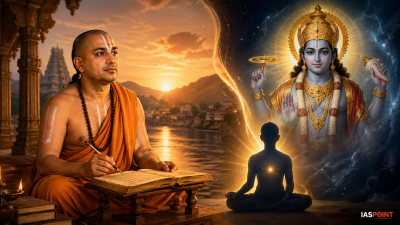
Dvaita Vedanta is one of the three major sub-schools of the Vedanta system of Indian philosophy. Founded by Sri Madhvacharya (1238–1317 CE) during the Bhakti movement, it represents a radical departure from the monism of Advaita Vedanta. The term “Dvaita” literally translates to “dualism,” signifying the school’s core belief in the eternal, fundamental difference between the individual soul and the Supreme Being.
Foundations and Key Literature
The philosophy of Dvaita is rooted in the Prasthanatrayi (Upanishads, Bhagavad Gita, and Brahma Sutras) but interprets them through a strictly dualistic lens, emphasizing the sovereignty of God.
- Madhvacharya (Ananda Tirtha): The proponent of this school, he was a prolific writer who authored 37 works collectively known as Sarvamula Granthas. His commentaries on the Brahma Sutras and the Bhagavad Gita are foundational.
- Successor Scholars: The tradition was furthered by intellectual giants like Jayatirtha (known as Tikacharya for his commentaries) and Vyasatirtha, who provided the logical defense of Dvaita against Advaita critics.
- The Haridasa Movement: The philosophical tenets were popularized through devotional songs in Kannada by saints like Purandara Dasa and Kanakadasa.
The Doctrine of Pancha-Bheda (Five-Fold Differences)
The most distinctive feature of Dvaita Vedanta is the assertion that the universe is characterized by five eternal and real differences. Madhvacharya argued that these differences are not illusory but represent the true nature of reality.
| Difference Type | Entities Involved | Philosophical Implication |
| Jiva-Ishwara | Soul and God | The individual soul is eternally distinct from and dependent on God. |
| Jiva-Jiva | Soul and Soul | Every individual soul is unique; no two souls are identical in nature or capacity. |
| Ishwara-Jada | God and Matter | The Supreme Being is distinct from insentient material nature. |
| Jiva-Jada | Soul and Matter | The conscious soul is fundamentally different from dead matter. |
| Jada-Jada | Matter and Matter | Different material objects are distinct from one another. |
Concept of God (Vishnu-Tattva)
In Dvaita philosophy, the Supreme Reality is identified as Lord Vishnu (or Narayana).
- Svatantra (Independent): Vishnu is the only “Independent Reality” (Svatantra-tattva). He possesses infinite auspicious attributes and is the efficient cause of the universe.
- Asvatantra (Dependent): All other entities, including souls (Jivas) and matter (Prakriti), are “Dependent Realities.” They exist and function only by the will of Vishnu.
- Personal God: Unlike the Nirguna Brahman of Advaita, the Brahman of Dvaita is Saguna (with attributes), personal, and the object of intense devotion.
The Nature of Jivas and Taratamya (Hierarchy)
Dvaita introduces a unique concept of Taratamya, which is a hierarchical classification of souls based on their inherent nature and spiritual eligibility.
- Jiva-Traividhya (Classification of Souls): Madhvacharya classified souls into three categories:
- Mukti-yogyas: Souls eligible for liberation (Moksha).
- Nitya-samsarins: Souls destined to remain eternally in the cycle of birth and death.
- Tamo-yogyas: Souls destined for eternal damnation or darkness due to persistent hatred of God.
- Bimba-Pratibimba Vada: The relationship between God and the soul is described as that of an object (Bimba) and its reflection (Pratibimba). The reflection is real but entirely dependent on the original.
Path to Liberation: Bhakti and Grace
Liberation in Dvaita is not a merging of the self into God but the soul’s realization of its true nature as a dependent servant of Vishnu.
- Bhakti (Devotion): Intense, selfless love for God is the primary means to reach Him. This Bhakti must be preceded by an understanding of the majesty of God (Mahatmya-jnana).
- Prasada (Divine Grace): While human effort and study are necessary, liberation is ultimately granted only through the Grace of Vishnu.
- Moksha Experience: In the state of Moksha, souls experience bliss according to their inherent capacity. This is known as Ananda-Taratamya, meaning even in heaven, there is a hierarchy of bliss, though everyone is perfectly satisfied.
Epistemology: The Three Pramanas
Dvaita Vedanta recognizes three valid sources of knowledge to establish its dualistic truths:
- Pratyaksha (Perception): Direct sensory experience. Madhvacharya gives high validity to perception, arguing that if the world is perceived as real, it cannot be dismissed as an illusion.
- Anumana (Inference): Logical deduction that must remain consistent with perception and scripture.
- Shabda (Vedic Testimony): Specifically the Apaurusheya (unauthored) Vedas. Madhvacharya emphasizes the Siddhanta (conclusive) parts of the Vedas that highlight the difference between God and the soul.
Facts and Trivia for UPSC Aspirants
- The Tulu Influence: Sri Madhvacharya was born in Pajaka near Udupi, Karnataka. He established the Ashta Mathas (Eight Monasteries) in Udupi to conduct the worship of Lord Krishna.
- Paryaya System: A unique tradition in Udupi where the right to worship and manage the Krishna temple rotates among the heads of the eight mathas every two years.
- Upanishadic Interpretation: Madhvacharya famously interpreted the Mahavakya “Tat Tvam Asi” (That Thou Art) as “Atat Tvam Asi” (Thou art NOT that) to maintain the distinction between the soul and God.
- Opposition to Maya: Dvaita is a staunch opponent of the Mayavada (Illusion theory). It asserts that the world is Satyatva (Real), as it is created by a real God.
- Symbolism: Sri Madhvacharya is traditionally regarded by his followers as the third incarnation of Vayu (the Wind God), following Hanuman and Bhima.