

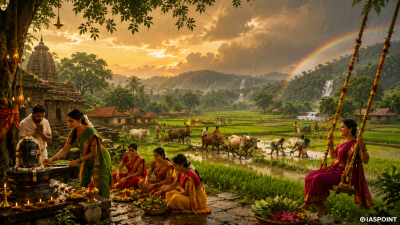
In the Indian Luni-Solar rhythm, the Monsoon or Varsha Ritu spans the Hindu months of Shravana and Bhadrapada (typically July to September). This period is crucial for India’s agrarian economy, as it follows the intense heat of Grishma (Summer). Culturally, it is a time of “Vratas” (penance), rejuvenation, and celebration of the life-giving forces of nature. The festivals during this season often emphasize fertility, the bond of protection, and the arrival of specific seasonal harvests.
Key Festivals of the Shravana Month
The month of Shravana is considered the most sacred month of the Monsoon season, dedicated largely to Lord Shiva and the celebration of fraternity.
- Teej (Haryali Teej): Celebrated primarily in Rajasthan, Haryana, and Uttar Pradesh. It commemorates the union of Goddess Parvati and Lord Shiva. Women wear green (representing greenery) and enjoy swings (Jhulas), symbolizing the joy of the first rains.
- Raksha Bandhan: Observed on the Shravana Purnima (Full Moon). While it celebrates the bond between brothers and sisters, it also has regional agricultural and maritime significance. In coastal regions (Maharashtra and Karnataka), it is celebrated as Narali Purnima, where offerings of coconuts are made to Varuna (the Sea God) to mark the end of the monsoon’s turbulence and the resumption of fishing.
- Nag Panchami: Observed on the fifth day of the bright fortnight of Shravana. It involves the worship of snakes, which emerge from their holes during the rains. It highlights the coexistence of humans with the local ecology and the significance of Nagas in Indian mythology.
- Krishna Janmashtami: Falling on the Ashtami (8th day) of the dark fortnight (Krishna Paksha), it marks the birth of Lord Krishna. In Maharashtra, the Dahi Handi festivities illustrate the communal spirit of the season.
Festivals of the Bhadrapada Month
This month marks the height of the monsoon and the transition toward the autumn harvest.
- Ganesh Chaturthi: Beginning on the Chaturthi (4th day) of the bright fortnight, this ten-day festival is most prominent in Maharashtra, Goa, and Karnataka. Historically, it was revived as a public festival by Lokmanya Bal Gangadhar Tilak in 1893 to foster national unity during the freedom struggle.
- Nuakhai (Odisha): An agrarian festival celebrated on the day after Ganesh Chaturthi. It is the “Thanksgiving” festival of Western Odisha, where the season’s first harvested rice (Nua means new, Khai means food) is offered to the presiding deity, Samaleswari.
- Onam (Kerala): Although it falls in the month of Chingam in the Malayalam calendar, it coincides with the post-monsoon bounty. It commemorates the homecoming of King Mahabali. Key cultural elements include the Vallam Kali (Snake Boat Race) and Pookalam (floral carpets).
Tribal and Regional Monsoon Celebrations
The monsoon is particularly significant for India’s tribal communities, who rely on the forest and rain for their livelihoods.
| Festival | Region / Tribe | Significance |
|---|---|---|
| Behdienkhlam | Jaintia Tribe (Meghalaya) | Celebrated in July to drive away the “Plague of Cholera” and pray for a good harvest. Features the “Khnong” (sacred poles) and mud-play. |
| Hareli | Chhattisgarh | Celebrated by the Gond and Baiga tribes. It involves the worship of agricultural tools and livestock, marking the greenery (Hariyali) of the fields. |
| Minjar Mela | Chamba (Himachal Pradesh) | A week-long fair where people wear silken tassels (Minjar) representing the maize shoots that emerge during the monsoon. |
| Karam Festival | Jharkhand, Bihar, Odisha | Celebrated by the Oraon, Munda, and Santhal tribes. It involves the planting of the Karam tree branch, symbolizing the God of Power, Youth, and Youthfulness. |
| Aadi Perukku | Tamil Nadu | Observed on the 18th day of the Tamil month Aadi. It pays tribute to the life-sustaining properties of water, particularly the River Kaveri, which overflows during this time. |
Scientific and Social Significance of Varsha Ritu Festivals
- Conservation of Ecology: Festivals like Nag Panchami and the worship of local rivers emphasize the preservation of biodiversity and water resources.
- Dietary Regulations: The period of Chaturmas (a four-month holy period starting in the monsoon) involves dietary restrictions, which traditionally aligned with the need to avoid water-borne diseases and allow the digestive system to rest during the humid season.
- Community Interaction: Since outdoor agricultural work is often interrupted by heavy rains, these festivals provide a social platform for community gathering, storytelling, and the performing arts.
Facts for UPSC Prelims
- Amarnath Yatra: This major pilgrimage in Jammu and Kashmir traditionally concludes on Shravana Purnima (Raksha Bandhan).
- Hemis Festival: Celebrated in Ladakh in June/July to commemorate the birth of Guru Padmasambhava; while Ladakh is a rain-shadow region, this aligns with the peak of the monsoon in the plains.
- Varalakshmi Vratam: A prominent monsoon fast observed by women in South India (Karnataka, Andhra Pradesh, Tamil Nadu) on the Friday before Shravana Purnima.
- The Concept of Sawan: In Hindustani Classical Music, the Malhar family of Ragas (e.g., Mian ki Malhar) is specifically associated with the monsoon and is frequently performed during these festivals.