
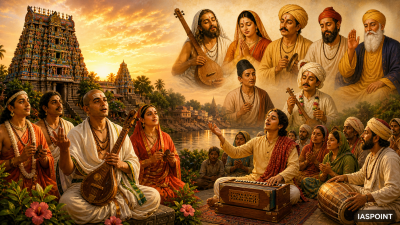
Bhakti literature represents a paradigm shift in Indian literary history, moving from the elite-dominated Sanskrit traditions to the grassroots “Bhasha” or vernacular literatures. This movement, which flourished between the 7th and 17th centuries AD, emphasized personal devotion (Bhakti) over ritualistic complexity. It originated in South India (Tamil Nadu) and gradually moved northward, acting as a catalyst for the development of modern Indian languages.
South Indian Bhakti Traditions: The Pioneers
The Bhakti movement began with the Alvar and Nayanar saints in the Tamil region. Their compositions are characterized by intense emotional longing for the divine and a rejection of caste hierarchies.
The Alvars (Vaishnavite Saints)
There were 12 Alvars who composed hymns in praise of Lord Vishnu.
- Divya Prabandham: A compilation of 4,000 hymns by the Alvars, often referred to as the “Dravida Veda.”
- Andal: The only female Alvar saint, famous for her work Tiruppavai and Nachiar Tirumoli, which express bridal mysticism.
- Nammalvar: Considered the greatest Alvar; his Tiruvaymoli is the core of the Divya Prabandham.
The Nayanars (Shaivite Saints)
There were 63 Nayanars who composed hymns dedicated to Lord Shiva.
- Tevaram: A collection of the first seven volumes of the Tirumurai, featuring the hymns of Sambandar, Appar, and Sundarar.
- Thiruvasagam: Authored by Manikkavasagar, this text is renowned for its profound spiritual depth.
- Tirumurai: The twelve-volume compendium of Shaivite hymns, often called the “Tamil Shaiva Canon.”
North Indian Bhakti Literature: The Two Streams
North Indian Bhakti literature is broadly divided into two philosophical schools: Nirguna (devotion to a formless God) and Saguna (devotion to God with attributes/incarnations).
Nirguna School (Monotheistic and Iconoclastic)
- Kabir Das: The most influential Nirguna saint. His compositions are found in the Bijak (containing Sabad, Sakhi, and Ramaini) and the Guru Granth Sahib. He used “Ulatbasi” (upside-down language) to challenge conventional logic.
- Guru Nanak Dev: His hymns, emphasizing the “Ik Onkar” (One God), form the foundation of the Adi Granth.
- Raidas (Ravidas): A saint-poet whose verses addressed social equality; many of his hymns are included in the Sikh scriptures.
Saguna School (Incarnation-based)
This stream focused primarily on the Rama-bhakti and Krishna-bhakti traditions.
- Tulsidas: Authored the Ramcharitmanas in Awadhi, making the story of Rama accessible to the masses. He also wrote Vinaya Patrika and Kavitavali.
- Surdas: A blind poet who wrote Sursagar, Sur Saravali, and Sahitya Lahari in Braj Bhasha, focusing on the Vatsalya Rasa (parental love) for Bal Krishna.
- Mirabai: A Rajput princess who composed “Bhajans” in Rajasthani and Braj Bhasha dedicated to Lord Krishna (Girdhar Gopal).
- Chaitanya Mahaprabhu: Though he wrote little (except the Siksastakam), his followers (the Six Goswamis) produced a vast body of Gaudiya Vaishnava literature in Sanskrit and Bengali.
Regional Contributions and Linguistic Development
Bhakti literature was the primary vehicle for the growth of regional identities and languages across the Indian subcontinent.
| Region | Major Saints | Key Literary Works | Language |
| Maharashtra | Jnaneshwar, Namdev, Tukaram, Eknath | Jnaneshwari (commentary on Gita), Amritanubhava, Abhangas | Marathi |
| Assam | Sankaradeva, Madhavadeva | Kirtan Ghosha, Bhakti Ratnavali, Ankiya Nat (Plays) | Brajavali/Assamese |
| Bengal | Chandidas, Vidyapati (Maithili) | Padavali (poems on Radha-Krishna) | Bengali / Maithili |
| Karnataka | Basavanna, Akka Mahadevi | Vachanas (prose-poems) | Kannada |
| Odisha | Panchasakha (Jagannatha Das, etc.) | Odia Bhagavata | Odia |
| Gujarat | Narsinh Mehta | Vaishnava Jana To (Bhajans) | Gujarati |
The Vachana Sahitya of the Lingayats
In the 12th century, the Veerashaiva movement in Karnataka led by Basavanna produced Vachanas. These were brief, rhythmic prose compositions that criticized social evils and emphasized “Kayaka” (work) as worship. Notable contributors include Allama Prabhu and Akka Mahadevi.
Women in Bhakti Literature
The movement was revolutionary for providing a platform for women poets to express spiritual autonomy.
- Lalleshwari (Lalla Ded): A Kashmiri saint who composed Vakhs (sayings), laying the foundation for Kashmiri literature.
- Akka Mahadevi: A Kannada poet who surrendered herself to “Chenna Mallikarjuna” (Shiva).
- Bahinabai: A Marathi saint-poet who wrote about the tensions between domestic life and spiritual seeking.
Key Facts for UPSC Prelims
- Pushtimarg: The “Path of Grace” founded by Vallabhacharya, which inspired the Ashtachap (eight poets), including Surdas.
- Dadu Dayal: Founded the Dadu Panth in Rajasthan; his teachings were compiled in the Dadu Anubhav Vani.
- Shankardeva’s Contribution: He introduced Sattriya (dance-drama) and Borgeets (musical hymns) in Assam.
- Vithoba Cult: The Varkari sect in Maharashtra focused on the deity Vithoba (Panduranga), with the Abhang being their primary literary form.
- Prasthantrayi Commentaries: Many Bhakti saints wrote “Bhashyas” (commentaries) on the Upanishads, Brahma Sutras, and Bhagavad Gita to provide a philosophical basis for their devotion.