
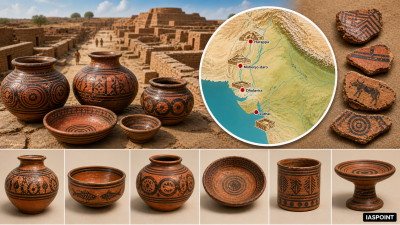
Harappan pottery represents the pinnacle of ancient ceramic technology in the Indus Valley Civilization (c. 2600 BCE – 1900 BCE). It is a primary source for reconstructing the socio-economic life, religious beliefs, and trade networks of the era. The pottery is characterized by its high degree of standardization, suggesting a mass-production system driven by the use of the fast-spinning potter’s wheel.
Primary Classification: Painted and Plain Ware
The Harappan ceramic repertoire is broadly divided into two categories based on aesthetics and utility.
- Plain Pottery: The most common form found across sites. It is generally made of red clay, with or without a fine slip. It was primarily used for daily household chores like cooking and storage.
- Painted Pottery (Red and Black Ware): This is the “Deluxe Ware” of the Indus Valley. The pots were first coated with a red slip (ochre), and designs were then painted using manganese-based black pigment.
Technical Characteristics of Harappan Ceramics
The Harappans achieved a level of technical excellence that remained unsurpassed in the Indian subcontinent for centuries.
- Manufacturing Technique: Almost all Mature Harappan pottery is wheel-made. The use of the fast wheel allowed for uniform thickness and symmetrical shapes.
- Clay Composition: The potters used fine alluvial silt collected from riverbanks. To prevent cracking during firing, “tempering agents” like sand, lime, or mica were added.
- Firing Process: Pottery was fired in specialized circular kilns with underground firing chambers. The high-temperature, oxidizing atmosphere turned the iron-rich clay into a sturdy, burnt-red color.
- Surface Treatment: Many vessels were treated with a smooth “slip” to make them less porous. Some were “burnished” to achieve a metallic luster.
Specialized Pottery Shapes and Functions
The diversity of shapes indicates a highly specialized society with distinct culinary and ritualistic needs.
| Pottery Shape | Description and Probable Use |
| Dish-on-Stand | A unique Harappan form consisting of a shallow dish supported by a central pillar. Likely used for ritual offerings or as a high-status fruit stand. |
| Perforated Jars | Large jars with small holes all over the body. Hypothesized to be used for straining fermented beverages (liquor) or as incense burners. |
| Storage Jars | Massive, thick-walled jars, sometimes over 3 feet tall, used for storing surplus grain or water. Often buried in the floors of houses. |
| Goblets (S-Shaped) | Notable for their pointed bases (button bases). These were mass-produced and found in large quantities, suggesting they were disposable “use-and-throw” cups. |
| Beakers and Bowls | Straight-sided beakers and shallow bowls used for daily dining and serving liquids. |
Decorative Motifs and Iconography
The paintings on Harappan pottery offer a window into their environment and mythology.
Geometric and Abstract Patterns
- Intersecting Circles: A signature Harappan motif found from Mohenjo-daro to Lothal.
- Checkered Patterns: Often used to fill the space between larger motifs.
- Horizontal Bands: Thick black bands usually define the neck and base of the vessels.
Naturalistic and Faunal Motifs
- Flora: Detailed representations of Pipal leaves (Ficus religiosa), palm trees, and banana leaves.
- Fauna: Drawings of fish, peacocks, deer, goats, and the humped bull.
- Narrative Scenes: Rare but significant scenes depicting folk tales. For example, a jar from Lothal depicts a “Crafty Crow” (based on the Panchatantra-style story) and a “Thirsty Fox.”
Regional Variations and Evolution
While Harappan pottery is known for its uniformity, regional “sub-styles” existed.
- Lothal (Gujarat): Known for its “Micaceous Red Ware” and distinct miniature pottery.
- Surkotada: Yielded unique pottery types showing links with the peripheral regions of the civilization.
- Kalibangan: Transitioned from the Pre-Harappan “Six Fabrics” to the standardized Mature Harappan Red and Black Ware.
- Cemetery H Pottery (Late Harappan): Found at Harappa, this represents the “decline” phase. It features more ornate and surreal paintings, such as human figures trapped inside stars or birds, reflecting a change in burial customs and beliefs.
Facts and Trivia for UPSC Prelims
- The First Standardized Craft: Harappan pottery is the earliest example of mass production in India, where the ratio of dimensions and the quality of fabric remained consistent over 1,000 miles.
- Graffiti Marks: Post-firing marks or symbols are often found on the shoulders of jars, which many scholars believe are signs of ownership or potter marks, potentially related to the Indus Script.
- Glazed Pottery: The Harappans were among the first in the world to produce glazed pottery (faience), though it was restricted to small beads and amulets rather than large vessels.
- Terracotta Figurines: While technically different from vessels, the same kilns produced the famous Mother Goddess figurines and toy carts, highlighting the versatility of Harappan ceramicists.
- Disposal Culture: The pointed-base “Indus Goblets” are often found in “discard heaps,” indicating that the concept of disposable earthenware (similar to modern kulhads) existed 4,500 years ago.