

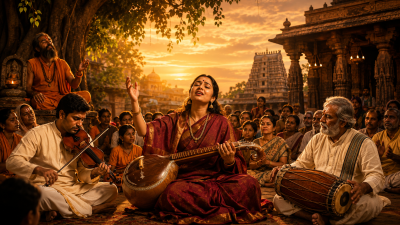
The Bhakti movement, spanning from the 7th to the 17th century, acted as a catalyst for the democratization of Indian music. By shifting the focus from rigid Vedic rituals to personal devotion (Anurakti), Bhakti saints utilized music as the primary vehicle for spiritual expression. This period saw the transition of music from the confines of temples and royal courts to the masses, utilizing vernacular languages and simpler melodic structures.
Evolution of Devotional Music: Alvars and Nayanars
The roots of the Bhakti musical tradition lie in South India, where saint-poets used music to challenge the social hierarchy and spread the message of egalitarianism.
- The Alvars (Vaishnavite Saints): They composed the Divya Prabandham, a compilation of 4,000 hymns. Their music focused on the “Nalayira” tradition, praising the incarnations of Vishnu.
- The Nayanars (Shaivite Saints): They composed the Tevaram and Thiruvasagam. These hymns are still sung in the Oduvar tradition in Tamil Nadu temples, representing some of the oldest surviving musical notations in India.
- Pann System: Long before the formalization of the Carnatic Raga system, the Nayanars used the Pann system—a sophisticated melodic framework that later merged into the modern Raga structures.
The Haridasa Movement and Carnatic Foundations
In Karnataka, the Haridasa movement played a pivotal role in shaping the pedagogical structure of South Indian classical music.
- Purandara Dasa (The Pitamaha): He distilled complex musical theories into simple devotional songs called Devaranamas. He introduced the Malavagowla scale for beginners, which remains the standard for Carnatic training today.
- Kanakadasa: A contemporary of Purandara Dasa, his compositions emphasized social equality and are celebrated for their rhythmic and lyrical simplicity.
- Tallapaka Annamacharya: Often called the Pada-kavita Pitamaha, he composed thousands of Sankirtanas in praise of Lord Venkateswara, establishing the Pallavi-Anupallavi-Charanam structure of the modern Kriti.
Bhakti Traditions in North India: The Emergence of Bhajan and Kirtan
The Bhakti movement in North India introduced diverse musical forms that bridged the gap between folk and classical traditions.
- The Nirguna Tradition: Saints like Kabir and Guru Nanak used Shabads and Padas to emphasize formless divinity. Their music focused on the “Bani” style, characterized by profound philosophical lyrics set to simple tunes.
- The Saguna Tradition:
- Surdas: A blind saint who composed the Sursagar, focusing on the Vatsalya Rasa (parental love) toward Krishna. His compositions are often set to Ragas like Bilawal and Sarang.
- Mirabai: Her Bhajans (devotional songs) are characterized by intense emotional longing (Madhurya Bhakti) and are widely sung in Rajasthani folk and classical styles.
- Tulsidas: His Ramcharitmanas popularized the Chaupai and Doha meters, which influenced the rhythmic structures of North Indian devotional singing.
Regional Devotional Genres and Their Characteristics
The Bhakti movement gave rise to specific musical genres that remain integral to India’s cultural fabric.
| Genre | Region | Key Figures | Key Features |
| Abhang | Maharashtra | Tukaram, Namdev, Jnaneshwar | Energetic devotional poetry dedicated to Lord Vitthala; characterized by community singing and the use of the Taal (cymbals). |
| Kirtan | Bengal/Odisha | Chaitanya Mahaprabhu | Emphasizes ecstatic singing and dancing; introduced the Nagar-Kirtan (processional singing) and the use of the Khol (drum). |
| Baul | Bengal | Lalon Shah | A mystic folk tradition that blends Bhakti and Sufi elements; uses the Ektara and focuses on the “Man of the Heart.” |
| Sankirtan | Manipur | Indigenous Saints | A ritualistic form of singing and drumming involving the Pung (drum); recognized by UNESCO as Intangible Cultural Heritage. |
| Borgeet | Assam | Srimanta Sankardev | Lyrical songs used in the Sattras (monasteries); they follow a specific Raga system distinct from Hindustani and Carnatic music. |
Musical Instruments of the Bhakti Era
Bhakti music relied heavily on portable and rhythmic instruments that facilitated community participation.
- Ektara/Dotara: Simple stringed instruments used by wandering bards and Bauls.
- Kartal and Manjira: Small cymbals used to maintain the rhythm during congregational singing.
- Pakhawaj and Mridangam: Horizontal drums used to provide rhythmic depth to sophisticated compositions.
- Harmonium: Though a later introduction, it became the backbone of modern Bhajan and Kirtan in North India.
Impact on Classical Music and Heritage
The Bhakti movement ensured the survival and evolution of Indian music during periods of political instability.
- Lyrical Content: Shifted from praising kings and patrons to praising the divine, leading to the “Padavali” style of literature.
- Raga Usage: Many Ragas used in classical music today were refined through devotional compositions (e.g., Raga Bhairavi for peace and Raga Desh for patriotism/devotion).
- Inclusivity: Music became a tool for social reform, allowing individuals from all castes and backgrounds to achieve “Moksha” through sound (Nada Yoga).
Factoids for UPSC Prelims
- Ashtachap: A group of eight Krishna-devotee poets (including Surdas) established by Vitthalnath, who institutionalized the musical worship of Shrinathji.
- Vithoba of Pandharpur: The central deity of the Varkari sect, whose praise is sung through Abhangs.
- Shabad Gurbani: The musical recitation of the Guru Granth Sahib, which follows a strict Raga-based system consisting of 31 Ragas.
- UNESCO Recognition: The Sankirtana of Manipur and the Vedic Chanting traditions are both inscribed on the UNESCO list, highlighting the global significance of India’s devotional musical heritage.