
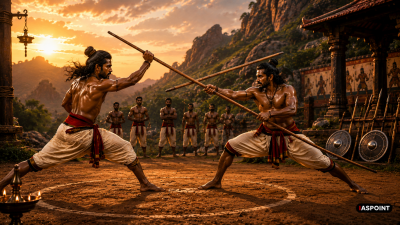
Silambam is an ancient weapon-based martial art from Tamil Nadu, considered one of the oldest in the world. The term “Silambam” refers to the sound produced during the swinging of the staff. It is derived from the Tamil words Silam (hill) and Kambu (staff), historically practiced in the Kurinji (hilly) regions of ancient South India.
- Literary References: The Silappadikaram (one of the Five Great Epics of Tamil Literature) and other Sangam literature works dating back to the 2nd century BCE mention the sale of Silambam staves, swords, and armor to foreign merchants.
- Mythological Roots: Tradition attributes the origin of Silambam to Sage Agastya, who is also credited with the development of the Siddha system of medicine.
- Royal Patronage: The art was extensively patronized by the Pandyas, Cholas, and Cheras. Later, the Maruthu Pandiyar brothers and Veerapandiya Kattabomman utilized Silambam techniques in their resistance against the British East India Company.
Technical Components and Training Methodology
Silambam training is a systematic progression that begins with footwork and moves toward the mastery of various traditional weapons.
The Primary Weapon: The Staff
The standard Silambam staff is made of Kurinji bamboo (Ochklandra travancorica). The length of the staff is typically measured relative to the practitioner—it should reach the forehead, approximately three finger-widths above the head, usually averaging around 1.68 meters (5.5 feet).
Footwork and Movement (Kaaladi)
Footwork is the foundation of Silambam. Before handling a weapon, a student must master sixteen different forms of movements.
- Key Patterns: Circular movements, zigzag patterns, and rapid retreats to evade strikes while maintaining the ability to counter-attack.
- Defensive Stance: Known as Nilayakal, it focuses on balance and the ability to pivot 360 degrees instantly.
Classification of Weapons in Silambam
While the staff is central, Silambam encompasses a wide array of weapons, making it a comprehensive combat system.
| Weapon Name | Description |
| Maru | A thrusting weapon made from the horns of a blackbuck (Antelope cervicapra). |
| Aruval | A curved sickle/machete used for slashing. |
| Vaul | A traditional curved sword. |
| Saviuku | A whip made of leather or metal. |
| Vel | A spear, often associated with the deity Lord Murugan. |
| Katti | A specialized dagger for close-quarter combat. |
| Valari | An iron or wooden boomerang used for long-range targets. |
| Surul Vaal | A flexible, multi-bladed “ribbon” sword (similar to the Urumi). |
The Science of Pressure Points: Varma Athi
Like Kalaripayattu, Silambam is deeply integrated with the knowledge of human anatomy and the Siddha system of medicine.
- Varma Point Attacks: Advanced practitioners are taught to strike specific nerves and pressure points (Marmas) to disable an opponent without causing permanent injury or, in extreme cases, to deliver lethal strikes.
- Healing: The Asans (Masters) are also trained in bone-setting and herbal treatments to cure injuries sustained during practice or combat.
Regional Styles and Modern Evolution
Silambam has diversified into several sub-styles, each emphasizing different tactical approaches:
- Nillaikalakki: Focuses on stationary stances and deceptive movements.
- Kuravanchi: Known for its agile, mountain-style footwork.
- Kallapathu: A style practiced primarily in the southern districts of Tamil Nadu.
Colonial Suppression and Revival
The British government banned Silambam in the early 19th century following the Polygar Wars (1799–1805), fearing its effectiveness in guerrilla warfare. The art survived in rural Tamil Nadu as a performance art during temple festivals (Thiruvizha). Post-independence, it was revived as a competitive sport.
Fact File for UPSC Prelims
- UNESCO Recognition: Silambam has been identified as a significant intangible cultural heritage of India, with efforts ongoing for formal UNESCO listing.
- Khelo India: Along with Kalaripayattu, Mallakhamb, Gatka, and Thang-Ta, Silambam was included in the Khelo India Youth Games to preserve traditional sports.
- Global Spread: Historical trade routes carried Silambam to Southeast Asia, where it influenced local martial arts like Silat in Malaysia and Indonesia.
- World Silambam Association: Founded to standardize rules for international competitions, shifting the art from purely combat to a recognized athletic discipline.
- Tamil Nadu State Sport: Silambam is recognized as an official sport by the Government of Tamil Nadu, providing practitioners with quotas in education and employment.