
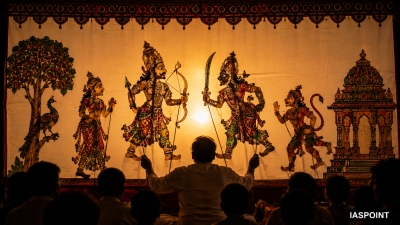
Shadow puppetry is an ancient theatrical form that utilizes the principles of light, shadow, and translucency. In this style, flat figures are cut out of leather, treated to become translucent, and pressed against a white cloth screen. A light source placed behind the puppets creates glowing, colored, or silhouette-like shadows for the audience seated on the other side. This form is predominantly found along the eastern and southern coasts of India, particularly in Andhra Pradesh, Karnataka, Maharashtra, Odisha, Kerala, and Tamil Nadu.
Technical and Aesthetic Foundations
The production of shadow puppets involves a specialized process that bridges the gap between craft and performing arts.
- Material and Preparation: Puppets are traditionally crafted from goat, buffalo, or deer skin. The leather is chemically treated with indigenous oils and herbs to achieve a parchment-like transparency.
- Perforation and Coloration: Intricate designs are punched into the leather to represent jewelry and clothing patterns. These perforations allow light to pass through, creating a “lace effect.” Vegetable dyes are applied to produce vibrant colored shadows.
- The Screen (Tirasseelai): The screen symbolizes the boundary between the material and spiritual worlds. The lamp, often fueled by coconut oil, represents the soul or divine knowledge.
- Manipulation: Puppets are controlled using bamboo or wooden rods attached to the limbs and torso.
Regional Variations of Shadow Puppetry
| Form | State | Material | Unique Feature |
| Tholu Bommalata | Andhra Pradesh | Goat/Buffalo Skin | Life-sized puppets; jointed at waist, shoulders, and knees. |
| Togalu Gombeyatta | Karnataka | Goat Skin | Size of puppets varies according to the character’s social status. |
| Ravanachhaya | Odisha | Deer Skin | Non-jointed; cast bold, opaque shadows; no color used. |
| Tholpavakoothu | Kerala | Goat Skin | Performed in special temple theaters called Koothambalams. |
| Tholu Bommalattam | Tamil Nadu | Leather | Similar to Andhra style but smaller in scale and highly stylized. |
| Chamadyacha Bahulya | Maharashtra | Leather | Features unique neck joints; heavily influenced by Paithani art. |
Detailed Analysis of Major Styles
Tholu Bommalata (Andhra Pradesh)
The term literally translates to “the dance of leather puppets.” It is perhaps the most visually spectacular form of shadow puppetry in India.
- Scale and Anatomy: These puppets are often 5 to 6 feet tall. They are highly flexible with multiple joints, allowing for complex dance movements.
- Iconography: The puppets follow the traditional attire and jewelry styles of the Lepakshi temple murals.
- Narrative: The repertoire is strictly limited to the Ramayana and Mahabharata, often lasting multiple nights.
Togalu Gombeyatta (Karnataka)
“Togalu” means leather and “Gombe” means doll. This form is distinct for its use of character hierarchy through size.
- Size Hierarchy: Kings and Gods are the largest, followed by commoners, while demons are depicted with grotesque, larger-than-life proportions.
- Musical Ensemble: The performance is accompanied by a Mridangam, Cymbals, and a Mukhaveni (a small wind instrument).
Ravanachhaya (Odisha)
This is considered the most primitive and subtle form of shadow puppetry, named after the shadow of Ravana.
- Opaque Shadows: Unlike the southern forms, these puppets are not translucent. They cast solid black shadows on the screen, creating a stark, dramatic effect.
- Non-Jointed Figures: The puppets are single-piece cutouts. Movement is achieved through the tilting and swaying of the entire figure.
- Scenery: It is one of the few forms that use “prop” puppets like trees, mountains, and animals to create a complete visual landscape.
Tholpavakoothu (Kerala)
This form is an integral part of the temple rituals in the Bhadrakali temples of the Palakkad district.
- Ritualistic Context: It is believed that the goddess Bhadrakali watches the performance. It is based on the Kamba Ramayana.
- The Stage: Performed in a long, permanent stage structure called Koothambalam, which can be up to 42 feet long.
- Lighting: Exactly 21 lamps, made of coconut shells and filled with oil, are placed behind the screen to illuminate the puppets.
Socio-Cultural and Religious Significance
Shadow puppetry in India functions as more than entertainment; it is a ritualistic medium.
- Democratization of Epics: It served as the primary mode of transmitting the Vedas and Puranas to the rural population who did not have access to formal Sanskrit education.
- The Vidushaka (Jester): Every shadow play features a comic character (e.g., Bangarakka or Anketigadu) who provides social commentary, often critiquing local administration or social taboos.
- Agricultural Rites: In many regions, shadow puppet plays are commissioned after a successful harvest as an act of thanksgiving to the deities.
Fact Sheet for UPSC Prelims
- Nodal Agency: The Sangeet Natak Akademi (under the Ministry of Culture) through its Indian Puppetry Unit provides fellowships and grants to veteran puppeteers.
- UNESCO Relevance: While Kutiyattam and Vedic Chanting are on the Intangible Heritage list, Indian Shadow Puppetry is a strong candidate for future nominations due to its ancient lineage.
- Sutradhara vs. Pulavar: While North Indian forms use the term Sutradhara, the lead puppeteer in Kerala’s Tholpavakoothu is known as a Pulavar (scholar).
- Earliest Reference: The Therigatha (Buddhist text) and the Mahabharata contain early metaphorical references to shadow-like figures and leather dolls.
- Vegetable Dyes: Traditionally, black is derived from soot, red from madder root, and yellow from turmeric or arsenic trisulfide (harital).