
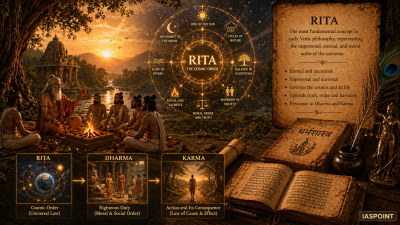
Rita is the most fundamental concept in early Vedic philosophy, representing the impersonal, eternal, and moral order of the universe. It is the precursor to the later concepts of Dharma and Karma.
Nature and Functions of Rita
- Cosmic Order: It governs the regularity of the cosmos, such as the rotation of the seasons (Ritus), the movement of celestial bodies, and the transition of day into night.
- Moral Imperative: It is not merely a physical law but a moral one. Truth (Satya) is considered the operational aspect of Rita.
- Guardians of Rita: The deity Varuna is designated as the Ritasya Gopa (Protector of Rita). Mitra is often associated with Varuna in upholding this cosmic balance.
- The Concept of Anrita: Anything that opposes this universal order or involves falsehood is termed Anrita (the opposite of Rita).
Evolution of Dharma in Indian Philosophy
While Rita was the primary focus in the Rig Vedic period, the term Dharma gained prominence in the later Vedic and Epic periods, evolving from a cosmic law to a comprehensive code of social and individual conduct.
Multidimensional Meanings of Dharma
- Etymological Root: Derived from the Sanskrit root Dhri, meaning “to uphold,” “to support,” or “to sustain.”
- Constitutional Role: It refers to the essential nature of a thing (e.g., the Dharma of fire is to burn).
- Social Order: It defines the duties and obligations of individuals based on their position in society and stage of life (Varnashrama Dharma).
Classification of Dharma
| Category | Definition and Scope |
| Sadharana Dharma | Universal ethical duties applicable to everyone regardless of caste or creed (e.g., Satya, Ahimsa, Asteya). |
| Varnashrama Dharma | Duties specific to one’s Varna (social class) and Ashrama (stage of life). |
| Svadharma | Individual duty based on one’s own nature (Prakriti) and aptitude. |
| Apad-Dharma | Special conduct allowed during times of extreme distress or calamity. |
| Rajadharma | The specific duties and ethical codes governing a King or the State. |
Comparison: Rita vs. Dharma vs. Satya
Though interconnected, these concepts represent different facets of Indian metaphysical thought.
- Rita vs. Dharma: Rita is the primordial, static cosmic order; Dharma is the dynamic application of that order in human society to sustain the world.
- Satya vs. Rita: Satya is the truth as expressed in speech and thought, while Rita is the truth as expressed in the working of the universe.
- Relationship: In the Upanishads, it is famously stated that “There is nothing higher than Dharma.” It is equated with Truth (Satya) because both are grounded in reality.
Related Philosophical Concepts
The Doctrine of Karma
The law of Karma is the logical extension of Rita and Dharma into the realm of human action. It suggests that every action has a corresponding reaction, maintaining the moral equilibrium of the universe.
- Sanchita Karma: The accumulated store of all past actions.
- Prarabdha Karma: That portion of past karma which is currently bearing fruit in the present life.
- Agami Karma: Actions being performed in the present which will bear fruit in the future.
The Purusharthas (Four Goals of Life)
Dharma serves as the foundational framework for the other three human pursuits.
- Artha (Wealth): Material prosperity pursued through Dharmic means.
- Kama (Desire): Sensory and emotional fulfillment within the bounds of Dharma.
- Moksha (Liberation): The ultimate release from the cycle of birth, governed by the realization of the highest Dharma.
The Concept of Rina (The Three Debts)
Vedic philosophy posits that every individual is born with inherent obligations that must be fulfilled to maintain social and cosmic harmony:
- Deva-Rina: Debt to the Divine, repaid through rituals and gratitude.
- Rishi-Rina: Debt to the Sages, repaid through study and the dissemination of knowledge.
- Pitri-Rina: Debt to the Ancestors, repaid through family lineage and social responsibility.
Significance in Art and Heritage
- Iconography: Varuna is often depicted with a noose (Pasha) to punish those who violate the laws of Rita.
- Architecture: The concept of Vastu Purusha Mandala in temple architecture is a physical manifestation of Dharma and Rita, ensuring the building is in harmony with cosmic laws.
- National Symbolism: The Dharma Chakra on the Indian National Flag represents the “Wheel of Law,” a concept shared by Vedic, Buddhist, and Jain traditions to symbolize the eternal motion of righteousness.
Factful Trivia for Prelims
- Dharmo Rakshati Rakshitah: A famous verse from the Manusmriti meaning “Dharma protects those who protect it.”
- Ekam Sat: The Rig Vedic declaration that Truth is one, which provides the metaphysical basis for the universal nature of Rita.
- Ashoka’s Dhamma: While inspired by Buddhism, Ashoka’s Dhamma was a secularized version of Sadharana Dharma aimed at social cohesion in a diverse empire.
- Ritasya Gopa: This specific title for Varuna in the Rig Veda is a frequent point of inquiry in cultural history examinations.