
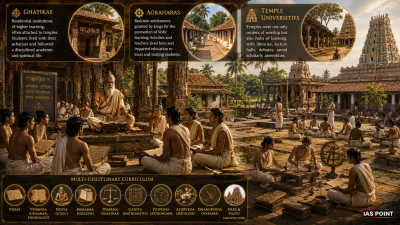
Education in ancient and early medieval South India was primarily institutionalized through Ghatikas, Agraharas, and Temple Universities. Unlike the North Indian Mahaviharas (like Nalanda) which were often Buddhist, the South Indian system was predominantly Brahmanical, focusing on Vedic studies, although it maintained a multi-disciplinary approach including grammar, logic, and professional sciences.
The Ghatikas: Centers of Advanced Learning
Ghatikas were prestigious institutions of higher learning, often attached to temples or established in capital cities. They were essentially “colleges” where scholars and students engaged in the deep study of the Vedas and Shastras.
- The Ghatika of Kanchi: This was the most famous institution in South India. Under the Pallava Dynasty, Kanchi became a global center for learning. It attracted scholars like Mayurasharman (founder of the Kadamba Dynasty) and the Buddhist logic scholar Dignaga.
- Structure and Function: These were assembly-based institutions where debates and discussions were the primary modes of instruction. Membership was highly selective and often restricted to the elite scholarly class.
- Inscriptional Evidence: The Kasakudi plates and the Velurpalayam plates provide detailed accounts of the patronage provided by Pallava kings like Mahendravarman I and Narasimhavarman II to these Ghatikas.
Agraharas and Brahmadeyas
Agraharas were entire villages or settlements granted to Brahmins by kings or wealthy merchants. These settlements functioned as decentralized educational hubs where the resident scholars taught students in a residential setup.
- Economic Basis: These were tax-free land grants (Brahmadeyas) intended to allow scholars to focus entirely on teaching and the preservation of knowledge.
- The Ennayiram Agrahara: Located in Tamil Nadu, an inscription of Rajendra Chola I (1023 CE) provides a meticulous breakdown of the curriculum and the number of students. It supported 340 students and provided them with free boarding and clothing.
- Curriculum: It included the four Vedas, the Vedanta, Mimamsa, Vyakarana (Grammar), and various Puranas.
Temple Universities and Mathas
Temples in South India served as more than just religious centers; they were the socioeconomic and intellectual hearts of the community. Large temples often functioned as “Temple Universities.”
- Salotgi Temple University: Located in Karnataka, this institution was supported by the Rashtrakuta kings. Inscriptions mention that it had 27 hostels for students who came from various parts of the country.
- Managoli Agrahara: Established during the Kalachuri and Chalukya periods, it was renowned for its diverse curriculum, including astronomy and linguistics.
- Role of the Mathas: Mathas were monastic institutions (often Shaiva or Vaishnava) that provided primary and higher education. They also maintained libraries called Saraswati Bhandaras.
Key Institutions and Royal Patrons
| Institution/Location | Primary Patron | Specialization/Distinction |
| Kanchi Ghatika | Pallavas | Vedic studies and Buddhist logic; highest seat of learning in the South. |
| Ennayiram | Cholas (Rajendra I) | Extensive Vedic curriculum; maintained records of student stipends. |
| Tirumukkudal | Cholas (Virarajendra) | Notable for its Aturasala (hospital and medical school) attached to the temple. |
| Salotgi | Rashtrakutas | Known for providing 27 free hostels for students. |
| Belur & Halebid | Hoysalas | Specialized in temple architecture, sculpture, and fine arts. |
| Shringeri Matha | Adi Shankara | Specialized in Advaita Vedanta and Sanskrit literature. |
Subjects and Methodology
The curriculum in these Southern institutions was categorized into religious and secular streams to ensure a holistic education.
- Fourteen Vidyas: The standard curriculum consisted of the 4 Vedas, 6 Vedangas, Puranas, Nyaya (Logic), Mimamsa (Exegesis), and Dharma Shastras.
- Vrittis (Professional Courses): Many Agraharas offered specialized training in medicine (Ayurveda), military science (Dhanurveda), and accountancy.
- Language of Instruction: Sanskrit was the medium for higher education and Shastric debates, while local languages (Tamil, Kannada, Telugu) were used for primary education and administrative training.
- Assessment: Knowledge was validated through public debates (Vada) and examinations conducted by the Mahajanas (village elders or scholarly assemblies).
Social and Administrative Impact
- Democratization through Temples: While Ghatikas were often exclusive, temple-based schools (Pathashalas) provided basic literacy and vocational skills to a broader segment of the population.
- Village Administration: Education was closely linked to local governance. For instance, the Uttaramerur Inscription of the Chola period specifies educational qualifications for candidates contesting village assembly elections.
- The Aturasala: Some temple universities (like Tirumukkudal) were integrated with hospitals, where students of Ayurveda received practical clinical training while serving the community.
Trivia and Facts for Prelims
- Saraswati Bhandara: The term used for libraries attached to temples and mathas in South India.
- Ghatikasahasa: A title given to a scholar who had mastered the curriculum of a Ghatika.
- Kadikas: Another term used for Ghatikas in certain parts of the Deccan.
- Dwarapandita: Though a Northern term, the concept of “Gate Scholars” was reflected in the entrance debates required to enter prestigious Southern Ghatikas.
- The Golaki Matha: A famous Shaiva institution that spread across the Andhra and Tamil regions, known for managing large tracts of land and running educational dispensaries.